Tag: 20th Century

  • Dead River: An Environmental History of the Tyne Improvement Commission 1850-1968CE

    For men may come and men may go,

    But I go on forever.

    – Alfred Tennyson, ‘The Brook’.

    Introduction

    The Significance of River History

    When searching for a location to build a home, the humans who founded the first settlements on the Tyne had several priorities in mind. First and foremost, they needed access to a sustainable source of food and water, but they were also looking for a site that was defendable, sanitary, and well connected, to facilitate fast travel and trade with the outside world; the river was the only logical place that satisfied these objectives. Soon many human settlements had clustered around the Tyne’s banks and over time the people of Tyneside built their houses, economies, and cultures around the river upon which they relied for survival and expansion. As time progressed this bond grew tighter as they discovered that the waters could be utilised for other purposes; generating power, producing chemicals, concrete, oil, and many other industrial materials, as well as in being a source of recreation. In this way they followed the global human trend of using the river as a basis for civilisation. Likewise, the Tyne itself, alongside all the other life it supported, found its fate acutely entwined with human developments.

    As historical agents, rivers and the life they support have never acted as passive resources to merely be consumed; time and again they have proved to human populations that they can knock civilisations down as easily as they built them up. In c.5000BCE, the fortunes of the peoples of Mesopotamia were dashed against the banks of the Tigris-Euphrates after repeated flooding, partially blamed on their own attempts to direct the path of the river. In c.2000BCE a 200 year drought hit the Indus river and spelled equal disaster for the peoples of the Indus Valley civilisation. In c.350BCE, it is theorised that the Guadalquivir river delta rose up to completely submerge the wealthy city of Tartessos based upon it, thus creating the origin of the Atlantean myth. In contemporary times rivers have become more entwined with human societies than ever, relied on as sources of food, water, culture, trade, and recreation, however they are also facing some of their greatest threats from the same source. The quantity of pollutants being discharged into waterways such as the Nile, the Ganges, and the Yangtze, as well as the effects of landscaping and unsustainable water use, is resulting in ecosystem collapse. This has resulted in ever-increasing quantities of resources being spent in efforts to save these unique environments both for their own sake and for humanity at large. The story of the relationship between human and river is an ancient one, and in the modern day is as important as it has ever been.

    Across history the story of the River Tyne is one that parallels that of the modern Nile or Ganges, and it maybe holds some lessons for them. The pertinent period to assess in regards to this began in 1850 when a body named, in retrospect perhaps ironically, as the “Tyne Improvement Commission” was appointed by parliament to increase the volume and profitability of trade on the river. This organisation’s conservatorship of the river would last until 1968, and whilst not solely accountable, it was predominantly responsible for the transformation of the river during this time from a natural estuary into, in their own words, ‘a great highway of industry’. Environmentally speaking, their century of “improvements” meant that in 1957, when the Tyne’s waters literally bubbled with noxious chemicals, the river was officially classified as ‘biologically dead’.

    Methodology and Historiography

    The focus of this article is therefore upon the Tyne Improvement Commission (TIC) and the unprecedented changes that they oversaw during their 118 years of authority. The primary route of analysis is through the extensive records that the organisation kept of their proceedings, documenting step-by-step how they went about their program of transformation. From an environmental perspective, these sources are used to assess the impact of the TIC’s works upon the river and its ecology and how those impacts then affected humanity in turn. Their discussions are also analysed to come to an understanding of the philosophy behind their actions. Ultimately it is a study of the relationships, both physical and intellectual, between humanity and the rest of the natural world as they developed during the TIC’s tenure and the ways in which they intersected with one another. A river is a complex, interconnected ecosystem where disturbances on the waters can ripple outward beyond foresight, therefore it only makes sense to assess it as such.

    What this article also provides is a counternarrative to the traditional histories of the region. Much of Tyneside’s modern identity has been built on its industrial heritage, for which it is proud, and a significant majority of its written history has forwarded a narrative where the river’s “golden years” are the same as those which resulted in the pollution and destruction of much of its natural resources. The modern Port of Tyne describes the appointment of the TIC as the beginning of ‘the heyday of the river’, but from the perspective of the river itself this is far from the case. It would be untrue to say that environmental concerns have been omitted in entirety across the historiography, although this is sometimes the case, but it would be fair to state they have been largely disregarded. The history of the Tyne’s shipyards, mines, and factories is far from something to be ashamed of, but it is, this article argues, something to be reconsidered and taken in duality in the light of an understanding that the benefits of industry came at a significant cost.

    The predominant concentration of previous histories of the river has been on the human activities that took place upon it; the history of export statistics, employment rates, and commerce. In 1880 James Guthrie’s The River Tyne: It’s History and Resources gave little attention to ecological concerns, focussing on the feats of engineering that had been so successful in remodelling the river’s form in his recent years. Throughout the 20th century this trend continued with texts that also focussed predominantly on human achievement and engineering such as Life on the Tyne, The Origins of Newcastle upon Tyne, and Maritime Heritage: Newcastle and the River Tyne. The same is true for the texts of the 21st century, such as The Story of the Tyne and River Tyne. All of these are fine publications which competently examine many aspects of Tyneside’s history, and indeed all were useful in the writing of this article, but it must also be said that they neglect environmental angles. Not all histories can or should be environmental histories, but the extent to which the natural history of the river has been buried beneath fascination at industrial achievement, even to this day, is surprising.

    One text, however, has acted as an exception to this rule, and has taken an ecological approach to the river’s history, this being Leona Skelton’s Tyne after Tyne: An Environmental History of a River’s Battle for Protection 1529-2015. Tyne after Tyne looks at the history of human environmental action and conservation on the river and therein Skelton analyses how approaches and attitudes to the Tyne have varied over time regarding conservation of its natural resources. This study has opened the field of environmental history on the Tyne and has revealed a forgotten and often ignored, yet fundamentally integral, facet of its past. Where Tyne after Tyne covers a broad time period however, this article more tightly directs its attention toward one specific stage of the Tyne’s environmental history, exploring it in greater detail and looking at the physical effects of that environmental action upon the biosphere.

    The importance of the relationship between human and river is one that has always been appreciated on the Tyne, but the importance of an environmentally sustainable relationship is one that is now having to be re-remembered. Indeed, for a majority of its history before the formation of the TIC, the citizens of Tyneside managed to live in comparative harmony with their river, and not because they lacked the technology to do it harm, as the Mesopotamians prove. It is crucial therefore that we understand the pre-industrial history of the river as both comparison and context within which to assess the momentous changes it would face post-1850 which so fundamentally shifted the ecological landscape.

    Chapter 1

    More lasting value than californian gold

    The Deep history of the tyne

    The history of the River Tyne began at the same time the British Isles rose from the sea 30 million years ago. Just north of Kielder at the Scottish border the north Tyne emerged and meandered eastwards before travelling south towards Hexham. The south Tyne began in Cumbria, flowing over the limestone rocks of Cross Fell and feeding into the north river at Warden Rock. At this meeting point they then processed eastwards, sculpting a valley out of the chalk which had formed 40 to 80 million years before. The formations made during these early chapters in the Tyne’s history have proved influential on its development thereafter, the movement of glaciers and other fluvial processes being the key instruments which created the landscapes and habitats that have dictated the character of the valley ever since. The result of these processes was that the Tyne region became naturally isolated from other parts of the country, establishing an environment that was ecologically unique for the plants and animals that occupied its banks. After humans arrived, this isolation drew people closer to the river as it created a greater need for water-borne trade.

    These ancient geological processes created the environments on which all life in the region has since been based, the Tyne’s mudflats, riverbanks, and tributaries encouraging the specific types of flora to grow and fauna to breed that have since become local to the region. Pink salmon, river otters, and water voles alongside rarer creatures like the kittiwake, white-clawed crayfish, and the freshwater pearl mussel all chose the Tyne for these characteristics, as did the human. Outside of wildlife, the prevalence of lead and coal on the banks of the Tyne has been extremely influential on its history ever since mining started in the 2nd century, and the abundance of gravel on its riverbed became a valuable resource in the creation of concrete in the 20th.

    Preservation for Profit: The Corporation of Newcastle

    The corporation of Newcastle could be described as the progenitor of the TIC, although the two organisations took considerably varying approaches to managing the river. It rose to prominence in 1319 when it was granted royal conservatorship of the Tyne between Sparrow-Hawk and Hedwin streams at the expense of rivals south of the river (in this context “conservatorship” meaning the preservation of commerce, not ecology). Soon after it acquired exclusive royal licenses to dig coal in 1330 and by 1530 it had been made illegal to load or unload goods anywhere along the river except from the city of Newcastle. Through taxes, trade, and tolls the corporation absorbed the majority of the Tyne’s profits and became efficient in preventing other townships from tapping its wealth. Alongside hundreds of minor blockages it brought major successful petitions against South Shields, Jarrow, and the Bishop of Durham to prevent them loading ships, building wharfs, and exacting tolls. In this way, the Newcastle Corporation acted as an unlikely force for ecological preservation, preventing redevelopment of the river as a means of blocking rivals’ opportunity to turn a profit.

    The nature of the corporation’s trade, being predominantly in hides alongside wool, fish, and corn (although coal was profitable and growing) also acted as a force for environmental conservation. These industries, being based on natural products, were considerably more reliant on the health of the river than those, such as coal, which would dominate the Tyne in later centuries and so this gave financial incentive for the Newcastle corporation to care for it. Local flora and fauna was also what the population of Tyneside predominantly survived upon in terms of sustenance as well as economics. Additionally, even if it did not fully understand the science behind the impacts of dumping in the river, the corporation was still very aware that its relationship with the Tyne was a ‘two-way process’, that their fortunes were bound; knowing the river’s tides and currents, and knowing where it was shallow or deep, or the best spots for fishing, was integral knowledge for the corporation’s success. It knew that the status-quo was profitable, and was therefore wary of change.

    The way the corporation managed this was through a “river court”, which it set up in 1613, soon followed by a conservancy commission in 1614. The river court, complete with river jurors and water bailiff, was held weekly and was used to impose fines on those who would ‘do harm’ to the water. This was meant in an economic sense, but it is clear that environmental and economic prosperity were inseparable in these cases, as they were so closely tied together. This approach was very effective, and Newcastle-upon-Tyne grew wealthy as a result of it. William Brereton, after a visit to Newcastle in 1635 remarked that it had become ‘the fairest and richest town in England’.
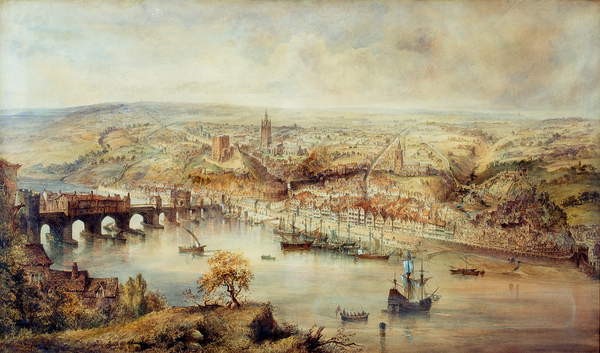
    Figure 1. A reconstruction drawing of 16th century Newcastle-upon-Tyne.

    Ballast Dumping in the 18th Century

    However, the impression must not be given that the river laid completely unsullied before the advent of the TIC. The Newcastle Corporation was not an environmentalist organisation and its river court was not created out of a desire to protect the natural world for its own sake. This is best shown by looking at the 18th century, in which the extent of trade on the river began to increase substantially. For many years beforehand ships had been dumping ballast into the river with less than stringent regulation; the entirety of Newcastle-Gateshead’s quayside had been created via a slow process of the filling in of old docks with silt to eventually form a platform of land. By the 1700s however, the extent of these depositions was causing the already narrow and shallow waters to grow narrower and shallower; indeed, at low tide you could wade across the river at the point where the present swing bridge stands. More importantly for traders however, the tides were pulling the ballast downstream towards the mouth of the river where it was feared the ports would become clogged to such an extent that commerce might be halted altogether.

    The health of the ecosystems within in the river were also being affected, as the sediments were burying habitats, thus reducing aquatic diversity. However, ultimately the environmental impact was not highly significant because it did not fundamentally change the environs of the river as the dredging of the same material would do in later centuries. The Tyne was already a shallows environment and the ballast, whilst causing some damage, did not alter this and was composed of non-toxic natural materials such as sand, mud, and rock. The ecological records available from the time, concerning concentrations of fish in the river (important to the fisheries of Tyneside) endorse this point, suggesting that the river was not only as healthy as it had ever been but was, in fact, healthier. It was recorded that on a single day on the 12th of June in 1755 more than 2,400 salmon alone were caught from the river. In comparison, over the entire month of June in 1996, only 338 salmon were recorded in the Tyne. The 1755 numbers may have been even higher without the dumping of ballast, but levels of local life were evidently not notably adversely affected.  

    In principal the corporation had always been against unlicensed ballast dumping into the river, this was partly the reason behind setting up the river court. In this case, however, it did not strongly push back against this process. Predominantly this was because these build-ups of sediment were creating new land along the riverbank, valuable land which, under the law, automatically belonged to the corporation. In this case, even after it was allotted government money to clear the silt in 1765, the corporation took the opportunity to turn a profit at the environment’s expense. Given the catastrophic impact that dredging would have on the river under the TIC however, it could equally be argued the corporation unwittingly took the more environmentally conscious approach in this decision. Either way, complaints from navigators on the state of the Tyne continued well into the 19th century.

    The Enlightenment and Proto-Industrialisation

    Whilst humans’ physical relationship with the Tyne may not have changed substantially in the 18th century, what did change was their attitudinal relationship; a shift which laid the groundwork behind the ideology of TIC. The enlightenment was the primary movement behind this change in relations, a philosophy with humanism at its core and a belief that scientific empiricism would lead humanity towards the conquering of the natural world. For the rational, orderly ideals of the enlightenment, the mercurial, muddy, meandering Tyne was something antithetical, something to be controlled. However, after these philosophies became popular the Newcastle corporation did not immediately set off on a crusade against the Tyne as the TIC later would, for three main reasons. The first reason was, as previously explained, that the corporation had been made extremely profitable by specifically avoiding tampering with the river’s natural systems. The second was that it lacked the technological ability to landscape a waterway such as the Tyne, or at least the ability to do it in a way that would not be prohibitively expensive. Thirdly was the fact the organisation’s frameworks and regulations had been set up hundreds of years before the advent of the enlightenment and adapting to fit this new ideology would mean a reinvention of what the corporation had stood for since 1400, a reinvention which never took place. It was also the case that enlightenment ideals were not fully pervasive, and many people, especially those in nature-based industries such as fishing, were sceptical of attempts to control it. Even in 1850, on the formation of the TIC and at the height of frustration with the Tyne’s unnavigability, the Shields Gazette wrote an endorsement of the river’s natural state, saying it was ‘of more lasting value than… Californian gold’.
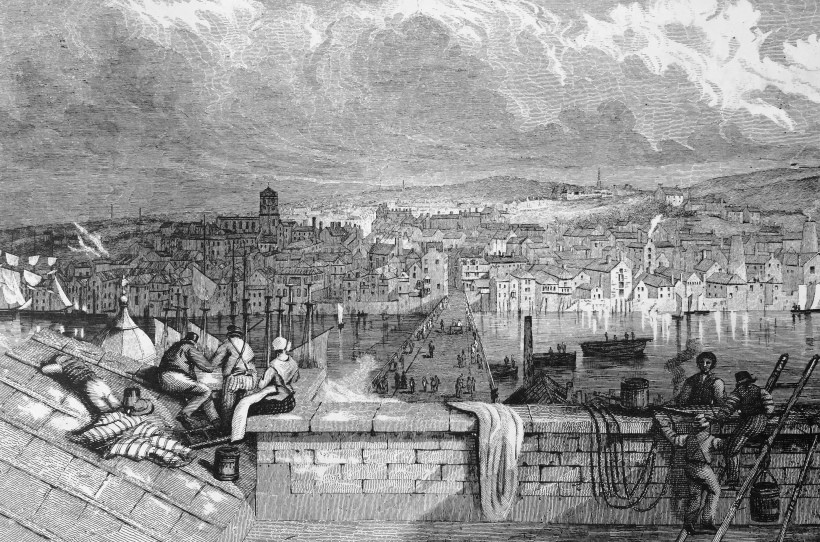
    Figure 2.A view of Proto-Industrial Gateshead in 1830.

    By the beginning of the 19th century however the physical landscape of Tyneside was beginning to match its ideological, despite the inactivity of the corporation. At Derwentcote, Winlaton, and Lemington were ironworks, and two glass manufactories. At Blaydon was a lead refinery, a flint mill, and a large pottery and at Derwenthaugh was a coke manufactory and coal tar ovens. The first Tyne tunnel was built at Wylam to transport coal under the river. The river was also home to two coal staithes and a number of lead mines, both materials having been mined on Tyneside since the Romans built its first bridge in 122AD. These were the first buildings to begin washing substantively harmful substances into the waters such as coke breeze, benzene, naphtha, ammonia, and phenol. However, without chemical testing, at this stage these industries were too new and too few for people to properly appreciate the harm they were causing to the river. An 1827 report from the topographer Eneas Mackenzie does approach this topic however, noting that levels of salmon in the river may be declining because of the ‘deleterious mixtures that are carried into the stream from the lead-mines and various manufactories on the banks of the river’. It is evident from this statement that Mackenzie was somewhat aware of the environmental damage being done to the river but what is also evident is that he does not consider the decline in river life to be an inherently bad event. The fact is only mentioned off-hand and quickly forgotten in his excitement around the wonders of industry.  

    In 1816 the corporation commissioned the engineer Sir John Rennie to create a report of suggested changes to the riverfront. Therein he recommended the construction of two piers at Tynemouth, embankments along the river as far up as Newcastle, and multiple quays; all of which would have to be accommodated through a program of extensive dredging and landscaping. His stated goal was to ‘direct the river in a straight, or at least a uniform course’, an idea very much in line with enlightenment ideals. The corporation however, still unwilling to instigate change, did not act to implement Rennie’s suggestions and this increased the growing frustration at the state of navigation on the river. Thus, the Tyne Navigation Act was passed in 1850, which resulted in the formation of the TIC. The organisation immediately set about its work of dramatically altering the landscape of Tyneside and by the end of the century, it had implemented all of Rennie’s suggestions and more so, creating a deep and orderly channel. This quickly resulted in the decline of Tyneside’s keelmen, whose entire trade had been built on the premise that large ships could not navigate the river’s shallows, but it also resulted in severe declines in plant and animal life, as well as the overall health of the river.

    Chapter 2

    A great highway of industry

    Reconceptualising the river

    The works of the Tyne Improvement Commission completely transformed the face of the river on a scale that had only ever been previously achieved through millions of years of geological landscaping; they also began an era that would result in the worst pollution the river has ever seen. The men, and unsurprisingly for this time they were all men, who constituted the commissioners for the TIC were a mix of local councillors and business owners who’s trade was located in the riparian zone, the majority of which were based in the coal and shipbuilding trades. Whilst this commission was officially unbiased, the more wealthy and powerful members were often able to exert their influence for their own ends. In their proceedings for 1875 for example, we can see how Lord William Armstrong was able to rush through expansion plans for his factory at Elswick without the usual scrutiny period of one month.

    Together however, the commissioners were united in a common goal, to make the Tyne as profitable as possible. This was the very purpose that the TIC had been set up for and its members ‘deeply’ believed in that task, with no thought towards environmental affairs unless they were to infringe on profits. Indeed, across all their proceedings papers of over 100 years of history the TIC demonstrates no discernible changes in attitude towards the river or their own purpose upon it; their proceedings in 1894, 1902, and 1945 all specifically stating that their prerogative as “conservators” of the river was not to look after its natural state, only to keep it in a condition suitable for facilitating trade. One proceeding from 1958, as the commission was reaching the end of its lifetime and as environmental concerns towards the river were growing in popularity, best demonstrates this intransigence. When the commissioner who represented South Shields, Mr. Gompertz, inquired as to the ‘risks we are running in further pollution of the river’, in relation to allowing sewage to be discharged directly into the water, the chairman, after some debate, responded that they had ‘no powers on that matter at all’. This statement is astounding given that the TIC specifically was the body that was responsible for the approval and regulation of sewage systems at this time. Evidently, they did not feel that environmental concerns constituted a legitimate reason for regulation in 1958, just as they hadn’t in 1850. They had similar reactions when requested in 1881 to help with the building of recreational facilities such as a rowing and sailing club, denying that this was their responsibility.

    This consistency of approach and unified direction of purpose is one of the astounding facets of the TIC, and perhaps one of the reasons behind its success in so categorically remodelling the river. This was not an organisation that passively and indifferently carried out its task, it actively pursued a vision and cared deeply about its planned “improvements”. The Tyne needed to be competitive in a global context, with the infrastructure capable of matching other industrialising rivers such as the Thames, Clyde, and Rhine, which could also be called inspirators for the TIC. In 1876, long before most of their works were close to completion, they had already proclaimed that the Tyne was ‘the finest port in England… and the world’, listing its safety, capacity, and possibility as reasons for this. This attitude is completely maintained 75 years later in a document the organisation published in 1951 entitled A Century of Progress. In a manner that could almost be viewed as fanatical they write that ‘commerce is our life blood’; this was a capitalistic institution in its purest sense. In this manner the TIC bares some resemblances to the former corporation of Newcastle, both being organisations that were granted conservatorship of the river and both primarily being concerned with its economics. However, where the Newcastle corporation stood to profit from preservation of the river’s natural state, the TIC’s business model meant that it was indifferent to such concerns and payed them little attention. Indeed, as it stated in 1908, it would use ‘all that science and nature can offer’ to achieve its ends.
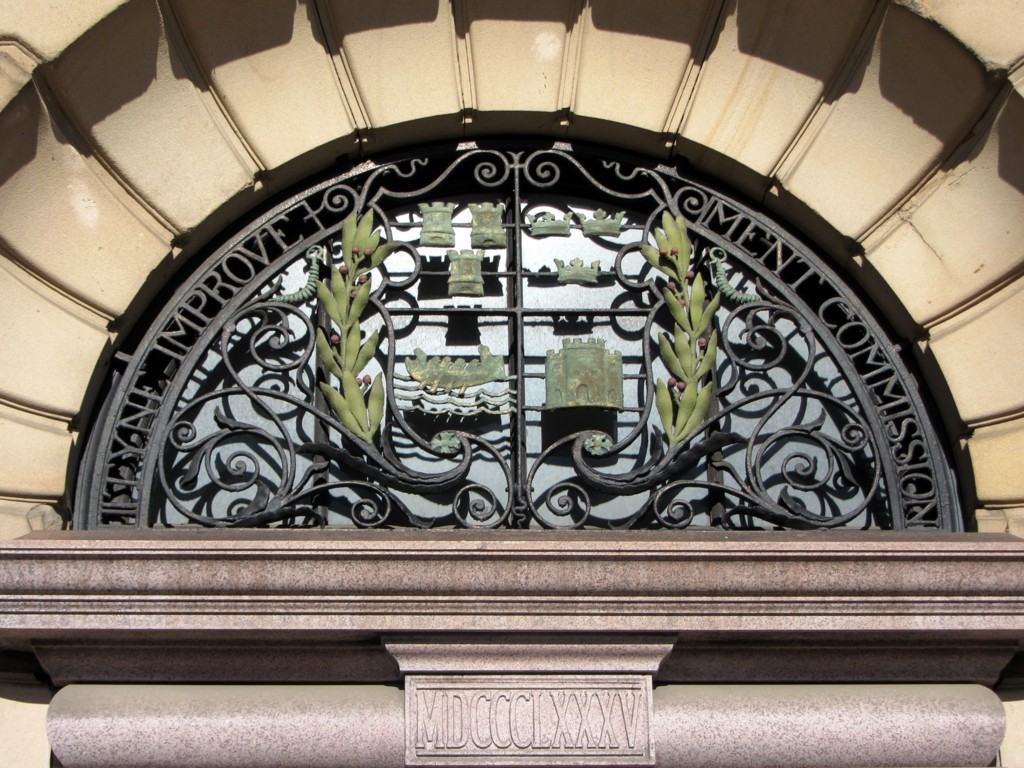
    Figure 3. Coat of Arms of the TIC above the doorway into Bewick House, Newcastle.

    Dredging the river

    In order for any of the infrastructural projects the TIC would undertake during its tenure to be worthwhile, such as the construction of docks, piers, and bridges, it first had to ensure that ships would be able to pass up the river far enough to access them. The solution to this was to dredge the river by removing the sand, rock, and mud that lay on the riverbed and dump them out to sea, a monumental task that had only been made recently comprehensible by the invention of the steam powered bucket dredger, the first ever of which had been employed in the neighbouring harbour in Sunderland. In 1850 the commission had access only to one steam dredger, which it had brought down from the river Tweed, but in 1853 they bought a second and by 1920 they had six all working to deepen and widen the river. These dredgers were tasked with ‘working day and night’ and so the citizens of Tyneside were forced to become used to their metallic clanks and churning coal-fired turbines.

    The commission’s reports comprehensively documented these dredger’s activities, as the organisation was very interested in maximising their efficiency, but they did not monitor the environmental repercussions that came with such work. The tests they did carry out, the first of which was in 1895, were concerned with the dumping of solid waste into, rather than the dredging of it from, the river. This was not because of environmental concerns however, but because the commission saw that this would result in an inefficient dredging process, the material being removed only to be replaced again overnight. The same reports make no attempt to measure or regulate the chemical composition of the water, only the solid material. Even in the TIC’s earlier years it cannot be argued that this was because of a lack of scientific understanding as the Tyne Salmon Conservancy (TSC, the body which represented the Tyne’s fisheries) carried out its own rudimentary chemical tests as early as 1866, being understandably concerned about the unhealthy state of the river.

    As the TIC was not concerned with such issues however, the dredgers continued their work and over a period of 70 years they deepened the Tyne from where it had lain previously at 1.83 meters to 9.14 meters. The commission’s own estimation for the extent of matter removed from the riverbed during this time amounts to the staggering figure of 149 million tons. This, alongside the TIC’s other infrastructural projects, had a huge impact on the capacity of Tyneside to trade on the river, with the Tyne becoming the largest repair port in the world by 1880, and the largest for the exportation of coal, producing 8,131,419 tons that year. Trade in total doubled on the river and the Tyne carried 1/9th of the total tonnage of the United Kingdom, second only to the Mersey, and built more ships than any other river aside from the Clyde. The cost of this was substantial to the TIC, over £3.5 million pounds (equivalent to £206 million pounds in today’s currency) which it managed to source from government grants, fundraising from local businesses, and its own taxation schemes. However, the cost was substantially higher for the flora and fauna of the river that soon found their habitats ripped from beneath them, a destruction which it is estimated will take hundreds of years to recover from.
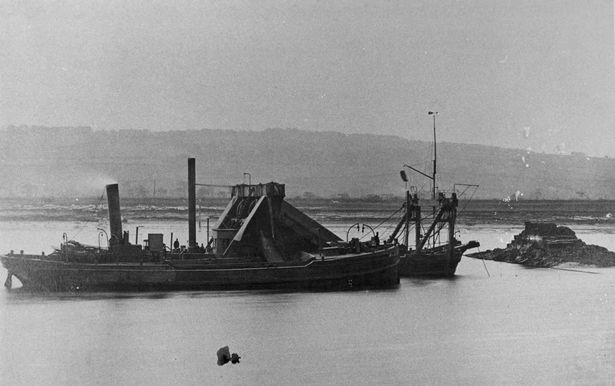
    Figure 4. “King’s Meadow” island being dredged from the Tyne 1885CE.

    The first and most evident effect of this dredging was the replacing of the river’s natural shallow environments with much deeper, faster-running waters. The problem with this was that much of the local plant life, including reeds, lilies, pondweed, and willows, were not suited to surviving in such a habitat and so soon began to disappear from the riverbank, as well as smaller fare like phytoplankton, algae, and zooplankton. The resulting collapse of the ecosystem overall was then the result of a domino effect as each creature in the food chain found its food sources diminished. Much of the plant life had also acted as a habitat and spawning ground for many shallow-water life forms such as crabs, worms, shrimps, and fry as well as for insects like dragonflies, water boatmen, and other small invertebrates like the caddis and the mayfly. This in turn meant a decline in the predators that eat such creatures such as the mackerel, flounder, and seal alongside birds like the heron, turn, and kingfisher. In areas of significant dredging, the result was the complete removal of a shallow-water habitat and the creation of a deep-water habitat, which significantly destabilised the local biosphere.  

    If dredging only resulted in this alone there would have been a possibility of ecological recovery in a relatively short time frame as whilst much of the local flora was forced out, some of the hardier specimens could have survived in the new environment; plants such as the sedge, plantain, starwart, and sharp rush. Other plants better suited to the new environment would have also moved in, such as cordgrass and seagrass. However, the impact of the steam dredgers went further than habitat destruction. All dredging by necessity causes disturbance to the riverbed but this early form of bucket dredging was particularly dangerous in this regard. The scoops dug far enough down into the riverbed to reach the benthic zone, the sediment sub-surface at the lowest level of a body of water, and if they didn’t, the explosives which were also used as part of the dredging process certainly did. The reason this was dangerous was that the benthic zone of the Tyne contained many chemicals of a toxic nature such as lead, biphenyl, and tributyltin, which were not protected from being released into the water as with modern dredgers, and as such they acted as biocides which weakened or killed plant and animal life in the river. This is especially the case when considering this period of disturbance lasted as long as 70 years, the prolonged deviations from natural water turbidity also affecting the metabolism and spawning of certain creatures such as trout and the seeding of vegetation like sea grass.

    Whilst unenlightened as to the chemical specifics, the TIC could still observe the very clear fall in biodiversity on the Tyne and was to some extent aware that this was a result of its own work. Indeed, when writing a promotional piece for their port in 1925 the TIC not only acknowledges this, but is very much proud of this achievement, and not wholly unjustly due to the monumental feats of engineering that it required. Therein they write that whilst the old river may have been ‘picturesque’ it was now ‘the Tyne of yesteryear’, thus positioning the TIC’s modern creation specifically as the antithesis to ‘picturesque’. Overall the commission’s language in this document is indicative of their view on their own accomplishments, that they had made the post-1850 Tyne into something that was, conceptually, a completely different body of water to the pre-1850 article. In their proceedings of 1875, they wrote that their goal was to make the Tyne ‘equal to a dock’, to remove its status as a river entirely, by 1925 they believed they had achieved this. It would not be entirely incorrect to agree with the TIC on this point, as the ultimate result of their dredging program was the effective conversion of the Tyne from a river into a very large canal from Dunston downwards, as it remains today. What previously had been merely a river was now, in their own words, a ‘great highway of industry’. ‘Highway’ is the notable word to examine here, as it distinctly encapsulates the perspective toward the river which resulted in its conversion; that being a view of the river as simply a road made of water, a transportation device. The commission valued the river just as much as the Newcastle corporation or the TSC, perhaps even more so, but the nature of their occupations meant they no longer valued it as an environmental resource, only as a logistical one.

    However, the relationship between the TIC and the Tyne was not so unidimensional, and the commission soon discovered that their program of dredging would, to some extent, need to bend to fit the Tyne’s will. Erosion was their primary difficulty, as the TIC soon found swathes of riparian land collapsing into the river, much of it their own, although they were reluctant to admit in their proceedings that this was a problem of their own causing. The problem persisted throughout the TIC’s administration, and they had to deal with the erosion problems caused by dredging into the 1950s and 1960s, long after they had stopped deepening the riverbed, in places as far up the river as Haydon Bridge on the South Tyne. The reason this was occurring was because the dredging process had increased the gradient of the river, heightening its power on its new steeper course, and thus causing more aggressive deterioration of the banks. This effect was intensified because of the straightening of the river, which meant much greater force was exerted against the riverside, and this consequently created the need for weirs and embankments to be built along much of the quayside, although much of the time the commission was forced to concede and allow the river to carve at the land as far in as it required.

    Further to this the dredging resulted in the forces that the tides exerted on the river becoming far stronger, making the waters more turbulent and unsafe to travel on, as well as causing further erosion and silting up the docks, ironically creating much more work for the dredgers. In 1881 tenants in North Shields complained to the TIC that the force of the river ‘shakes the building’ and the northern rowing club also complained the following year that their casting-off point had been made ‘excessively deep and dangerous’ because of this. Such problems also affected large structures such as the Scotswood bridge, the company for which wrote to the TIC in 1884 complaining that its foundations were being undermined and it was at risk of collapse. The use of unpredictable explosives for the purposes of dredging was even more dangerous, as proved when, in 1894, the dredgers came within ‘90-100 feet’ of breaking through the roof of a mine that ran under the river owned by the Montagu colliery.
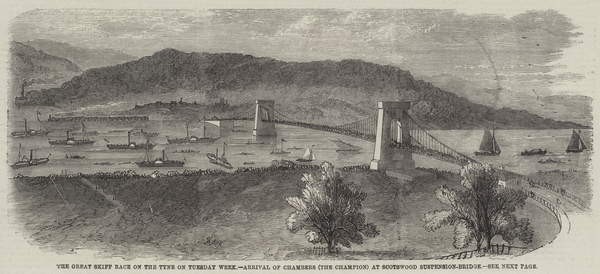
    Figure 5. Scotswood Suspension Bridge in 1832, Tyneside’s first industrial era bridge.

    The sheer scale of the dredging operation was also causing difficulties as the TIC found it increasingly difficult to regulate the process. Whilst there were only a handful of steam dredgers, there was a considerably larger number of ships known as “hoppers”, barges which were responsible for taking the silt from the dredging ships and dumping it into the North Sea. Two problems arose from this process. The first was that a number of hoppers were dumping their cargo too close to the shore and as a result it being washed back in to the river again, a problem which was expanded by the building of the piers at North and South Shields because they increased the area the TIC was obligated to manage. To combat this the TIC set a bylaw in 1885 that the silt had to be deposited outside of a three mile radius, but they still found that they were not always obeyed. Indeed, it was in the hopper operator’s financial interests to create more work for themselves.

    The second problem arose slightly later in 1900, after the program had been running for a while; what they discovered was that the sheer amount of material being dumped into the sea was beginning to threaten the passage of ships into the port because it was ‘raising the bed of the sea’. This also created problems for anglers both on the sea and the river, who found their nets and pots periodically smothered with ‘masses of refuse’, and often submitted complaints to the commission. With all of its technological might the TIC clearly thought of itself as an organisation that was above nature, that could do with the Tyne as it pleased, but the river proved time and again to be a force that could not be easily constrained and occasionally it would remind the commission that they were sometimes bound to playing on its terms.

    Reconstructing the River

    The dredging of the Tyne was only the preliminary stage, however, in the TIC’s plan. The removal of 149 million tons of material from the riverbed being simply the groundwork required which would allow larger ships to utilise the commission’s key infrastructure projects, these namely being the piers at north and south shields, the Albert-Edward, Northumberland, and Tyne docks, and the Tyne commission quay. A lot of resources were also spent on supporting projects to these large constructions such as the building of embankments, the swing bridge, and the destruction of rocky outcroppings.

    The construction of the Northumberland Dock in 1857 and the Tyne Dock in 1859 were the first major schemes to be completed under the TIC’s oversight, and work soon followed on another that would be named “Albert-Edward” in 1884. Significant excavations and further dredging was required for these projects, including the removal of tens of thousands of cubic meters of mud, gravel, clay, and sand; fortunately for the commission they received a good amount of private assistance in the removal as much of this material from firms such as the Wallsend cement company in 1877. This was especially true in regard to the gravel and clay, some of which was then used to create the base on which the docks stood. The Tyne commission quay, opened later in 1928, was built in the same manner and also with a small hydroelectric power station, an example of how the quickened current as a result of the dredging was utilised by the TIC to their advantage. This dredging caused all the same environmental problems as it did in the rest of the river but with the additional issue that the space was then entirely filled in with solid concrete, the Albert-Edward dock alone taking over 32,000 concrete blocks to construct, meaning the riverside and seaside ecosystems had no possibility of recovery.

    The single project which caused the TIC the most strife was the construction of the piers at North and South Shields. Partly due to the fact that dredging had caused dangerous tides to progress up the river, work was forced to begin ahead of plan in 1854 in order to protect ships in harbour, but the piers would not be completed until 1895 at a much higher cost than the commission intended of £1,000,094 pounds due to repeated damage from the force of the currents around the mouth of the river. After completion the saga was not over however as the north pier lasted only two years before being destroyed in a storm in 1897, and was only rebuilt by 1910 after bringing the total cost of the project up to £1,544,000. During all of this difficulty, in 1878, the TIC decided not to remove the “black middens” which were situated in front of the north pier because of their function as natural breakers which protected the coastline and, importantly, the walls of the pier, stating they were to a ‘general advantage’. These middens were infamous dangers to vessels, wrecking five ships in three days in a storm in 1864, but they were nevertheless so useful to the TIC that they were preserved. This case demonstrates that the TIC did not see itself as being on a mission against the natural world in all contexts. If a feature did not hinder, or even helped with their work, as with the black middens, they would be happy to leave it alone. By the same token however, they would not pause a second for anything which obstructed them, no matter its beauty or significance.
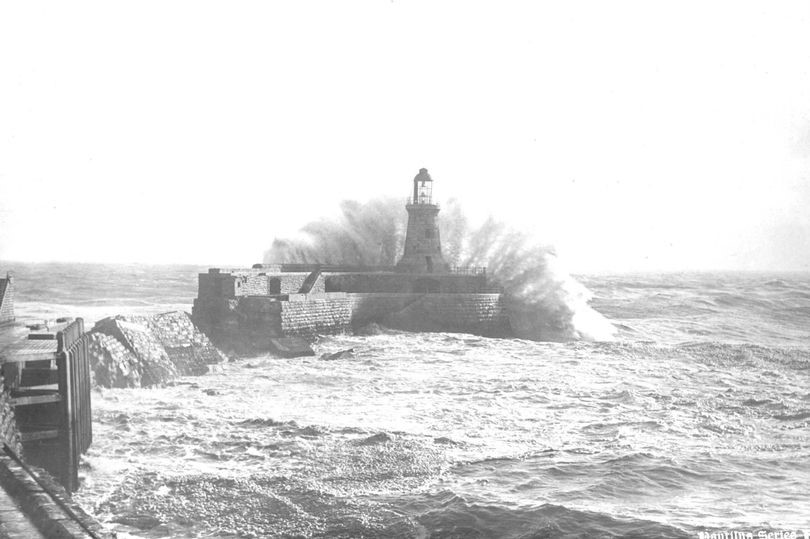
    Figure 6. North Shields pier collapsing into the sea, 1897.

    Generally, the TIC was quite happy to remove natural rock formations along the river however, if they were to get in the way of their “improvements”. As example to the fact that not everybody agreed with the prerogative of the TIC, two petitions were set up by the general public, the first in 1881 and the second in 1882, which were filed against the commission in attempts to save two popular natural beauty spots, Frenchman’s Bay and Lady’s Bay. Neither of these were successful, despite the fact they were signed by a great number of people of noteworthiness, including the mayor of Newcastle, the naturalist John Hancock, and a number of scientists with interest in the areas. Therefore the TIC carried on, removing a number of ‘protrusions’ at Felling Point, Whitehill Point, and Bill Point (amongst others) during the 1880s and significantly widening the river in one area near the mouth to create the Tyne main turning circle; both of these projects required the determined use of explosives over decades to complete. This is an example of the power of the TIC itself but also of the belief in the importance of its work, both from the organisation itself and from outside. The industrialisation of the river was an imperative, this was “progress”, unarguable and inevitable.

    Chapter 3

    NEITHER SALMON NOR CHILDREN

    Industrialising the River

    The TIC’s tentpole projects such as the docks, piers, and dredging program, whilst being the most impactful single enterprises on the environment on the river, were ultimately a drop in the water compared to the wider industrialisation that was taking place along the Tyne. The TIC was responsible for approving and regulating all new industries set up in the riparian zone, this task including the regulation of waste discharged into the river, but for the most part they took a laissez-faire approach to this duty. Their purpose as an organisation was to help, not to hinder, the growth of industry, and as environmental regulation would have hindered, they left it alone. Instead they acted as facilitators for the mass production of coal, coke, oil, timber, pottery, concrete, meat, iron, steel, glass, a vast array of chemicals, and all of their waste products. All these industries were built around the river (along with a multitude of smaller businesses) and they used it to help produce their goods, to transport them when complete, and to discharge their wastes into. Alongside these were the sewers of Tyneside, which were also approved and regulated by the TIC, and the number of which consistently grew across the TIC’s tenure until there were 270 active sewers draining into the Tyne when the TIC was replaced by the Port of Tyne Authority in 1968.

    The Tyne was thus party to a vast array of industrial processes and substances that it had never encountered before after the TIC took control, and a dramatic increase in those which it had. The primary categories for these substances in terms of environmental concern break down to organic material, organic chemicals, inorganic chemicals, sediments, and hot water. The effects of heat on natural ecosystems can often be overlooked but the amount of water from the Tyne which was used for coolant and then ejected back into the river still warm was enough to deal considerable environmental damage, this hot water predominantly coming from iron works, steel mills, and refineries such as Crowley’s iron works at Swalwell. The warmer a body of water is, the less oxygen is dissolved into it, whilst at the same time warmer water increases the metabolic rate of organisms within it, thus increasing their demand for oxygen. A reduction in oxygen in the Tyne therefore meant a reduction in the amount of plant and animal life that could survive there.

    The main culprit however in causing the deoxygenation of the Tyne was the discharge of organic material such as sewage and drainage from slaughterhouses, tanners, and flour mills, such as the Baltic Flour Mills at Gateshead. Once discharged these organic materials begin to decompose, the decomposition process being achieved by a flourishing of aerobic bacteria which are highly ‘oxygen hungry’ life forms. In the Tyne this occurred on such a large scale that the very first oxygenation test in 1912 concluded that there was ‘almost no oxygen’ in the river, which was alone nearly enough to end all life within. Once this had occurred it meant an increase of anaerobic bacteria, which produce foul smells. Other bacteria and viruses which were harmful to local river life, such as those of the Faecal Coliform or E. Coli varieties, also bred and spread quickly on this organic material.

    Organic and inorganic chemicals were likely far larger killers of river life than bacteria and viruses however and were indeed the killers of bacteria and viruses as well. Salts, acids, mercury, arsenic, benzene, naphtha, cyanide, lead, and phenolic wastes were all being ejected into the river from mines, farms, sewers, oil refineries, and coking plants such as the Derwenthaugh Coke Works which alone in 1928 pumped 1kg of cyanide into the river for every ton of coke produced. These substances were toxic to almost all river life, and toxic even at low concentrations, which they were not in the Tyne, and together were the one factor that caused the most damage to the Tyne’s ecosystems and led to it being classed as biologically dead in 1957.

    The dumping of sediments into the river, such as wood pulp, coal washings, and sludge was the one area where the TIC did attempt significant regulation. This was because of their dredging program, for which they did not want to create more work, and so they would inspect the discharges of factories to make sure nothing too solid was being ejected, first hiring Hugh and James Pattinson in 1895 to conduct tests to help them with this task. One substance they also attempted to prevent entering the river was oil from plants like the Benzol Works, which was the first place in the world to produce petrol from coal, because of the damage it caused to their property. It is evident therefore that the TIC would only step towards regulation if the environmental interests of the river aligned with their own economic concerns.
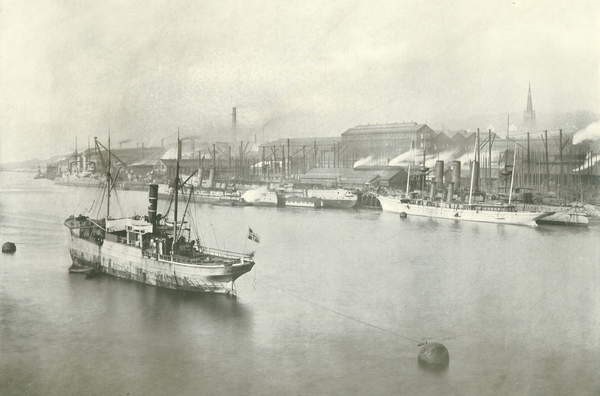
    Figure 7. Elswick Engineering Works, 1900.

    Turning Away from the Tyne

    In 1910, a street of houses in Lemington called Bell’s Close was erected along the riverfront. What distinguished this street from others that came before it, however, was that it was facing backwards, away from the Tyne. Indeed, the backs of the houses didn’t even have windows, they had turned away from the water because it had become ugly, foul smelling, and dangerous. This was exemplative of the larger trend that had been taking place all along the river, of houses and town centres moving further and further away from the river, being demolished in favour of factories and warehouses. After the first and second world wars, when industrial production on the Tyne began to decline, this resulted in the complete abandonment of much of the riverside¸ what had historically been some of the most desirable land available. A committee set up in 1969, immediately after the dissolution of the TIC, wrote that where Newcastle’s quayside had previously been one of the most overcrowded regions in the country it had now become a ‘neglected back alley’. Humanity’s environmental impacts had impacted on themselves. In 100 years the TIC had overturned what had seemed an inalienable truth for thousands, that rivers were at the centre of human civilisation. By 1940, the 1969 committee wrote, ‘neither salmon nor children could enter its polluted waters’.

    As the scale of the destruction became apparent, however, pressure mounted on the TIC from both the public and other organisations to do something about it. The primary driving force behind this was the TSC, which had been advocating stricter environmental regulation all throughout the TIC’s lifetime, but to little avail. In 1921 they helped set up the Standing Committee on River Pollution Tyne Sub-Committee (SCORP) which produced a number of reports with suggestions for how to improve the water quality, including a comprehensive sewerage treatment plan in 1936, but the TIC, the second world war, and a lack of funding blocked any progress. A Newcastle university report in 1957 said that public opinion ‘requires an improvement’ of the river environment and a 1958 motion in the house of commons recommended action for tackling pollution in the Tyne, but the TIC was as equally uncooperative with these as it would be with the Tyneside Joint Sewerage Board, set up in 1966. Just as with the Newcastle Corporation before it the culture of the TIC had become engrained, it saw itself as the heroic protector of orderly, profitable trade against the dangerous, unpredictable natural world. To a growing number of people however, the TIC had become the villain, too willing to sacrifice the picturesque for the profitable.

    CONCLUSION

    The success of the TIC was ultimately short lived when compared with its predecessor the Corporation of Newcastle, which lasted for nearly 400 years. For an environmental historian however this is not surprising, as they can appreciate the benefit that the Newcastle Corporation found in achieving a balanced relationship with the river on which it was reliant. Conversely, what the proceedings of TIC show us is that they did not look out for the health of the river, nor did they care for it. Instead they grew wealthy on the back of ‘robber industries’, trades that ‘carry the seeds of their own decline’. It cannot be denied that their works were marvels of engineering, and for some of the human population also brought great wealth, but to celebrate the reign of the TIC as the “heyday” of the river is a perverse anthropocentric notion that ignores the vast majority of Tyneside’s inhabitants. It operated in a way that was harmful to the health of all life based around the River Tyne, including the human population, and the scars it left are costing the region in the long run in the resources spent attempting to heal them. The modern Nile, Ganges, and Yangtze, whilst being far grander waterways, might do well to pause a moment and listen to the Tyne’s story, as they will find parallels and lessons within which they may wish to act upon.

    Author/Publisher: Louis Lorenzo

    Date of Publication: 24th of August 2019

  • Devoted Admirers and Bitter Enemies – Assessing our current understanding of T. Dan Smith Part 3: Sources

    If you are unfamiliar with the history of T Dan Smith, it is advised that you read part 1 (‘Local Hero or Corrupt Councillor?’) and part 2 (‘Which Way to Utopia’) before reading this.

    Thomas Daniel Smith will always exist as a controversial figure, a polariser of public opinion. For the people of Newcastle-upon-Tyne his legacy is unavoidable, it is spread all over the city in the form of vast swathes of concrete, often ill-repaired and forgotten, which speak of a separate world from that of the Victorian terraces and Georgian streets. For some, his imprisonment on charges of corruption in 1974 was a justice well served to a politician who had taken advantage of the city to better himself and those close to him. For others, and for Smith himself, he had been pilloried by a political establishment who saw him as a threat to their own authority and made the scapegoat for higher ranking officials who were the truly corrupt forces at play. As he put it, he had to be disposed of because he ‘wasn’t one of them’. The three sources I investigate herein have been chosen to help me examine the character of T. Dan Smith in public life and understand how the public perception of him has been informed by the media that portrayed him. Primarily however I examine the man’s vision and assess whether his passionate talk of creating a ‘new Brasilia’ was merely a show to cover his untoward deeds or whether it did truly represent a devotion to positive change. Ultimately, I will conclude that these sources indicate that he did.

    The earliest of my three sources dates from 1969, before allegations of Smith’s involvement in corruption came to the fore. It is a booklet distributed by the Northern Economic Planning Council (NEPC) which sets out its vision for north-east development over the next 12 years up toward 1981. Smith was the chairman and head of the NEPC at this time and he wrote in the foreword to the document that it should be ‘given the widest possible circulation within the region’. It is a statement of desire for the future and I will be assessing it to determine exactly what Smith envisioned he could achieve in the region if his tenure had not been cut short by a jail sentence 6 years later. It also shows us what Smith though most important to communicate to the people of the region.

    The second of my three sources dates from 1971, three years before Smith would be convicted on charges of corruption, however it does still originate from a time when Smith was embroiled in allegations of corruption brought against him. The source itself is a correspondence between Smith and Henry Parris (Smith’s friend and a lecturer in politics at Durham university) and it follows straight after a 1971 corruption trial for which Smith was found not guilty. Parris’ letter to Smith also includes an attached newspaper article from the guardian which he explains is from where he learned about Smith’s trial. I will be using this source to assess public attitudes towards Smith before he pleaded guilty to corruption and to examine how he was depicted in the media during this tumultuous time.

    My final source dates from 1987, after Smith had been released from jail and somewhat receded from the public eye. It is a documentary film produced by Newcastle-based studio “Amber Films” which includes interviews with Smith and with several other persons from his history. From this source we get to assess Smith’s responses to the allegations made against him and how his legacy was remembered publicly after his spotlight had since faded.

    The NEPC booklet does not provide an optimistic view of the future for the north-east, indeed, it is resolved to a process of damage mitigation; using phrases such as ‘the region cannot hope to halt net outward migration’ and ‘heavy job loss… will almost certainly continue into the mid-1970s’. At initial observation this does not align well with T. Dan Smith’s notion that he could turn Newcastle into the ‘Venice of the north’, as he would sometimes claim. However, reading further into the NEPC’s policy proposals reveals that this is not the case. This is because the document outlines a strategy of concentrating all resources towards certain key areas of economic activity within the region at the expense of others; Newcastle being the foremost of these chosen areas. In astonishing brusqueness, as this document was made widely available to the general public, it pronounces that ‘There is no point in pretending that all the communities which now exist in the region will be capable of surviving’ and states that ‘this policy would accept… a gradual rundown of some of the less favourably placed communities’. The spines around which these ‘growth areas’ will be built were the proposed ‘growth corridors’; an idea based on the conclusion that roads are critical to the economy and that investing in road infrastructure will bring wealth to the area that surrounds them. This came to Smith through his city planner Wilfred Burns who took much inspiration from modern American cities. This is why most of the “new towns” built during this period, such as Washington and Meadowfield, were deliberately based around ‘motorway interchange points’. Comparing the map showing proposed ‘growth corridors’ against a concurrent plan for road extensions reveals how exactly these two plans align. Indeed, the ‘main growth corridor’ aligns exactly with the line of the A1 motorway.

    This document reveals the harsher side of Smith’s visionary rhetoric. Within this document genuine and practical belief is shown in the ability of Newcastle to foster ‘seeds of future growth and prosperity’ but this is acknowledged only at the expense of other areas in the region. What this does help us acknowledge however, is the practicality at the heart of Smith’s vision; he does not outline a perfect scenario and nor does he claim to hold all the answers, but he does want to attempt an ambitious strategy for turning the fortunes of the region around. This is not a document produced by a man who does not understand the realities of his situation and is a demonstration of Smith’s unreservedness in communicating to the people of the area what he intends to realistically achieve.

    It is interesting therefore to see in the newspaper article attached to the letter sent from Henry Parris to Smith how the media of the time portrayed this unreserved vision. What is immediately communicated through this source is the real respect and influence he had garnered for himself despite the allegations brought against him. He is described as the man who ‘virtually invented regionalism’ and the article plays up his “rags to riches” tale, a man ‘unfettered by formal education’. The context of this article within this correspondence via letter also enforces the conclusion that Smith was well thought after, a foreword stating that he had received ‘hundreds of messages’ of support. Smith’s determination to carry on with his work is also evident here, which he states very plainly in both his newspaper interview and his personal reply to Parris: ‘I am planning my diary again with confidence’. It is interesting and slightly sad to note this optimism in the knowledge of his imprisonment that would follow this correspondence only 3 years later.

    However, there is a clear subtext to pick up when assessing this source which does imply that Smith had his detractors at this time, which he certainly did. A fault of this source is that it does not fully represent the other side of the argument as it only includes comment from those predisposed towards Smith: his friend and a newspaper which broadly aligns with himself politically. Nonetheless when Parris writes that ‘I felt I could not remain silent’ or when the paper writes that Smith commanded over a ‘reluctant Newcastle-upon-Tyne’ it is made clear that Smith was not universally admired. Indeed, overall across all of the three primary sources I examine the picture developed of T. Dan Smith is a mixed one, a man who attracted ‘devoted admirers and bitter enemies’. 

    Certainly the 1987 Amber documentary brings the conflicting elements of Smith’s career to the fore, using its two narrators as points from which to argue the two sides of the story; one a detractor and the other a supporter. The film shows a society which finds it difficult to come to grips with Smith’s character, a man who cannot be simply labelled into the category of hero or villain. In particular its interviews with members of the general public of Newcastle prove enlightening; an ambivalent atmosphere flows through all of these conversations which seem to both condemn and praise at the same time. One man states: ‘He did a wonderful job for the town, but unfortunately he was found out’ and another: ‘to me he’s a criminal… but now he’s more or less hailed as a hero’. The interviews with Smith himself show a very different character to that seen in the newspaper and the NEPC document. These detail him as a bold and harsh character, not afraid to offend in order to get things done. Now, after his time in jail, the man set before us is defensive and calculating, carefully choosing his words to justify and explain his former selves. In regard to the public opinion of himself, he says that people seem to ‘reflect the society that was able to convince them of what ever they want to be convinced of’, in other words, he feels the public have been misled as to his role in the wider corruption scandal involving the architect John Poulson and the conservative home secretary Reginald Maudling. His view is now that he was made a scapegoat for ‘bigger fish’, and although he did plead guilty to charges of corruption he now claims to be innocent.

    Certainly, his decision to appear on such a program does lend a legitimacy to his assertions. We see him now, still living in Newcastle, in one of the very concrete towers he laid the foundations for. He lives no ‘life of luxury’, as one of the citizens claims, he appears as he proclaims himself, cast out. Overall the feature does portray Smith in a sympathetic light and does not take such a balanced view as it wishes you to believe it is taking. It is another example, as with the newspaper, the letter, and the NEPC booklet, of people being swept along in the wake of T. Dan Smith. Through all of the sources his personal drive and commitment appears infectious on those around him, a naturally likeable character.  

    What these sources all indicate is that T. Dan Smith did have a genuine vision and love for his home city. As to the extent of his involvement in the corruption scandal I do not believe these sources provide enough information to make an informed assessment of that. What they do show is that across time, from his heyday to his downfall to the present, he remains a man who can inspire passion in those around him.

    Author/Publisher: Louis Lorenzo

    First Published: 3rd of August 2018

    Last Modified: 3rd of August 2018

  • Which Way to Utopia? Assessing Our Current Understanding T. Dan Smith Part 2: Historiography

    If you are unfamiliar with the history of T Dan Smith, I recommend that you read part 1 (‘Local Hero or Corrupt Councillor?’) before reading this.

    For this article I have chosen eight pieces of historiography surrounding the life of T. Dan Smith to review. Due to the relatively small amount of published material on T. Dan Smith I believe these to be sufficient to fully cover the historiography.  Primarily, I will be assessing how attitudes towards Smith’s legacy have evolved over the years, relating to his charges of corruption and his personal vision for the city of Newcastle-upon-Tyne. I highlight a clear transition in the historiography, which progresses from the notably negative appraisals of the early 1980s towards the far more positive revisions of later years; all culminating in Chris Foote-Wood’s 2010 text which boldly proclaims Smith as ‘NOT GUILTY AS CHARGED’. I will finally evaluate whether the historiography overall has provided a conclusive narrative on the figure of T. Dan Smith, and decide that there are still many unanswered questions surrounding his character to be explored.

    The earliest major text to be released about T. Dan Smith is his own: “An Autobiography”, which was released in 1970 before any corruption charges were brought against him. In contrast to later sources Smith’s own text carries a far more nonchalant tone, not cast in the harsh light of criminality. Indeed, Smith gives the impression of a man stepping back from ‘my public life’; by its very nature an autobiography indicates a conclusion, a summary of one’s achievements in the assumption of the best being behind you. One consistency with later sources is the emphasis placed on Smith’s working-class youth and the impact of the Second World War (WW2) on Smith’s life (perhaps because the later sources had no other source material to work with apart from Smith’s recollections). What Smith emphasises is his love of the radical politics of the post-WW2 era which gave birth to the national health service, and his disappointment in how quickly after the fact politicians turned instead to ‘petty things’. Certainly Smith casts himself as somewhat of a visionary, someone who had brought us back to ‘those radical days of 1945’. He regards the brutalist architecture executed under his stewardship, a factor so often used against him in later evaluations, as a prime example of this future-facing attitude, describing the buildings as being of ‘the highest standard and best design’.

    In 1975 a small article was released from an Australian university interested in local government studies which discussed Smith’s political career. However, it makes no reference to the corruption trial that had taken place only one year hence. Furthermore, the article is particularly positive, saying that Smith ‘engendered an optimistic and dynamic attitude’ in the city council. If nothing else, this article shows the unusual impact Smith had on the political sphere in his time; few leaders of local councils are written extensively about at all, never mind from across the globe.

    After this point no major evaluations of T. Dan Smith are released until, in typical form, two come very close together in the early 1980s. These are by far the most condemnatory texts on Smith to be released. The first of these, “Nothing to Declare”, primarily focusses on John Poulson, but the text devotes an entire section to Smith. It casts him as a young visionary socialist with good intentions who lets himself get corrupted by Poulson and the system at large. It proclaims that ‘by the end the vision was gone, replaced with tawdry self-interest’. In the context of itself the text builds a strong case against Smith, using extracts from letters sent between Smith and various other figures as evidence. In the most damning of these correspondences Smith writes that a potential employee must ‘be unaware of any tie between J. G. L Poulson and me’. However, the provenance of these extracts is often unclear and always appears mixed in with passages of hearsay and speculation which somewhat degrades the argument. Smith is quoted as having said ‘I support the building of council houses, but that does not mean I want to live in one’ but no source is provided. Indeed, later in life Smith did live in a council house. There is a distinct sense that the main desire here is to neatly slot Smith in to the overall narrative on Poulson presented, describing Smith as Poulson’s ‘chief lieutenant’, Poulson of course being the ‘arch corruptor’.

    The second of these texts, “Web of Corruption”, places Poulson and Smith in the exact same relationship, even using the term ‘lieutenant’ in just the same context. However, the differences between these two texts are more pronounced than may initially appear, because although they hold similar sentiments towards Smith, they are marketed towards different audiences. Web of Corruption is a text aimed toward a far wider audience than Nothing to Declare, the large red font over the bright yellow cover immediately catching the eye. Its attacks on Smith are a viscious spectacle, describing him as a ‘con’ who was nothing more than a ‘moderately gifted amateur’. It paints a vivid image of a ‘socialist hero’ who has fallen from grace to become ‘unemployed but almost friendless, isolated but not ignored’. This text more than any other demonstrates the public appeal of Smith’s character and case, a man who had lived such a public life now finding his fame turned against him. Rather hypocritically the text goes on to criticise Nothing to Declare for sensationalism, describing it as looking for ‘another Watergate conspiracy’. Contrarily I believe Web of Corruption to be a far more sensationalist piece, looking to attack anyone associated with the Poulson scandal. No references are provided and in all the text is more interested in human tragedy over hard evidence.

    In contrast to these highly critical texts, the later 1980s saw a selection of material which did not cast Smith in as much of a devilish tone. Two documentaries produced at similar times both seek to somewhat revaluate his character. They do not claim that he was innocent of corruption but do begin to frame this affair as a case not so firmly closed. The first of these, a 1986 British broadcasting corporation (BBC) production entitled “T. Dan Smith”, describes him as a good man manipulated by private business into doing bad things. The key difference here is that it does not describe him as being “corrupted”, he himself has not turned onto a dark path; instead others have manipulated him. The film also gives more time to his achievements, casting him as the ‘pioneer and prophet’ of local government and giving him the title of ‘a modern crusader’. This together with the second of these documentaries from Amber Films gives the impression that, after enough time had passed, the public were willing to reassess Smith’s character.

    The 1987 Amber Films production, “A Funny Thing Happened on the Way to Utopia”, takes a similar position to the BBC film; although where the BBC film takes a more neutral stance, A Funny Thing is quite sympathetic towards Smith. The style of the production as half documentary half drama points, in the same fashion as Web of Corruption, to the popular appeal of T. Dan Smith. His story is exciting and his personal involvement as both a character and an interviewee highlights his own desire to be fictionalised. A Funny Thing takes great interest in the conspiracy surrounding the idea that Smith was made a scapegoat for higher powers, such as Reginald Maudling and the privy council, an idea that Smith is happy to engage with in proclaiming that he had been ‘fitted out’ because he ‘wasn’t one of them’. There is talk of a ‘power above parliament’, a dark underworld which still remains uncovered. What strongly comes across in the interviews with Smith is how incredulous he feels in how he has been treated by the media, angry at an injustice done against him. Overall the film does not acquit Smith of guilt but makes no compromise in eulogising his vision for the city as a ‘new Brasilia’, although concluding that the result of his work did not match his ambition.

    In 1993 a thesis entitled “The New Brasilia?” takes a further step toward favouring Smith. The thesis does not tackle the allegations of corruption but does seek to assess whether Smith’s vision for the city was ‘harmful or beneficial’, and then to conclude if he did ‘realise [his] goals’. It also goes somewhat into the state of Tyneside before Smith took over in 1965, noting that unemployment at that time was twice the national average, a statistic which Smith helped reverse. In its conclusion the thesis is surprisingly positive, describing Smith’s assessment of the issues that Newcastle faced as ‘basically correct’ and his solution as a ‘relative success’. The New Brasilia decides that, in the context in which it was carried out, Smith’s redevelopment was good for the city in its ability to stimulate the local economy and deal with traffic problems, and that his vision was sound.

    Ultimately, we are brought to the 2010 text “Voice of the North”, which inverts all assessments of Smith thus far. The text frames itself as a “myth buster”, carefully going through all the allegations made against Smith and rebuffing them. It seeks to reinstate Smith as the proud figure of north-eastern regionalism he once was before the 1970s. The text goes through many of Smith’s achievements which are not discussed in any of the previous sources, such as his opposition to modern developments on the picturesque Grey street and to the bulldozing of the holy Jesus hospital which was shockingly described by the northern architectural association (NAA) as ‘not of the first importance’. It also goes to lengths to disassociate Smith from many of the concrete edifices so often linked to his name, pointing out how many of these were built after his tenure. Most strikingly of course, the text absolves Smith of his crimes entirely, favouring the view that he was ‘ground down’ into confessing his guilt by the press, the public, and other politicians. In regards to the specific case for which Smith was charged I find the argument convincing that he was indeed not guilty but overall I do not find myself persuaded as to his innocence in other matters, and indeed upon the book’s release there was resistance to this notion. Although I would regard this as the most historiographically sound of the sources I have reviewed I do believe it’s take on T. Dan Smith to be slightly too reverential. It is understandable why this may happen as a reaction to the previously overly-negative material, but a more balanced view would be appropriate.

    Across these eight pieces of historiography a clear progression is visible surrounding our appraisals of T. Dan Smith. In entirety this has been a trend towards the positive, both in terms of his vision and his charge of corruption. In all it is clear however that no conclusive narrative has been produced on the figure of T. Dan Smith, and questions over his innocence and his intentions still remain.

    Part 3 will look at the primary source material we have available about Smith and will ask whether it is substantial enough to come to some judgements about his case and character.

    Author/Publisher: Louis Lorenzo

    First Published: 21st of May 2018

    Last Modified: 1st of June 2018 (Grammar Corrections)

  • Local Hero or Corrupt Councillor? Assessing Our Current Understanding T. Dan Smith Part 1: Introduction

    This article will initially seek to introduce you to T. Dan Smith and the debates that exist surrounding his political and personal careers. It is deliberately short and omits much fine detail however this is in service of its central aim: to peak your interest in this topic and spark some enthusiasm for the mysteries presented herein.

    To summarise: Smith was born in 1915 to a working-class family in the city of Newcastle-upon-Tyne in the north of England. His parents were communists, and in his youth, Smith joined the revolutionary communist party himself. He was a conscientious objector to the second world war and honed his skill for oration during this time whilst making impassioned speeches which criticised the British state. At the back of all his speeches he would always spot the same man, whom he would later discover was an MI5 operative tasked with watching him.

    After the war he moved away from communism toward the labour party and rising through the ranks eventually found himself elected as leader of the city council in 1959. His time in office is controversial. As such I will present to you here the two narratives you will generally encounter when looking at Smith, the positive and the negative.

    The Positive

    T Dan Smith had a vision for Newcastle as a city reborn, the ‘Venice of the north’, and he hired planners and architects from around the world to build his new utopia. Newcastle became the first city in the UK to clear all its slums, and in their place tall towers were erected alongside modern blocks of offices and flats. Many of these were efforts of much-needed social housing, including the famous Byker wall. The whole road network was redesigned in tandem with the pedestrian footways; the entire structure planned to completely separate pedestrians and cars through an intricate network of tunnels and “sky walkways”. Smith also oversaw huge investment into local arts institutions, as well as the creation of the city’s first university and a profitable shopping centre. Few cities in the modern day see such investment. He is known as ‘the inventor of regionalism’ for his refusal to move to a better paid job in Westminster in favour of standing up for his home region, little wonder he was known as ‘the voice of the north’.  He was wrongfully accused of corruption, taken advantage of by the truly corrupt forces above him in higher government who didn’t like that he was a strong independent voice for the north that didn’t play nice with the political establishment.

    The Negative

    T Dan Smith almost ruined the city of Newcastle. The elegant Georgian streets were demolished in favour of monstrous grey blocks of concrete. The skyline was now dominated by towers which gave no effort to integrate themselves with the existing landscape and walkways which lead to nowhere. The greatest insult of all being that all this was done for his own personal gain. By hiring his own firms and those of his friends with government contracts, Smith made money hand-over-fist through underhand deals and unethical accounting. His contact with the notoriously corrupt architect John Poulson only implicates him further. He lied to the people of Newcastle for his own gain and his 1974 jail sentence of only 6 years was criminally short. He may have claimed he was a socialist, but when the money was in front of him he preferred to line his own pockets.

    Guilty or Not Guilty?

    So which narrative is correct? At this current stage, this is an unsolved mystery. You know as well as I. At the time the general opinion in the public and the media was that he was guilty. Having previously been a media darling, Smith found his popularity turned against him. However, over time that opinion has slowly began to change, and recently a book was published which proclaimed smith ‘not guilty as charged’. The case is far from closed. Is it not fanciful to believe that smith was framed by MI5 as he claims? But is it not also naïve to dismiss this claim, given we known this was a scandal which went deep into the heart of government?

    His guilt is not the only question however. How about his legacy? Built corruptly or not, were Smith’s modernisations the right thing to do for the city? It’s hard to argue that the grey blocks as they stand today are particularly aesthetic, but it wasn’t Smith that dictated the architectural style of the time, these buildings were built everywhere. It’s also true that Smith never got to finish his vision for the city, would the whole network have worked better if it had been completed?

    There are so many more questions to answer and mysteries to unravel. For example: why did Smith plead guilty in court but protest before and after that he was innocent? Answers are intended to be found! Part 2 will be my assessment of all the material produced about Smith thus far, and my argument for why there’s still more to be done.

    Author/Publisher: Louis Lorenzo

    First Published: 21st of May 2018

    Last Modified: 22nd of May 2018 (Grammar Corrections)

    If you’re interested in learning more you can watch this fascinating documentary from Amber Films.

  • Imperialism Personified: A Brief Evaluation of Evelyn Baring’s “Modern Egypt”

    Even in 1908 it was apparent to many people that Modern Egypt was written with an agenda. Indeed, critics within Britain and Egypt accused Lord Cromer of peddling ‘half-truths’ and using his text as a ‘velvet glove [to hide] the iron hand of his own jealous autocracy’. It was felt by many that the whole text was, ostensibly, lying to the British public who were almost entirely ignorant of Egyptian and Sudanese history. In this extract, the way Baring casts aspersion across the entirety of Egyptian history is extraordinary; he has no qualms in simply stating that Egypt has been misgoverned ‘from Pharaohs to Pashas’. Edward Said identified this as a central facet of imperial “orientalism”, the notion of a “timeless orient”, somewhere that, unless there is outside intervention, will never change. It is an idea that therefore justifies a British presence in Egypt.

    In Egypt’s case this is especially relevant as Britain often saw the country as not only unchanging, but childlike. Alfred Milner, one of Baring’s contemporaries, was most influential in bringing this idea to the fore, claiming that Egypt had ‘dwindled to insignificance’. Said also comments on this, explaining that infantilising Egypt was important to the paternal role that Britain wished to play in its relationship with the country, in control but also in favour, offering a ‘hand of fellowship and encouragement’ to its guileless subject. In this text, Baring is considering Egypt as infantile in two areas, ‘morally and materially’. On a material level he is referring to infrastructure and capital, and on a moral level he refers to “work ethic”. In both of these cases he is arguing that British intervention is solely for the benefit of the native people, as one faithful reviewer commented at the time; Britain is ‘animated at no time by the slightest influence of personal greed’. However, it is evident today through the work of historians such as A. G. Hopkins, that Egypt was a great source of income for many British bondholders who held as much as 50% of the country’s wealth, and whose interests were a large factor behind the original occupation of the country. 

    Religion is another key area that Baring picks out as underdeveloped within Egyptian society. Interestingly however, throughout Modern Egypt Baring is careful not to completely discredit Islam, but instead proselytise the greater benefits of ‘Christian civilisation’. Here also the notion of a childlike state comes into play in that Islam is good for ‘a primitive society’ but that only Christianity will bring you a fully adult state. There are two main reasons why Baring would criticise Islam so heavily yet not fully condemn it. The first is that he knows it would be an impossible task to attempt to convert ‘ten million native Egyptians’, both on a spiritual and logistical level. Secondly, as Said also comments, another central idea in creating an image of “the orient” is to keep it distanced from yourself. By supporting the continuation of Islam, Baring is allowing Egyptian society to continue acting as a “constitutive other” to the western world. Because Britain defines its superiority via the differences it holds between itself and the “the orient”, it is crucial that those differences remain pronounced. However, some scholars such as Humayun Ansari and Kenan Malik have argued against this notion, saying that the creation of such as “constitutive other” was not a consideration of Baring or other colonial officials and that Said conflates western thought with western imperialism. Ansari points out that there was no one idea between states, groups, or individuals of what “the other” was, and thus the idea could never take effect. Malik argues that Said’s view reinforces east/west divisions by placing all agency on the west in creating an “other”; the east therefore appears passive in not being able to change either itself or western opinion of itself.

    For all historians it is generally difficult to assess Baring’s true motives within this text, this is because the internal logic of Modern Egypt is constantly in flux. Just within this section Baring indicates that Britain both accidentally and intentionally conquered the country. In the first paragraph he suggests that Britain simply “found” Egypt and decided to help, yet in the next it appears he has been ‘guided… by his forefathers’ to his current position. This confusion at least reveals the one clear motive behind Modern Egypt; Baring’s attempts to desperately try and clear his name. He was facing criticism in the press for his handling of Egypt and Sudan, and was often blamed for the death of General Gordon, who was now solidified as a national hero. He was also associated with the infamous ‘Denshawai Incident’, in which several villagers were wrongly imprisoned and hanged for the death of a British officer, for which one critic pronounced, ‘the blood of the innocent rises up against us’. It is easy to see Baring as imperialism personified; controlling, powerful, and paradoxically senseless.

    Author/Publisher: Louis Lorenzo

    First Published: 1st of February 2018

    Last Modified: 1st of February 2018

  • The Effect of The Civil Rights Movement on United States Foreign Policy

    On the 17th of May 1954, the United States Supreme Court concluded a landmark case that would bring to the fore a national movement which would last for nearly 15 years. The case, known as ‘Brown v. Board of Education’ ruled for desegregation in schools nationwide, calling on the 14th Amendment in espousing “separate but equal”. Yet, we must question how it is that this specifically national movement had such great international consequence, defining the way the United States (US) conducted itself on the world stage. I argue that the civil rights movement affected US policy towards the newly independent nations within Africa and Asia, and towards the rest of the world positively, in the context of cold war propaganda. I also point to the idea of an internationalist policy resulting from World War 2 which created an internationalist environment for change. However, overall, I identify that it was the nationalist civil rights movement and subsequent backlash which was the greater driver of US foreign policy in this period.

    The internationalist approach to civil rights was influential within the movement itself, within public perception, and on domestic policy, but was not as influential on US foreign policy as the nationalist approach. Martin Luther King placed the civil rights movement squarely in a global context. In texts such as ‘The Ethical Demands for Integration’ it becomes clear that King’s philosophy centred around the concept of a peaceful international understanding that all humans have intrinsic worth, and that changing policy will have negligible effect if you cannot change ‘hearts and minds’. King linked this internationalism with American patriotism when he alluded to Abraham Lincoln’s ‘Gettysburg’ Speech in his ‘I have a dream’ speech of 1963.

    Indeed, King was ultimately successful in changing those hearts and minds, as his peaceful protest endeared the freedom struggle to the American public. However, leaders such as King, Robert Moses, and Marcus Garvey were not influential in changing US foreign policy, although you can say they were instrumental in assisting it. In the context of the cold war, where the US and the Soviet Union (USSR) were vying for world influence, both countries wanted to be seen as internationalist. Therefore, the internationalists in the civil rights movement were useful in promoting the US image, especially in newly independent nations such as the Democratic Republic of the Congo (DR Congo), and in existing nations such as Ethiopia, which were receptive to the idea of a pan-African movement. However, the promotion of figures such as Louis Armstrong and Duke Ellington as ‘Jazz Ambassadors’ by the United States Information Agency (USIA), is exemplary of both the country’s desire to be perceived as internationalist and the superficial way it conducted foreign policy to achieve that goal. The assassination of Patrice Lumumba in 1961 has since revealed to historians the validity of claims that the US was not practising its preaching’s in terms of global freedoms. The internationalist civil rights activists were helping the US government maintain a veneer of an internationalist foreign policy without having to implement much change.

    Conversely the nationalist civil rights activists did cause meaningful change in US foreign policy. The reason for this was that, in this movement, the nationalists were a more militant group than the internationalists. Whereas King sought inspiration from those such as Gandhi and the Indian civil rights movement, figures like Malcolm X drew guidance from more violent protests. Malcolm X, as laid out in his 1963 speech ‘Message to the Grassroots’, believed that if change was needed, they would have to take it, using the French (1789), Russian (1917), and American (1776) revolutions as examples. Despite these international influences Malcolm X and others like Elijah Muhammad and the Black Panther Party (BPP) still led a nationalist approach, not seeking cooperation with those other countries, but attempting to mimic them in ethnocentricity. This was intensified by their movement being conflated with communism. Because Soviet propaganda focussed on America not having complete civil rights, some Americans’ response was to say that civil rights were anti-American. Thus, with accusations of being unpatriotic, and their militancy associating themselves with revolution, the militant nationalists had to ensure that they were seen to be patriots. Physical acts of rebellion, such as the 1964 Harlem riots or the 1965 Watts riots, were so influential on US foreign policy because they produced images which would be spun around the world and affect global opinion, all eyes were watching a country in turmoil. Thomas Jackson has shown particularly that the Kennedy administration was very concerned with this image, trying to get protestors “into the courts and out of the streets”. Indeed, it was the case privately, despite the public message, that the administration thought the whole affair “bad for the country”.

    Michael Klarman has discussed the notion that in fact it was not even the nationalist civil rights movement that had the greatest impact on US foreign policy, but was instead the nationalist backlash towards it. This is because this backlash was tied into several other issues including abortion, the death penalty, and same-sex marriages. This gave the impression of more than just rebellion, it was beginning to look like a repeat of the civil war. It was the “everyday racism of any white person”, as Thomas Borstelmann explains, which was the most problematic. Borstelmann explores the legacy of the Jim Crow laws that hung over American life and were called its “Achilles’ heel before the world” by senator Henry Lodge. He highlights also how America’s opposition to European colonisation, justified partially on racial grounds, forced its hand in adopting a more interventionist foreign policy. Feeling it must now enforce that vision of post-war anti-colonialism around the world, America then intervened in areas of proxy war, such as Vietnam, Iran, South Africa, and Guatemala. Additionally, America’s words of equality stated during World War 2 rendered any endorsement, nationally or internationally, of discrimination, contradictory, as Mary L. Dudziak explains in her preeminent work in this field. She also talks, along with Brenda Gayle Plummer in her text, about the key role of the media in foreign policy. Dudziak particularly notes the role of the foreign media, in that civil rights activists may have “manipulated” such sources, knowing the US government would be reading, to be particularly critical of discriminatory practice.

    It is interesting to observe that in many ways the nationalist and internationalist branches of the civil rights movement had the opposite effects on US foreign policy than what they intended. The internationalists were the ones who achieved domestic change by winning over the American public, whereas, the nationalists, by tarnishing the American image, incited a foreign policy that promoted an internationalist agenda.

    Author/Publisher: Louis Lorenzo

    First Published: 09th of September 2017

    Last Modified: 09th of September 2017

  • History in the making: How the Past is Made

    This article has been created deliberately in tandem with another entitled ‘The Soft Underbelly of Winston Churchill’. Please read that one before you read this one.

    People often express the opinion that they are viewing, or are party to, ‘history in the making’. That they are bearing witness to some momentous occurrence which is inherently ‘history’. Surely though, isn’t everything history? When are we not party to ‘history in the making’? Just because something is significant to you does not make it more history than anything else.

    This is certainly true, but somewhat of a contrarian statement to make, because I am blurring the line between history – as in the sequence of events that happened in the past – and history as in the study of the past and its significance in the present and future. This indistinction in terms is why it is easier to refer instead to the study as historiography and the timeline as history. Therefore, a more accurate statement would be: ‘historiography in the making’.

    Even given this distinction, how do we determine what is worthy enough to be deemed suitable for historiography? What is it that makes something a historical event? Is everything that happened in the past ‘history’? The question here really is whether certain events have an inherent value which makes them ‘history’, or whether it is the witnessing of such an occurrence that makes it history. In other terms, is it the recording of the event which is the history, or the event itself?

    If you say it is in the recording, then, is everything which is recorded history? Thousands of innocuous things are recorded every day; bus ticket sales, facebook feeds, lecture attendance… are these ‘history’? Have they the potential to become it? And if so, when?

    If you say it is an inherent quality to the event itself then you must ask. What if nobody is there to record it? History is only important to humans, it is a humanity after all. If no humans are affected, aware of, or record something, then surely it cannot be history.

    The point of this preamble is to highlight the malleable nature of history and why it can often be all too easy to twist the past into something it was not.

    I wrote the article ‘The Soft Underbelly of Winston Churchill’ with no doubt in my mind that what I was saying was true, that the events I described really happened and that my conclusions were reasonable based on the evidence I provided. I would hope that many people would read that article and agree with me on many points. However, that article is not good historiography, in fact, it is bad historiography. I avoided discussing opposing views, mentioning only the ones I knew I could counter. I was selective in choosing my evidence, and did not provide the reader with any reference to where I took my figures from. Most importantly, though, I set a tone through my language (one that aimed to be sarcastic, derisive, and haughty) which was employed specifically to get the reader to side with me against Churchill. It starts right from the first line where I write ‘Winston Churchill is often cited as one of the ‘great persons’ of history’. Putting ‘great persons’ in quotes already seems dismissive of the concept. Now, this is not a lesson in English literature, but it is incredible to note how only small details implemented by a historian can drastically change a historiography, and thus, history itself.

    ‘History’ as people know it is a construct, and not in a metaphorical sense, in a very real sense. Historians construct history, they choose what to include and how to include it. This is a necessity as otherwise every historiography book would be an exact copy of all others, each including all of history and all drawing the same conclusions from it. The construction process is as essential to historiography as the discovery and recording of the events of the past. Without construction, we can derive no use from our past, we need it to focus on what we deem important and to convey the lessons we want to express.

    An article about Churchill was especially suitable to my point because he is, perhaps, the ultimate constructor, having written the most influential text on the most influential event in history (to contemporary western audiences). There are some events in history that the historians don’t get to first. Events that are so self-evidently important that those involved feel the need to produce their own histories, oftentimes with the intention of attempting to cast themselves in the best light possible. Because after all, a villain in history is a villain for eternity. In the aftermath of the second world war the scramble for history began; leaders, generals, soldiers, everyone knew that if they were to be remembered unfavourably by history in relation to the blood-bath that was the second world war they would surely become such villains. Churchill was keenly aware of this.

    The evident problem with these histories however, is that they are produced by persons who have vested interests in the material and, on top of this, they tend to be mixed in with ideas of nationalism, defensive self-legitimisation, and accusatory spite. What you end up with is a particularly polarizing result. Winston Churchill is clearly not someone who’s history of the second world war should be taken seriously for many of the reasons listed above, and yet, it still is. Published only 3 years after the end of the war, his book is one of the longest works of history ever written, spanning 6 volumes and over 2 million words. It has gone some way to solidifying him as a national hero, and to some extent, a global hero. He is after all the ‘Greatest Briton Ever’. 

    Thus, against his self-aggrandisement I produced an opposite. I hope that this highlights the importance of an historian who understands how to produce an article which is constructed but is not misleading. It is a fine line to walk. Certainly, I myself am not qualified to venture out across it. But at the very least I can see the line and know the consequences of falling from it.

    Author / Publisher: Louis Lorenzo

    First Published: 09th of September 2017

    Last Modified: 22nd of May 2018 (Grammar Corrections)

  • Churchill’s Soft Underbelly

    This article has been written in tandem with another, entitled: ‘History in the Making: How the Past is Made’. Please read that one after you have read this one.

    Winston Churchill is often cited as one of the ‘great persons’ of history. In 2002, a BBC poll had him voted the ‘Greatest Briton Ever’.  He is remembered colloquially as the man who turned Britain’s darkest hour into its finest; a people’s hero, leading the allied forces to victory with bold and eloquent speeches accompanied by his sharp strategic mind. He is, undoubtedly, placed at the very heart of British patriotism.

    But as many have observed, this is a rather maudlin view of the man. In the general populous there is little inclination towards seeking objectivity when looking at this character. Rather unsurprisingly, the real Winston Churchill would prove quite averse to the character solidified into public consciousness. What is being focussed on in this article will be almost exclusively Churchill’s flaws, hopefully in order to produce some balance toward the history of the man.

    Winston Leonard Spencer-Churchill was born on the 30th of November 1874 in Blenheim palace, Oxfordshire. As you will have already surmised by the nature of his birthplace, Winston was born into a life of excess privilege. This wealth came mostly from the ‘Spencer’ section of Winston Leonard Spencer-Churchill, the Spencer family being one of Britain’s most affluent families of the time. Even today, though it has fallen in stature somewhat since then, it is still worth around £111 million pounds.

    Churchill’s parents; Lady Jeanette Randolph Churchill and Lord Randolph Henry Spencer-Churchill were introduced to each other on the Isle of Wight by King Edward the seventh and within three days were engaged to be married. He was a tory politician and the son of the 7th Duke of Marlborough and she was an American millionaire.

    Now, being wealthy is not an inherently negative trait, however it does tend to result in a world view somewhat distorted by a lack of, shall we say, difficulty. This can be especially true when you are born to wealth. I would not mention this were not clearly apparent that Winston suffered some of these biases, of which traits will be revealed herein.

    You might expect, that with so many resources behind him the young Winston would excel in his academic studies. Churchill, however, failed miserably at school. Or rather, schools, as he had to be sent to 3 separate private institutions during his youth: St. Georges Ascot, Stoke Brunswick, and Harrow. He carried a very poor academic record at all of them. When Winston entered Harrow, he was the lowest achieving pupil, in the lowest class, in the entire school. He never even made it into the upper school.

    It was a miraculous stroke of luck he even got in at all considering his entrance exam. It is rather long, but here is how he described it:

    “I wrote my name at the top of the page. I wrote down the number of the question ” I.” After much reflection I put a bracket round it thus “(I).” But thereafter I could not think of anything connected with it that was either relevant or true. Incidentally there arrived from nowhere in particular a blot and several smudges. I gazed for two whole hours at this sad spectacle: and then merciful ushers collected my piece of foolscap with all the others and carried it up to the Headmaster’s table. It was from these slender indications of scholarship that Mr. Welldon drew the conclusion that I was worthy to pass into Harrow. It is very much to his credit. It showed that he was a man capable of looking beneath the surface of things.”

    I wonder whether Mr. Welldon really was as discerning as Churchill claims him to have been. He seems to me to show a complete lack of discernment; admitting a pupil in on no merit whatsoever. I wonder if “capable of looking beneath the surface of things” is perhaps code for Welldon’s ability to understand that Churchill came from such a very respectable and wealthy family that it simply would not do to have someone of that stature not attend Harrow.

    Once into Harrow Winston wasted no time in joining the Harrow rifle corps and, halfway through his studies he left school entirely in 1893 so he could focus on joining the Royal Military College, Sandhurst which he eventually succeeded in after three tries on their entrance exam. He applied to the cavalry rather than the infantry because the required grade was lower and there was no mathematics involved. It is clear to see by this point that Churchill’s interests lay in war, not peace.

    He left Sandhurst in 1894 as a cavalry officer with a payroll of, in today’s equivalent terms, around £36,000 pounds’ annual income. However, he insisted that he needed at least an extra £60,000 a year equivalent income if he was to live a lifestyle ‘appropriate to his position’, which, in the end, his mother mostly paid for.

    In October 1896 Churchill was transferred to British colonial India. Churchill was a fervent imperialist and never supported any of the freedom movements against the British empire, especially in India. He was quite happy to take part in what he described as: “A lot of jolly little wars against barbarous peoples” in defence of king and country. In 1937, when the secretary of state for India put to Churchill that Britain: “might have some compunction is she felt she was downing the Arabs year after year when they wanted to remain in their own country” Churchill replied thusly:

    “I do not admit that the dog in the manger has the final right to the manger even though he may have lain there for a very long time. I do not admit that right. I do not admit for instance, that a great wrong has been done to the Red Indians of America or the black people of Australia. I do not admit that a wrong has been done by these people by the fact that a stronger race, a higher-grade race, a more worldly wise race to put it that way, has come in and taken their place.”

    He described Mahatma Gandhi as “a seditious middle temple lawyer” and “nauseating to see”. Someone who: “ought to be lain bound hand and foot at the gates of Delhi, and then trampled on by an enormous elephant with the new Viceroy seated on its back”.

    Clearly, Churchill was racist and took pleasure involving himself with colonial atrocities in India. Afterwards he moved to what today we would call Pakistan and then Sudan, getting in his fair share of the murdering of indigenous peoples along the way. He bragged that he had personally killed three “savages”.

    In 1899, he took time off from the army for his first foray into politics with the conservative party, following in his father’s footsteps. He stood twice and lost both of the former conservative seats in Oldham, then deciding to leave politics and heading for South Africa to get involved with the second Boer war. It was of course in south Africa that the British devised the concept of the concentration camp, something more synonymous with Nazi Germany. 32,000 men, women, and children died in these camps and I will let you discover for yourself the horrific conditions within. Needless to say, Churchill described the camps as producing “the minimum of suffering”.

    So, after a job well done, Winston retired from active service in 1900 and went back into politics. But he did not temper his outspoken opinions simply because he was going to be doing work which had national security at stake, if anything they became more pronounced. In 1902, he talked of how as “civilised nations become more powerful they will get more ruthless” and that eventually “the Aryan stock is bound to triumph” over the “barbaric nations”. These are deeply unsettling words today, but they bring you closer to understanding how Hitler was able to get as far as he did unchallenged, when other politicians of the time talked in this manner.

    Now, you might assume that Winston’s opinions are just indicative of the times, that ‘everybody thought that way back then’. This is unfortunately not true, he was seen at the time as the most brutish of the imperialists and particularly right wing. Stanley Baldwin was warned not to appoint him to the cabinet because of his archaic views. His doctor lamented that “Winston thinks only of the colour of their skin” when speaking of other races.

    So, Winston went into the Conservative party in 1900, then decided he preferred the liberal party in 1904. After the liberals came to power in 1905 Churchill was made ‘Under-Secretary of State for the Colonies’. Which effectively meant he was now in charge of those “barbaric peoples” which he displayed such open hate for.

    In 1910, now as home secretary, Winston sent armed soldiers to quell a worker’s protest over wages in the Welsh town of TonyPandy. He also became the very first man to instigate police force against the suffragettes, a day which has become known to gender historians as ‘Black Friday’. In 1911, his police killed 2 civilians in Liverpool who were also on worker’s strike. Another highlight was his attempt in 1911 to pass into legislature the sterilisation of people with “illnesses or deficiencies of the mind”, trying to pass into law his ongoing struggle against the “feeble minded and insane”, who he saw as deteriorating the ‘British stock’.

    Much controversy has been had over Churchill’s direct involvement with the police, which are supposed to be independent of the Government to avoid corruption. In 1911 Churchill ordered rescue workers to deliberately not douse a building that was ablaze, the three criminals the police were after died inside. Churchill of course took the opportunity to have his photographer take pictures of him in front of the inferno. Lord Robert Cecil summed up the prevailing opinion of the times nicely with this: “I do believe that Winston takes no interest in political affairs unless they involve the chance of bloodshed”.

    When the first world war started, Churchill was ‘First Lord of the Admiralty’ and was in command of the infamous seaborne invasion of Gallipoli. You may have heard of this event before as it was one of the most disastrous events of the war for the allies. Over 100,000 volunteers were slaughtered for a pointless cause on the beaches of Gallipoli and it caused a major scandal which eventually forced Churchill to resign and sent him into the political backwaters.

    So, Winston went back to the army in 1915 where he did what most rich people in the army did at the time and took up a command job as a Lieutenant Colonel, nicely away from the front line. The first world war is of course, infamous for the terrible leadership that lead to such an excess in loss of life, and brought about the popular expression of ‘lions led by donkeys’. Of course, the claims that he went in to no man’s land 36 times are true, but only in the area of Ploegsteert Wood, which was an area where units would be sent to retrain and recuperate as there was very little fighting that took place there after 1914.

    By 1919 Churchill was back in government as secretary of state for war and air when the Irish made their bid for home rule. In response, he deployed the ever-controversial ‘Black and Tans’, known for their use of excessive violence. Despite calls to stand them down Churchill repeatedly refused to do so and even advocated use of the air force to quell the Irish rebellion.

    In 1924, he went back to the conservatives as the chancellor of the exchequer and oversaw Britain’s return to the ‘gold standard’. This resulted in deflation, unemployment and led eventually to the general strike of 1926, the only general strike in British history. It was soon repealed.

    It is at this point that we get back to India, which we have discussed somewhat already. Churchill was the founder of the ‘India Defence League’ (IDL) and expressed unrivalled hate towards the Indian people and particularly Mahatma Gandhi. He raged that: “I hate Indians. They are a beastly people with a beastly religion.” This hatred killed, the Bengal Famine broke out in 1943 and Churchill not only refused to direct food supplies to the region he forced them to continue exporting rice for the war effort. He even had 170,000 tons of spare wheat lying around that he could have used for the purpose. Australian wheat was sent past the shores of India to Europe where it was left in storage for use after the war. Furthermore, Churchill even blamed the locals for the famine, saying the problem was that they “breed like rabbits”. When the secretary of state for India requested food to combat the famine Churchill replied: “if food is scarce, why isn’t Gandhi dead yet?” At least 3 million people died during the Bengal famine.

    In Kenya, Churchill approved the clearing out of the ‘blackamoors’, claiming that the land should be only for white people. 150,000 were forced at gunpoint into detention camps where horrific torture took place. Including electrocution, whipping, shooting, burning and mutilation. Those who survived never truly recovered. One of the survivors was Hussein Onyango Obama, whose grandson went on to become the president of the United States of America.

    When the second world war began, Winston was appointed the first lord of the admiralty again and set about organizing the Norwegian campaign in which Britain was defeated resoundingly by German forces. A move which, bizarrely, ended up forcing Neville Chamberlain to resign as prime minister despite him not being responsible for the debacle and put Winston into the job of Prime Minister in his place.

    So, Churchill became Prime Minister. There is quite a lot of the war that we could go through but in an effort to retain brevity we will cover just some of the noteworthy actions of the war.

    Throughout the war, Churchill was constantly aware of maintaining the empire which he held so dearly. It can easily be argued that Churchill was fighting on imperialist grounds rather than for any moral reasoning. He was dogged in his want to hold and control the Empire, especially key areas such as the Suez Canal. This is partly why he constantly pushed for the idea of an invasion into Italy through North Africa, claiming it was the ‘soft underbelly’ of the axis. This was on the face of it a not too terrible idea as it was thought that Hitler would not fight over Italy, but when it became clear that he would, and make the allies pay for every inch of ground gained, the Mediterranean theatre quickly became a grinding bloodbath. The soft underbelly, was, in fact, a ‘tough old gut’. Still though, Churchill obsessed over Italy, even though it was clear that it was not working as intended. And he brought the Americans with him, delaying the D-day landings by as much as 3 years, and thus, extending the war.

    He is also held at least partly responsible for the horrific blanket bombing campaigns on German cities, specifically Dresden, these campaigns aimed simply to cripple the people’s morale by destroying and killing as much as possible. There were no targeted strikes and more civilians killed than by the nuclear bombings of Hiroshima and Nagasaki.

    Immediately after the war Churchill instigated a policy to round up thousands of war orphans and children from deprived families and forcibly ship them to Australia, even, in some cases, if they had relatives willing to look after them. He was voted out of power at the first election, having never actually been voted in in the first place.

    Author / Publisher: Louis Lorenzo

    First Published: 23rd of April 2017

    Last Modified: 19th of September 2017 (Grammar Corrections)

  • When the Subaltern Spoke

    In the mid-20th century, social history, by which we mean social historiography, saw a major alteration in its focus. It shiftedaway from 19th century Marxist interpretations of a form that concentrated on ‘society’ and the lives of workers who had been underrepresented in favour of a small elite. Its new focus looked instead toward specific historically underrepresented minorities. This approach has been termed neo-Marxism.

    But what caused this shift in focus? I argue, it was the influence of ‘history from below’ which forced social historians to focus on minorities. This is because history from below gave a stage to real individual ‘commoners’, they were no longer one hegemonic group as theorized by academics. This revealed the hypocrisy at the heart of 19th century Marxist historiography, being that it was the top-down, dictatorial version of history it claimed to rebuke, generalising what ‘the people’ believed in.

    Post-imperial subjects were one of the most influential historical minorities to facilitate the rise of ‘history from below’ and thus the wider shift in social history in the mid-20th century. Their sheer numbers being partly why; 145 countries gained independence in the 20th century. Additionally, their collective influence was added to by the proximity of their releases from imperial historiography (a few decades). They spoke loudly and together.

    The popularisation of the term ‘subaltern’ amongst social historians is a testament to the relationship between post-imperial history, history from below, and social history.The term was first coined by Italian Marxist, Antonio Gramsci, in 1926, but only became significant to the world of ‘history from below’ in 1988 when the post-imperialist historian, Gayatri Chakravorty Spivak revived the term. She defined the subaltern as “persons who are socially, politically and geographically outside the hegemonic power structure”.

    In Spivak’s essay, ‘Can the subaltern speak?’ and in her subsequent text; ‘Towards a Critique of Post-Colonial Reason’ she explains that, although the metaphor used is one of minorities ‘without a voice’, a more accurate appraisal would be of ‘a deafened hegemonic ear’. Meaning that minorities had always been expressing their views, they just weren’t being listened to. The importance here is that subalterns have agency in these new histories, they do not simply act at the behest of their oppressors and fade away when not doing so. They are autonomous and can act independently of elites. This is a form inherent to ‘history from below’.

    We can see from this how history from below led to a focus on historical minorities within social history, and Post-imperial history shows us one of the reasons why history from below affected social history in this way.

    Author / Publisher: Louis Lorenzo

    First Published: 05th of April 2017

    Last Modified: 05th of April 2017