- 2.1 Introduction
- 2.2 Cars: The Missing Moral Panic
- 2.3 Out of the Shadows: The Press ‘Discovers’ Child Abuse
- 2.4 The Orkney Satanic Abuse Scandal
- 2.5 Stranger Danger and Boundary Making
- 2.6 Video Nasties
- 2.7 Conclusion
- References
2.1 Introduction
The relaunch of the previously ailing Sun newspaper in 1969 as Britain’s first modern-style tabloid marked the beginning of a fundamental shift in the country’s media landscape.1 The format proved popular and by 1978 The Sun had turned around its fortunes to become the country’s best-selling paper, inspiring many others to (re)launch in the same fashion such as The Daily Mail, Daily Mirror, and News of the World. These ‘new’ papers differentiated themselves from traditional strait-laced broadsheets with exciting, polemical, and often inflammatory commentaries alongside a focus on deeper engagement with their readership and public feeling. They were also the product of a consolidating industry with a small number of media moguls – Rupert Murdoch in particular – amalgamating their ownership. By 1987 Murdoch papers like The Sun constituted 1/3rd of all newspaper sales in Britain, and his symbiotic relationship with the Thatcher governments was a defining factor in both the deregulation of the industry and the explosion in readership of tabloids during the 1980s.2 Conversely, local newspapers had for some years been experiencing a ‘provincial meltdown’ as readership plummeted, sending many out of business and stripping those that remained of the income necessary to engage in consistent high-quality reporting, further centralising and concentrating news media production.3
Despite the growing popularity of the TV, and later the internet, historians have argued that the tabloids defined the media landscape during the 1980s, 1990s, and 2000s, and indeed forced new digital media to adapt to their ‘populist priorities’ of ‘speed, brevity, accessibility, drama and controversy’.4 The drama-led skew of the tabloid reporting style often led papers like The Sun to spotlight and repeatedly return to specific individual human stories – or ‘scandals’ – with which the public could emotionally connect, and such coverage would frequently turn to campaigning as the newspaper took up the cause of a certain afflicted individual or community. This approach was both one of the keys to the success of tabloid journalism and a key driver behind wider discourse also being defined by various ‘scandals’ during this period.
Of special relevance to this thesis was the openness of the tabloid press toward collaboration with members of the public – either as individuals or assembled as campaign groups – to bring their issues into national discourse. Parents concerned for the safety of their children around strangers featured in the press often, and conversely so too did people fearing the dangers of a ‘new youth’ that was said to be more uncaring, disrespectful, and violent than ever before. Both narratives problematised the relationship between children and outdoor environments, as either the outdoors was characterised as unsafe for children, or children as unsafe for the outdoors. New technologies were also common subjects of concern, with the discourse around them blending fears about the corruptible nature of children with the dangers of what were seen as unknown, unpredictable digital environments in which – much like the outdoors – adults had less control over children than they would like. Indeed, technologies like the TV and internet played a complex role as both informers of – and subjects of – public discourse about their safety, as symbolised by the 22-year-long TV run of Why Don’t You?.5
This chapter will mirror the tabloid format by focussing on three defining ‘scandal’ stories of the period relating to the dangers children faced by strangers and technology, and how the reporting of those events chose to represent different environments of childhood. The first scandal I discuss is the 1991 Orkney satanic child abuse case, in which city social workers removed nine children from a rural island on suspicion of child abuse, only to return them a month later amidst a massive media storm. In Orkney, I find that the reporting of the event infused the pastoral island landscape with a notion of a middle-class, rural purity in which children necessarily flourish set against an urban environment of cosmopolitan corruption – as embodied by the social workers. This narrative was indicative and promotional of a social belief that not only cast urban environments as improper for childhood but also rural environments as something urban people were not necessarily worthy of.
The second scandal I examine is that of a longer panic the press played a key role in stoking during the 1990s and 2000s: ‘stranger-danger’. Coverage of stranger-danger problematised all public outdoor space on grounds of safety, as dramatic reports of (in actuality very rare) attacks on children by strangers scared families into restricting childhood freedom and mobility for fear of a danger that was ever-present because it was unknowable. This promoted the use of private enclosed spaces like gardens and sports centres over public streets and parks, disadvantaging households with worse access to such private environments. Very importantly, this also ignored and distracted from the far more pervasive and unseen danger of at-home abuse.
The final scandal I examine is the ‘video nasty’ panic of the mid-1980s which is an early example of how technological environments accessed at home were also being positioned in the media as spaces that corrupted children. This meant that children who had the least access to ‘acceptable’ outdoor space (and thus spent more time indoors) were left with no physical place where they were not seen to be in danger either from others or themselves. Within this framework, it became increasingly common to think of children themselves, corrupted by modern technology and permissiveness, as the cause of their own decline in outdoor play and the decline of childhood itself, as an idea and experience.
Overall, this chapter demonstrates the media’s significant role in contributing to the milieux of social anxiety amongst parents and policymakers during this period that led to both an increase in restriction of children’s mobility and an outcry over the laziness of the modern ‘couch potato generation’. Drawing on and adding to the well-established historical literature on media moral panics, particularly the work of Adrian Bingham, Jenny Kitzenger, David Jenkins, and Jennifer Crane, this chapter advances an environmental argument that connects media representations of certain ‘scandalised’ environments with their real-world consequences for children’s relationships with those places – as interpreted and mediated by adults. As with the first chapter, this style of study is justified on the basis Mora et al.’s analytical framework of the ‘circuit of culture’ – connecting public and media representations of childhood environments to how those spaces were produced, identified, and consumed.6
This chapter is also concerned with how parents, carers, and institutions changed their approaches to managing children based on how their perceptions of different environments were shaped by public discourse. This extends not only to parents disallowing younger children from doing things like walking to school or playing outside unsupervised, but also to how adult society at large came to frown on older children for ‘hanging around’ in parks or shopping centres, or indeed for spending too much time indoors. This approach grounds my analysis of public discourse in the physical environments being discussed and, more specifically, how during this period they came to change children and be changed by them. When discussing the two North East case study areas in subsequent chapters, this national context is essential to understand when considering how it impacted upon, and was intermediated by, local communities.
Importantly, this chapter will also address why there was no moral panic surrounding cars and urbanism as there was for strangers and technology despite (as outlined in Chapter One) the topic’s popularity in expert discourse. I do so by utilising Martin Innes’ concept of ‘signal crimes’, Rob Nixon’s concept of ‘slow violence’, and Stuart Hall’s concept of the ‘signification spiral’ to explain why Orkney, stranger-danger, and video nasties became such significant and influential media events whereas the destruction of childhood play environments and danger to children’s lives posed by cars was comparatively ignored. Stories such as the dangers of leaded petrol and the construction of new motorways through protected landscapes were reported on and did enter public discourse, but never with the intensity and purpose typical of a ‘moral panic’. Primarily this was because the danger was characterised by ‘slow violence’ – a steady, encroaching change – and not the kinds of explosive scandals or ‘signal crimes’ that fuelled tabloid campaigns, and thus there was no clear single idea that could be latched onto and used as part of a ‘signification spiral’ to draw people to conclude that one event was emblematic of a much larger issue that needed to be addressed. This analysis is key because by revealing how cars’ real threat to children failed to result in a significant panic or response, it demonstrates that what was regarded as dangerous to children was contingent on socially constructed discourse. Therefore, restrictions placed on childhood freedoms were not based simply on pragmatic response to danger, but on perceived danger that was neither inevitable or immutable and was the product of historically specific factors. I also utilise these analytical concepts to bolster the argument that media coverage explicitly and/or implicitly causally linked scandal events not only to the specific environment they took place in, but to a wider category of environment that was then viewed with public suspicion.
2.2 Cars: The Missing Moral Panic
The British media’s approach to the reporting of threats to childhood during this period was to focus on specific key events. Certain emotive stories that fit well with tabloid-style journalism were presented as symbolically representative of a wider problem that the British people should demand something be done about, typically by giving their support for new regulations and enforcement measures. Martin Innes calls these events ‘signal crimes’ – media-events which highlight the symbiotic relationships journalists have with the police and criminal justice system. For example, the police commonly used media publicity to appeal for witnesses in cases like the decade-long hunt for serial killer Robert Black during the 1980s; this was in the interests of both detectives and journalists who worked together to both solve a case and get a story.7 However, such collaboration worked to amplify the ‘signal value’ of a particular event and ‘either intentionally or unintentionally transform it into a focal point for public concerns about crime and crime control’, as well as lending the authority of the police to whichever moral panic the papers were presenting a particular event as symptomatic of.8 The problem with the threats posed to childhood from the new urban environment of the car was that there was no associated explosive ‘signal crime’ to attach the issue to; just a steady, encroaching change. This is very often the case with environmental threats that move predictably but slowly, compared to human threats that can be both fast and unpredictable, as with the sudden introduction of a new technology or appearance of a strange figure. The spread of the motor car was a form of what Rob Nixon calls ‘slow violence’; the sort of ‘catastrophic acts that are low in instant spectacle but high in long-term effects’.9 Partly because of this spectacle-deficiency, I argue, whilst the car was the primary force exacerbating the decline in environmental quality and choice available to children, it was ignored in favour of the more minor but more ‘newsworthy’ dangers of strangers and technology.
A defining feature of the signal crime phenomenon is that it is intended to ‘bring something to light’ and therefore reconfigure people’s behaviours or beliefs in some way. Most importantly, the response to the signal may involve either an individual or collective decision to make changes to the environments perceived to be under threat – the environments of childhood in this case. During the studied period, these changes were sometimes physical crime-prevention measures like the installation of CCTV cameras, but more crucially they were also changes in communities’ social fabric that leant toward risk-avoidance and political demands for more policing, laws, and social control. Less explicit, but equally important, these changes involved a reframing of the mental maps that people used to locate potential dangers and threats in everyday life. Thus, the media’s role in amplifying signal crimes not only spread fear about the risks posed by the specific danger in a case (like an individual), but of a more general threat that they came to represent (like a type of individual). To put it simply, parents were being told that if one child wasn’t safe, no child was. As Cutter has shown through studying health risks, people tend to worry more about high-profile, dramatic, and visible risks than they do about the comparatively invisible hazards that they are routinely exposed to, such as that posed by air pollution.10 Furthermore as Slovic identifies, these worries find particularly fertile soil when centred around a topic that is poorly understood.11 Parents felt they understood the car and its risks – statistically they owned one – but they didn’t necessarily feel they understood the unknowns of new technologies and strangers. This is how car-oriented urban environments could be seen as dangerous, but cars themselves as safe. The car itself was a bubble, a moveable extension of private home space over which a parent had, in theory, total control.12
The ubiquity and symbolism of the car were two further factors making it an unlikely target for the press. Rising rates of car ownership and expansion of facilitating infrastructure during the 1980s, 1990s, and 2000s did threaten children – but it was the population at large that drove cars, not a specific minority. In the early 20th century, the ‘extreme danger of motor cars’ came under constant criticism in newspapers due to their high death toll for children in particular, but by 1980 the climate had changed.13 If the papers had attempted to create moral panic around the issue of cars, they would have needed to pick out the motorist as a target, which would have meant picking out their own readers as targets. Aside from being unpopular with readership, this would not have aligned with the politics of most of the tabloid press which during this period was supportive of the individualist freedoms that the car had come to represent. This was why even during the height of public protests against the construction of hundreds of new road schemes following Thatcher’s Roads for Prosperity programme during the 1980s and 1990s (most famously Twyford Down in 1992) – widely supported around the country and described by the Economist as a ‘a truly populist movement drawing from all walks of life’ – tabloid press did not get involved or call for legal change to the extent that they did after the Orkney scandal, for example.14
2.3 Out of the Shadows: The Press ‘Discovers’ Child Abuse
The British media and the tabloid press often perpetuated inaccurate and harmful representations of who and what did (and did not) pose a threat to children during this period. However, it must also be acknowledged that during the 1980s the media played a key role in publicising endemic problems of child abuse, and child sexual abuse in particular, that had been ignored in prior decades. In America in 1983 Time declared that ‘private violence’ was finally being ‘yanked out of the shadows’.15 In the UK, public recognition was emblematised by the launch of the TV show Childwatch in 1986. Childwatch included statistics and in-depth discussion about abuse and how to support victims, and its popularity with viewers led to the setup of the charity Childline. Childline itself received 50,000 calls on its opening day and calls continued at a rate of 8-10,000 per day after that, a fact which generated further media attention.16 The Childwatch programme was accompanied by a remarkable expansion in attention to child abuse, particularly sexual abuse, from other TV formats as well as the print media. Reporting of sexual abuse in The Times, for example, increased by 300% between 1985 and 1987.17
Sexual abuse within families also became an issue for flagship UK documentary series such as Brass Tacks (BBC2, 1987), Everyman (BBC1, 1988), Antenna (BBC2, 1989) and Horizon (BBC2, 1989).18 TV films also increasingly played an important role. The American made-for-TV drama Something about Amelia broadcast in the UK in 1989 and was ‘often credited with doing for child sexual abuse what Cathy Come Home did for homelessness’ – getting the public emotionally invested in the subject matter.19 By the early 1990s child sexual abuse also began to appear in drama series. It featured in The Bill and Casualty as well as in a two-year running storyline in Channel 4’s soap-opera Brookside from 1993-1995. The storyline of the victim, Beth, was so important to some viewers that when the news leaked that the producers planned for her to commit suicide, various incest survivors’ groups demonstrated outside the TV studios under banners reading ‘Save Our Survivor’. Under this pressure the producers agreed to rewrite the plot so that Beth would die of natural causes.20
The decade between 1985 and 1995 was thus a time of dramatic shifts in the public profile of child abuse. Indeed, this was so much the case that journalists who said they had been discouraged from following up stories of child abuse in the 1970s and early 1980s reported to the Economic Social Research Council (ESRC) that they now were suffering from ‘abuse fatigue’ from an over-reporting of these stories.21 It must be acknowledged, however, that the groundwork for recognising this abuse came initially from the grassroots work of early feminist activists and organisations, such as Florence Rush at the 1971 New York Radical Feminist Conference, who had called child sexual abuse ‘The Last Frontier’, challenging the pervasive Freudian view which held children responsible for their own abuse as ‘seducers’ of adults.22 In the UK the topic was a focus of the 1982 National Women’s Liberation Conference and the London Rape Crisis Centre made headlines when it reported in 1986 that a quarter of its clients were under 16.23 Furthermore, media interest in cases of child-abuse during this period focussed on particular forms of abuse at the expense on others, leading to a situation where many cases of at-home abuse from known persons were still being ignored.24
The issue had broken into the mainstream towards the end of the 1980s, but how did the media portray the perpetrators of these crimes? At the crudest level sex offenders were often personified as sub-human animals. Many headlines dropped the straightforward term ‘man’ in favour of ‘fiend’, ‘pervert’, ‘monster’ or ‘animal’.25 Such reporting was often accompanied by disturbing mug shots of these ‘beasts’ with captions or headlines drawing attention to their distinctive appearance, such as The Sun’s ‘Evil Mr Staring Eyes’.26 On the other hand, if a photograph made an abuser look normal then a Jekyll and Hyde type-metaphor might be used such as The Star’s ‘Smile that hid the violent depravity of sex fiend headmaster’.27 This approach dehumanised the men who committed these crimes as individualised embodiments of evil, and thus avoided some of the trickier questions these incidents brought up around wider societal issues over the relationship between sexuality, masculinity, and power.28 Another related tactic was to associate attacks on children with homosexuality. One study that analysed all national British press reporting during 1991 found that abusers were explicitly identified as ‘homosexual’ in 50 newspaper articles such as The Independent’s ‘Man tells of homosexual abuse by care staff’, yet no article in any newspaper identified an abuser as heterosexual.29 Unlike the use of terms such as ‘monster’ and ‘beast’ which were mostly confined to the tabloids, identifying abuse as gay was common across all the press. A case in point was the coverage of the Frank Beck case, a man who assaulted boys over many years in the care home in which he worked. On that case The Guardian reported dismay at the fact that a care worker was allowed to foster two boys ‘even though there were complaints that he was homosexual’.30 In a clear demonstration of the interchangeability of the terms ‘homosexual’ and ‘paedophile’ in the British press, a Sunday Times report on a ‘murderous sex ring’ stated that the police had interviewed 92 men and ‘Not all of them were paedophiles; sometimes they were straight men’.31 Children were being ‘swallowed up in large cities’, the article went on to say, linking the urban environment to concepts of danger and depravity.32 This type of disparagement of the cityscape was common in the media during this period, despite the fact that most academic reports found that rural areas had equal to or higher rates of child maltreatment than urban areas, and indeed urban areas were at the ‘forefront’ of activities to prevent child abuse.33
The environments of the school and the care home are interesting to examine, as they straddled the line between public and private space. By strict definition they were private premises, but they were not the nuclear family home, and their boundaries were more permissive. Stories about abuse in those environments carried with them the horror factor of the perpetrator being a trusted, known adult, but as they were also public institutions they could be simultaneously thought of as public environments wherein abuse was more ‘expected’ than at home. Furthermore, dangers or even just suggestions of dangers around these institutions were necessarily widely publicised though school letters, local papers, and school-gate gossip because of their public profile, and thus more likely to make it into a national paper. In reporting of child abuse in these settings, press coverage again individualised the problem down to the specific perpetrators, with little to no focus on the patterns of abuse in these settings, such as the preponderance of abuse cases coming out of private schools during the 1990s. Private schools had such an acute problem that Childline set up a specific helpline for them in 1991, yet reporting of abuse always framed the problem as certain men taking advantage of the institution in which they worked rather than also interrogating how the structures of that institution allowed abuse to occur for so long.34 In the prosecution of the headmaster with the ‘smile that hid violent depravity’, for example, the judge in the case made a point of saying that the man was a good teacher and the school ‘had admirable facilities and was well run’, despite what had been taking place there.35
The media thus helped to bring to light issues of child abuse both at home as well as from strangers, but the question of who was to blame for these issues was more complex than that. Individualising the problem to ‘a few bad apples’ allowed abuse at large to continue. Contrarily, the press did often identify experts – those who had ‘allowed’ these things to occur – as needing institutional reform. Social workers attracted the most concentrated ire despite other professionals like police, doctors, and nurses usually being involved in the same cases. Indeed, these more respected professionals were likely to be portrayed as heroes rather than villains. The Department for Education’s (DfE) Munro Review of Child Protection, carried out in the wake the murder of the 1-year-old Peter Connelly (‘Baby P’) by his parents in 2007, found that 70% of news articles about the event were negative about social services.36 The report analysed all the coverage in The Sun, Mail, Mirror, Telegraph, Times and Guardian, and found that the equivalent figures for medical staff were just 54% negative, and for the police only 30%, when all had had involvement with the family before the death.37 Even more telling was the fact that the proportion of negative coverage given to social services (70%) was equivalent to that given to the parents themselves – the perpetrators of the crime.38 The message – intentional or otherwise – was that social workers were just as much to blame for the infant’s death as the parents.
Why then was it that social workers attracted such exceptionally negative attention from the press? First, the nature of social work inevitably tended to attract media attention only when something had gone badly wrong; their day-to-day work understandably attracted little media interest, but whenever catastrophe struck it could not help but be dramatic and newsworthy, especially if children were involved. Second, as Leedham and Georgeson have studied, female-dominated professions like social workers were held to higher moral standards than others (and therefore more scathing critique), rooted in a misogynistic expectance for women to be morally pure.39 Third, the stereotype of ‘The Social Worker’ had earned a reputation in the tabloid press as being synonymous with ‘politically correct’ professionals employed by what came to be known as ‘loony left’ Labour councils – especially during the 1987 general election.40 In 1984, shortly after the media had generated this concept, the murders of two girls, Tyra Henry and Jasmine Beckford, occurred in London boroughs that were already in the media’s cross-hairs as ‘loony left’, and journalists weren’t slow to draw connections between the left-wing policies of these urban boroughs and the perceived failings of their social services departments. These inner-city places like Islington, Ealing, and Liverpool with a leadership focus on issues of gender, race, and sexuality that the press regarded as fringe issues. The Daily Mail’s ‘Poison at Red Ted’s Town Hall’ (18 July, 1985) focussed on Tyra and divisions in Lambeth council caused by ‘criticism and interference by black councillors especially’.41 Ted Knight, the leader of Lambeth council, was made (not entirely unwillingly) into a figurehead for the ‘loony left’ due to Lambeth’s famous use of lesbian and gay committees, nuclear-free zones, and flying of red flags.42 Another article from The Daily Mail on Brent council and Jasmine’s case read:
But what of those who could have saved her; who had the legal power, the professional responsibility and, in theory, the trained expertise to save her? What of the social workers of the London Borough of Brent?43
Because ‘loony left’ councils and associated social service departments were always city-based, urbanity came to be the associated environment of moral suspicion in most of the tabloid press. As a counterpoint the rural environment was commonly represented as a place of safety and common sense, where the more conservative populations knew better than to fall prey to ‘loony left’ ideology. This can be seen most evidently and most explosively in one of the defining child abuse ‘signal’ cases of the 1990s: the February 1991 Orkney satanic abuse scandal.
2.4 The Orkney Satanic Abuse Scandal
Early in the morning of the 27 February 1991, and without warning, social workers came to the Orkney island of South Ronaldsay and forcibly removed nine children from their homes and parents on suspicion of widespread ritual child abuse. The allegations, however, would turn out to be false and the children were returned home two months later. The story became a huge media eventduring this period withover quarter of all UK press stories about child abuse during 1991 given over to it – more than 400 features.44 This is a prime case study of a moral panic linked to media representations of childhood environments. As will be shown, the way the remote rural island of South Ronaldsay was represented in the press against the city environments the children were taken to, such as Inverness and Glasgow, is telling of how urban places and children were increasingly portrayed as incompatible during this time.
From an early stage after the ‘dawn raids’ – as they came to be known – coverage by the press and TV was sympathetic to the islanders, particularly after the formation of the South Ronaldsay Parents Action Committee (SRPAC). SRPAC decided to work closely with the media to put their case forward, sharing the highly emotive stories of the moments their children were taken away, such as one mother describing how ‘I actually came running into the house screaming for my own mother who’s been dead for 20 years’.45 This parent-paper partnership was recognised by another mother interviewed on the return of her child, saying ‘just thanks, everybody. Thanks press, thank you community, wonderful to have the children home’.46 This contrasted starkly with the social workers who communicated very little with the media, partly due to reticence, but also to legal restrictions surrounding client confidentiality.47 Indeed, during the two months before the official dismissal of the social workers’ case in April, most reporting was at the very least sceptical of the charges of satanic abuse, and it is my contention that the evidence suggests that South Ronaldsay’s landscape acted as both proof of, and a metaphor for, its inhabitants’ innocence in press coverage. Such stories had always been popular in the printed press, but the unusual popularity of this story with TV news media is evidence of the essentiality of South Ronaldsay’s image to the story. For months, news reports would open with evocative shots of the isolated harbour or scenic countryside, to the extent that in a study asking people their memories of the event, one participant described how she ‘got into the habit of going off to make herself a cup of tea whenever she saw the typical “establishing shot” on TV’.48
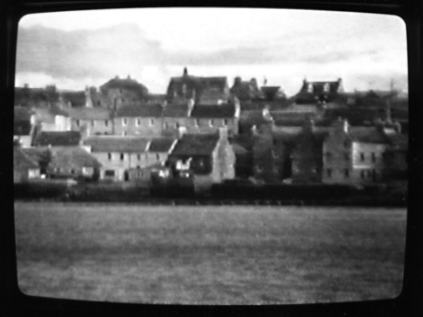
Figure I. South Ronaldsay’s Harbour, as shown on BBC news.49
In almost all reporting the island was depicted in utopian terms, the perfect place to raise a child. The language used upheld the romanticist association between childhood innocence and natural virtue. Newsnight describedSouth Ronaldsay as a ‘haven of peace’ and the locals as ‘good working people’.50 Most had not grown up in Orkney but had moved there in pursuit of ‘the simple life’, according to Channel 4 News, or to ‘escape the rat race of contemporary urban society’ as Scotland on Sunday put it.51 Indeed the island’s very remoteness and physical distance from the metropolitan sphere, which in prior decades would likely have been used to cast it as uncivilised, was instead a mark of its purity from urban corruption, allowing its inhabitants ‘a quieter, more fulfilling existence’.52 Amongst many others, the Sunday Tribune made the point the people were ‘uniformly English, articulate, and middle class’ and had chosen Orkney specifically because ‘It was regarded as a “place of safety” to bring up their children’ – this phrase used with deliberate irony as a ‘place of safety’ order was the name of the ruling used to take the children off the island.53 Making pains to connect South Ronaldsay’s ruralness and its middle-classness pre-empted any reader preconceptions surrounding rural backwardness, but it was also revealing of a prevailing presumption which connected middle and upper-class children to nature and purity in a way that working-class children were not.
As well as conducting many interviews with individual islanders, the media also worked to broadcast group SRPAC petitions and demonstrations, in which ‘the island’ and its people became synonymous. Very little reporting acknowledged any differences in opinion on South Ronaldsay, creating the impression of a homogenous group of people. The Mail on Sunday wrote of ‘Fears of an outraged island’, The Daily Mail of ‘Village fury’, and Scotland on Sunday went for ‘Orkney Reels’ as a headline.54 In these articles, terms like ‘parents’, ‘islanders’, ‘village’, and ‘the island’ were used with little distinction between them to refer to the people of South Ronaldsay, evidencing and propagating the idea that people and place were one and the same. This is a common way to talk about communities generally, but within this construction, no islander could not fit the vaguely held perception that South Ronaldsay’s landscape had the ability to purify its inhabitants. The 1983 film ‘Local Hero’, which follows an uncaring American oil executive redeemed by a ‘dreamlike’ Scottish coastal village, is an example of this idea expressed in the popular culture of the period.55 Unlike South Ronaldsay’s residents however, the social workers were incomers who had not stayed long enough to breathe the cleansing air. Some descriptions of the ‘dawn raids’ implied the social workers had introduced a kind of evil to this contemporary Eden. The Daily Record showed a picture of parents looking over the Orkney landscape with the caption ‘Paradise Lost’.56 The Daily Telegraph also used the term ‘paradise lost’, and described the morning of the raid in gothic fashion:
It is a story that can only be thought of in monochrome. There are houses of grey granite and a swirling Orcadian mist.57
Weather was a key component of how the island’s environment came to be integral to the story, partly due to its metaphorical value. Shortly after the event The Times described ‘islands under a cloud’, again demonstrating the monolithic depiction of the Orcadians, but also the pseudo-biblical manner in which weather was often used to synthesise this satanic story.
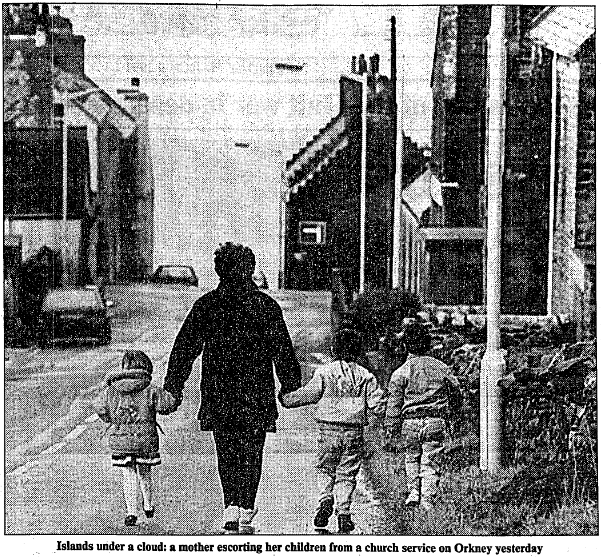
Figure II. Captioned Photo of St. Margaret’s Hope in The Times, 4 March 1991.58
On the children’s April return to the island The Daily Mirror picked up a similar theme with ‘Storm as sex abuse kids fly home’.59 ITV news, on the other hand, reported that ‘After days of rain, the island was bathed in sunshine today, a fitting welcome back for the children’.60 Despite two opposing weather-metaphors being used, in both cases South Ronaldsay’s environment was utilised to vindicate the inhabitants – as if the landscape itself knew of how it had been wronged by the social workers. The Express described the ‘brilliant sunshine etching the hills and fields in spring gold’ and explicitly linked this to the island’s status as a secure playground for youngsters: ‘It looked like the perfect safe haven for children to play…’.61 The Scotsman used ‘Sunshine after the storm’ , and Scotland on Sunday went with ‘From magic summer to winter nightmare’.62 In the same article a photo of the quarry where the abuse was alleged to have taken place was captioned poetically as ‘In that long, now lost summer, the place where the water warmed up and brought youngsters from miles around’.63 The island environment did not have to be employed this way, as one anomalous Evening News article from before the children’s return proved. In it, the paper represented the island as a cold, shadowy, and divided place. South Ronaldsay was ‘a place so wild it appears to have been abandoned totally by both God and man’ and described the same quarry from the Scotland on Sunday article as ‘remote… shrouded in mist [and] partially filled with muddy water’.64
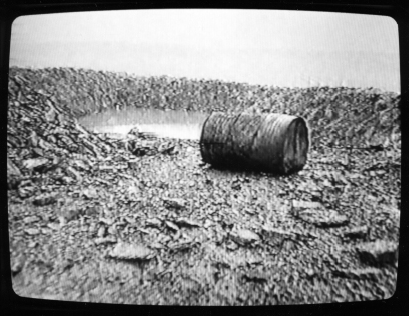
Figure III. The quarry, as shown on BBC news.65
Similarly, The Evening News’ negative portrayal of the rural focussed on the concept of ‘wilderness’, a dangerous environment in which children hurt themselves and are roughened by. Conversely, the numerous positive portrayals depicted a tamer, more genteel landscape that better fit the image of a middle-class idyll. For much of the press, it was the cities the children were taken away to that took on the role of ‘wilderness’. The corrupting ‘urban jungle’.An interview with one of the returned children was highlighted in the Daily Record and many other newspapers wherein a boy ‘spoke of learning to steal cars, roll a cannabis joint and glue sniffing’ after being taken off the island – a clear demonstration of a loss of childhood innocence and corruption by the urban sphere.66
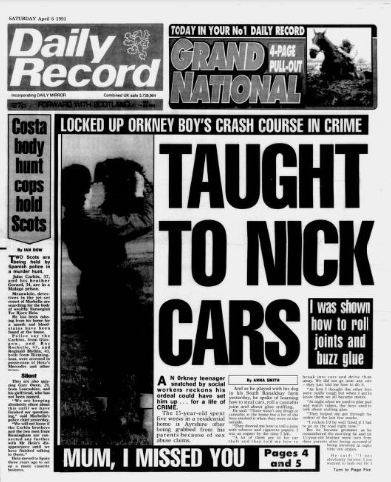
Figure IV. Front page of the Daily Record, 6 April 1991.67
The Daily Mirror ran the headline ‘They left here unharmed, they’re coming home abused’.68 One mother described how her daughter had been bullied and withdrawn when they lived on the mainland but had ‘made very good progress’ since moving to Orkney – which she feared would now be ‘set back badly’ after the ordeal.69 The whole saga was understandably traumatic for the families, and it was used by tabloid and TV news to promote a general narrative about the benefits of country over city life for children. In reading the Daily Record article more closely, it is made clear that the car-stealing, cannabis-smoking, glue-sniffing boy only ever talked about these things with other kids, though the headlines implied he witnessed and took part in them.70 However, while the prevailing impression given was that something so abhorrent as child abuse simply could not happen in idyllic Orkney, almost no papers mentioned that five years earlier a father on South Ronaldsay had been imprisoned for abusing eight children, and that none of the locals had suspected anything at the time.71 Furthermore, it was accusations made by the abused children during that legitimate case that led to the 1991 dawn raid.
The Independent did mention this in one article and quoted a local as saying ‘We’d never have thought. He must have been a Jekyll and Hyde character. Nobody could believe it when he was taken away’.72 This, The Independent noted, brought under suspicion the claims from locals and the press that they would somehow instinctively know if something like that was going on. It was symptomatic of the common assumption that an abuser had a particular ‘look’ or ‘manner’, and furthermore – I argue – lived in a particular environment. Additionally, what was not reported on was the fact the dismissal of the social workers’ case was overturned not because it had no substance but because it was deemed ‘impossible’ for the sheriff ‘to bring a fair and balanced judgement to the issues’.73 Because the case was then dropped due to being deemed ‘compromised’, the social workers’ evidence was never heard in a court of law or officially dismissed. There was no ritual abuse on South Ronaldsay, but the conviction that there never could be, and the general assumption that the social workers had no evidence because the case was dismissed, was false and partially based on a form of environmental prejudice that favoured an image of South Ronaldsay’s middle-class rustic charm.
The importance of media representations of the environment during a key a signal-crime ‘scandal’ such as Orkney was made apparent during a study over a decade later into the public’s memories of the event. The powerful image of the rural idyll against the urban mire constructed in the media made a lasting impression on the public, more so than any specific details of the scandal, as most people could (unsurprisingly) only remember headlines, broad strokes, and impressions. What they remembered most were particularly powerful or oft-repeated talking points and imagery: the close-knit united community nestled into a beautiful rural landscape suddenly sundered by the ‘dawn raids’, evocatively described by both reporters and in the emotive pleas of parents.74 One of the consequences of newspapers and parents working so closely together on this story was the lasting impact that personal accounts had on the public compared to third-party reporting. For example, very few of the research participants remembered that social services won an appeal against the decision to return the children home, and could have taken them away again if they wanted, but decided not to partly because of the media backlash such a move would have generated. Very few ascribed any blame to the police for the incident, who helped orchestrate and were present at the dawn raids but came under far less media scrutiny. Furthermore, because the parents were absolved in such a high-profile story, the Orkney scandal helped to reinforce the idea of the ‘stranger’ – especially the urban stranger – as the real danger to children. After all, had not the big-city social-workers been the real menace? The pervasive idea that the Orkney islands were ‘not that kind of place’, both at the time and decades after, was propagated by press representation, despite the fact that urban areas were at the ‘forefront’ of child abuse prevention during the period.75 Ultimately, the message scandals such as Orkney sent to families was that the best environments to raise a child were rural, remote, and ‘respectable’.
2.5 Stranger Danger and Boundary Making
Despite public opinion being led to believe otherwise, there were no significant changes in the prevalence of attacks on children from strangers during the 1980s, 1990s, and 2000s.76 As before, during this period less than 1% of all missing children per year were the victims of the ‘stereotypical kidnapping’, as in abduction by a stranger.77 As David Pimentel illustratively put it, ‘It would take your child, left outside, 500,000 years to be abducted by a stranger, and 1.4 million years for a stranger to murder them’.78 By contrast, in 1995 the ESRC found that 96% of newspaper articles about how to protect children focussed on threats from strangers.79 Following a spate of attacks by strangers, The Sun’s ‘WEEP, 3 children murdered in 100 hrs as Britain sinks to a new low’ (14 August 1991) ignored the fact that a child was being killed by their parents every two or three days in Britain, and this statistic had been unchanged for many years.80 Similarly, a 2002 study for the Journal of Interpersonal Violence found that TV news reports covering child sexual abuse perpetrated by persons known to the child led only 31% of viewers to assign ‘moral responsibility’ to the abuser because they perpetuated stereotypes about the victim ‘leading them on’.81 Home abuse, despite being significantly more prevalent than abuse from strangers, was disregarded because it was not proportionally represented in the news and victims were more likely to be considered morally suspect. Indeed, the message of ‘stranger danger’ relied on the idea of the safe home environment to act as its foil. If stranger meant danger, then familiar meant safety. In this fashion, all public space (particularly urban space) was characterised as dangerous and as such the importance of having boundaries between public (outdoor) and private (indoor) space became a critical issue.
A representative for the Kidscape charity said in an interview in 1995 that stories of home abuse were rarely printed because ‘it’s not a fun subject, it’s likely to put readers off… and it’s easier and safer to concentrate on strangers and bullying’.82 The message that an abuser ‘could be anyone’ had reached people to some extent but, as interviews undertaken on this subject in the mid-1990s highlighted, most people – while salient of this fact – were not prepared to believe allegations made against anyone they knew. This assumption was ‘often accompanied by a sense that, if they did meet an abuser, they would instinctively know’, showing how the idea that an abuser would be identifiably different from a ‘normal person’ was pervasive.83 As an extension of this, people also found it hard to believe that an abuser would be living in their community, even if that community was the sort of working-class urban estate usually characterised as the places most at risk of such attacks.84 This exemplifies the fact that ‘the stranger’ existed predominantly as a conceptual category. The danger was real enough for people to limit their children’s mobility and freedoms in response to it, but the threat was always thought about as something unknowable and outside the bounds of familial control. The vagueness of the concept affected children too. A survey carried out by Kidscape in 1984 found that 90% of children could not identify or define who might be a ‘stranger’, despite knowing that they were dangerous.85
Media representations of stranger-danger were reinforced and reiterated through everyday conversation, particularly because events involving strangers, such as a strange man hanging around outside a school, were collective experiences in public spaces, whereas events involving known persons were hidden from view inside. It was also common for police officers to go into schools to show videos about stranger danger and give out warning slogans such as ‘keep away from people you don’t know’ and ‘you don’t want to end up dead or in hospital, say ‘No’ to strangers!’, encouraging children and parents to talk over the idea.86 When particularly shocking cases of abuse from friends or relatives did make headlines, the perpetrators, dehumanised into ‘monsters’, were represented as if they had been Jekyll and Hyde split-personality types, as if to some extent they had secretly been an ‘outsider’ all along. In this fashion, high-profile cases of abuse perpetrated by known persons were wrapped up into the media’s broader obsession with ‘the stranger’. More to the point, at-home abuse was simply less likely to be reported in the media – or at all – because the issue was not discussed with children or adults, making an already very difficult topic to discuss ever harder for kids who may be manipulated, confused, or ashamed by what was happening at home.
Depending on the size and strength of a community’s social cohesion, the inside/outside dynamic could also play out at a neighbourhood level as opposed to just a household level. As seen with Orkney, close-knit communities found it hard to believe that one of their own (an insider) could be an abuser.87 Accepting such a fact meant admitting that an environment they previously conceived of as safe could, in fact, be corrupted from the inside as well as outside forces. However, the key difference between (most) neighbourhoods and homes is that a neighbourhood’s boundaries are social whereas the walls of the home are physical, meaning outside dangers can more easily cross the community threshold. It is unsurprising then that the visual language used to describe strangers very often positioned them as being on the other side of a boundary like a fence or window, just outside, and therefore placed extreme importance on such boundaries. As Markus noted, the very purpose of a building or built environment is to serve certain people and exclude others. In this way, ‘social structures are made tangible in the spaces and buildings that groups use’.88
For example, the establishing shot of the PIF Say no to Strangers (1985), shown in schools and on TV, framed its stranger through the links of a school fence.89 The effect of this representation was to promote an insider/outsider mentality and by extension place a great deal of importance on the fence itself as a barrier to threats beyond it, as well as encouraging parents to ‘always know where they are any time of the day’ as a contemporary PIF put it.90 Higher walls, fences, and hedges around private gardens was indeed an increasing trend during this period and new housing developments were also built to more insular design standards, with smaller windows in the front, windowless garages, and smaller front porch areas – in contrast to the growing popularity of fully windowed architecture in commercial and professional environments.91 This was also evidence of the increasing premium being placed on private spaces as the ‘proper’ place for children to be raised, which meant that those families with the least private space were seen as negligent for letting their kids roam the public realm.92 Ironically, the increase in the quantity, height, and opacity of barriers ultimately reduced the amount of ‘eyes on the street’ able to keep a passive watch on kids at play, as had been common on working-class streets in the first half of the 20th century, reducing child safety.93
Say no to Strangers also depicted its stranger in a car, a trope in media representation that was fairly accurate as cars were a common tool for kidnappers who wanted to get in and out of an area quickly. To a certain extent this was another symptom of the dangers cars and car infrastructure posed to children who increasingly needed to wait for a lift to get anywhere. Furthermore, it demonstrated how the completely enclosed environment of the car represented a unique danger as it allowed anybody to bring a small piece of dangerous ‘outside’ space into the inside of a community and tempt a child across that threshold. As was shown in many theatrical films and PIFs of the period, once inside a moving car with the doors locked, it was not feasible for the child to leave. In this way, the car’s boundaries could be made permeable or solid at the will of the stranger, and that is why it was promoted in the Never go with Strangers PIF that ‘it is best to think about a strange car as danger’.94
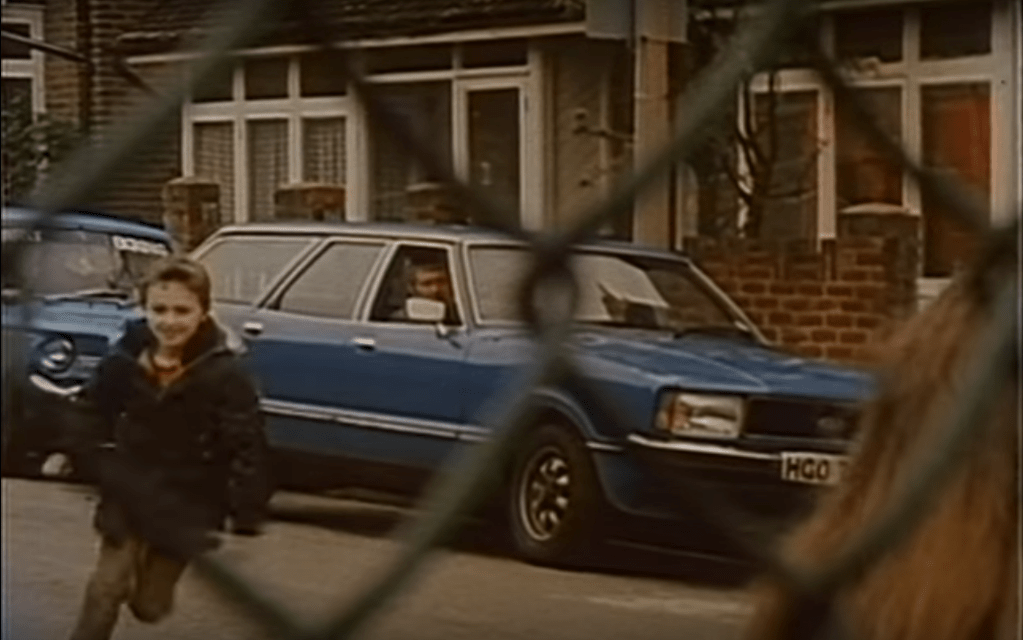
Figure V. A stranger beyond the school fence, as shown on the ‘Say no to Strangers’ PIF.95
In the second half of the 1990s a slightly modified version of the traditional threat rose to media prominence and created a more specific and intense moral panic: the paedophile. In essence the threat of the paedophile was no different from the more general ‘stranger’ threat before it, but it chimed with the particular focus placed on child sexual abuse during this period in both expert and public discourse. A number of serial child sex murderers made famous in the 1960s and 1970s were due to be released from prison in the 1990s. Myra Hindley, in particular, who the press had made into ‘the face’ of these crimes, was in and out of the papers during the 1990s and 2000s due to a long twisting string of events including parole hearings and appeals. This reached one moment of culmination in 1990 when, close to her release date, the home secretary David Waddington increased Hindley’s sentence amidst a flurry of fearful tabloid reporting.96 Also in 1990, Robert Black, the serial rapist and murderer and Britain’s most wanted man, was finally caught and put on trial after a decade on the run; the extensive reporting further raising the profile of this type of threat.97 The murder of James Bulger in 1993 also shook the nation, particularly because his abduction was caught on security camera, allowing parents to visualise the threat. The Newcastle Journal reported that it was this event which had prompted one man from Whitley Bay ‘to invent the revolutionary new child safety strap’ (a lead for your child).98
With danger repeatedly in the news, parents were understandably increasingly fearful of public outdoor spaces because they were portrayed as fundamentally unsafe, especially for their daughters. Indeed, a 1993 survey found that ‘British parents fear the abduction of their children over any other danger’.99 Of course, this understanding failed to recognise the higher likelihood of attack from known persons, which also most threatened girls. From the 1970s onwards UK street crime had in fact been falling as a proportion of the population whilst a 1985 NSPCC report found that abuse of children at home had increased by 70% between 1979 and 1984.100
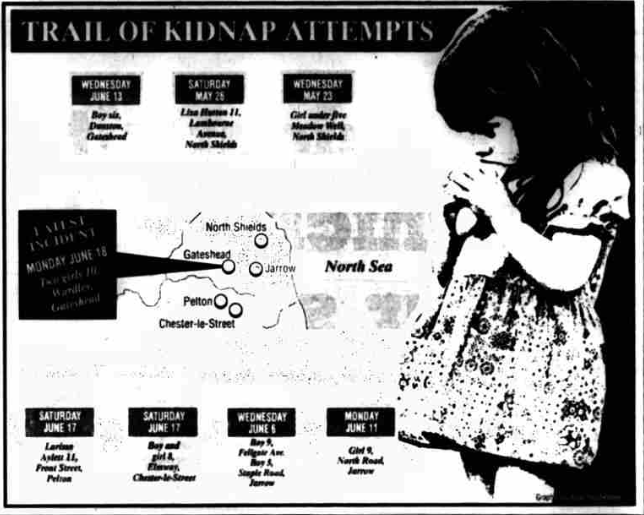
Figure VI. The Evening Chronicle reporting day-by-day kidnap attempts, not clarifying if these were from strangers or from estranged parents, as was most common.101
Nevertheless in 1996, in an attempt to assuage public fear over paedophiles, the home secretary Michael Howard introduced legislation to create a register of sex offenders and monitor them after release, generating headlines like The Times’ ‘Paedophile lists for police’, highlighting how child sex offenders were seen to be the primary target of the law, even though the list was for all sex offenders.102 However, the creation of the register prompted many questions about how the list would be managed and who would have access to it. Community organisations usually based on council estates such as ‘Freedom for Children’, ‘People’s Power’, ‘Parents Opposed to Paedophiles’, and ‘The Unofficial Child Protection Unit’ began to demand public access to the register and that they be notified when dangerous individuals moved into their neighbourhood.103 In the US, legislation known as Megan’s Law introduced in 1996 did just that.104 In this way the creation of the register increased awareness and fears over the paedophile threat, as parents knew that there was a list which could confirm or deny if a former sex-offender lived in their area but that they could not access it.
The strong correlation between anti-paedophile campaigns and council estates is evidence of the fact that the paedophile threat was understood to be an issue particular to a certain type of community. For practical reasons councils tended to place released prisoners in hostels and housing in working-class areas, often on council estates, where it was cheapest. Furthermore, the growing body of negative press about social workers – a more common sight in working-class neighbourhoods – fuelled distrust in authorities to monitor or investigate properly should a crime occur. Especially within these communities therefore, agitation grew into letter-writing campaigns and petitions set up by newspapers, and then further into demonstrations, civil disobedience, and even attacks on suspected paedophiles. In several instances the police even had to be brought in to protect released sex offenders from the public, and in some cases as with Francis Duffy in 1997, a person was wrongfully attacked after being mistaken for a paedophile identified in the paper.105 Already more likely to lack access to safe outdoor spaces for play and natural environments, working-class families were now also especially exposed to the perceived dangers of paedophiles in their communities. The very name of a group like ‘Freedom for Children’ alluded to the much broader mission the group saw itself as undertaking to restore lost childhood environments in which their children could safely play. Similarly, ‘The Unofficial Child Protection Unit’ name underlined the lack of faith in ‘official’ child protection organisations.
The phenomenon of parent-activism had already been seeing a noticeable uptick since the 1960s – following in the post-war tradition of the self-help group – but in the 1970s the nature of these groups began to change into something more political and campaign-oriented. Crane argues that groups post-1945 were often focussed on mutual support and aid of their members, whilst also making ‘representations to Parliament looking to add complexity to visions of “normal family life”’. In the following decades under Conservative governments however, these groups challenged ‘individualist models of responsibility for child protection’ and campaigned directly for more state resources for childcare. As outlined in the previous chapter, Thatcher’s distrust of the public sector resulted in an explosion of new smaller organisations that operated with great freedom in between the bureaucratic cracks, such as Kidscape, Childline, and Children in Need. These new groups were assisted by the media which offered a public forum to discuss children’s experiences and emotions, albeit around a news-cycle built on cases of terrible child abuse. By the time of the paedophile moral panic in the 1990s and 2000s, a number of groups had embraced an ethos of vigilantism, bolstered by media praise and enabled by reporting of suspected paedophiles’ descriptions and addresses. On the other side of things, Parents Against Injustice (PAIN) was a group set up to make it harder for accusations of child abuse directed at parents and other known-persons to result in legal action. This was because, they said, an ‘anxious climate’ had emerged where false accusations were common.106
Co-operation between the press and community organisations was thus key to the rise of the paedophile threat in the late 1990s and 2000s. Newspapers almost always sided with parents when protests or even violent attacks occurred; headlines in the national press included: ‘Parents in dark as paedophiles stalk schools’, ‘Paedophile out of prison “fearful for life and limb”’, ‘Mothers drive sex criminal off estate’, ‘Stop hiding perverts say protest mums’, and ‘Town not told of paedophile’s stay’.107 Such reports were also often accompanied by photographs of local people marching with banners declaring ‘Perverts out’ or children carrying placards reading ‘Make Me Safe’.108 In this way both the imagery of the child and children themselves were being used to advocate for the cultural and legal changes during this period that resulted in their lives becoming increasingly restricted. A self-perpetuating cycle was created between public protests against paedophiles living in their area and tabloid press fuelling and being fuelled by them, which together gave the impression that working-class estates were the only places at risk.
In 1997 the Manchester Evening News published a front-page spread about a local sex offender alongside a photograph of him in his car behind a smashed windscreen after ‘a vigilante mob had vented their anger’.109 Many newspapers took this more proactive role as guardians of public safety over merely reporting local unrest. When Robert Oliver, who had murdered a boy in 1985, was released from prison in 1997 he was pursued by journalists. The Sun asked its readers to phone an emergency number if they spotted him and, when he moved to Brighton the local paper, the Evening Argus, published his picture on their front page with the headline ‘Beware this evil Pervert’.110 In other cases, journalists alerted people to the presence of paedophiles, either through knocking on the doors of neighbours and asking how they felt about living near a sex offender or through outing them on the front page. The Sunday Express printed photographs and details of offenders with their last known address under the headline ‘Could these evil men be living next door to you?’ and the Daily Record produced a similar campaign, devoting the bulk of one issue to asserting a ‘Charter for our Children’ and demanding the ‘legal right for communities to be told when a pervert moves into the area’.111 By promoting suspicion, these reports sundered the social boundaries of community, leaving only physical boundaries as the ‘last line of defence’ against sexual predators. This of course ignored the more prevalent danger of abuse from known persons. Particularly revealing is the 1985 Guardian article ‘The Video Nasty that Children Ought to See’ which reviews an education film titled Kids Can Say No!.112 The film was presented by Rolf Harris, who, it was later uncovered, was actively sexually abusing children at the time of the recording of this film. In the film Harris advises that ‘some people don’t act right with kids and they need help… It’s better to say something so that you and the family can get the help you need’. This statement presupposes that ‘the family’ will not be the source of danger. More to the point, Harris’ position as a popular known person helped to protect him from the consequences of his abuses for decades, the reality being that abuse from familiar persons was still a taboo subject being overshadowed by the inflated spectre of stranger-danger.113
The British media’s reporting – and that of the tabloid press in particular – clearly contributed to an exaggerated atmosphere of fear and unrest across the country, however this did not mean the entire moral panic was vacuous. What it did mean was the more prevalent, systemic, personal dangers to children went underreported and as such unacknowledged by the public. Because of this, parents across the country were being given an inaccurate picture of where danger lay, and as such promoted an isolationist approach to the physical and social makeup of homes, schools, and communities via the use of high, opaque walls, fences, hedges, private indoor spaces, curfews, and other restrictions on children’s independent mobility. By privatising childhood environments in this way, whilst also placing ‘the outdoors’ on a pedestal, morally acceptable childhoods became restricted to those families who had large gardens and the time, money, and means to take their kids to sports activities and National Trust landmarks. In this environment, technologies like TVs, games consoles, and computers came to be integral to childhood experience across the three decades of this study.
2.6 Video Nasties
Due to their vulnerable position in society and reliance on adults, children can prove a perfect vessel for moral panic. This is also true because children as historical agents throughout the 20th century acted as creators of new attitudes, subcultures, and trends that challenged or subverted those of their elders.114 As such, moral panics in Britain during this period were not always on behalf of children, but about them as well. Unfamiliar and often deliberately insular from adult society, the customs of the young came to be targets of suspicion. The idea of the ‘hoody’ is an example from the 1990s and 2000s where the clothing preferences, drinking habits, and other social choices of teenagers were used in the press to present a negative stereotype of children as menaces to society.115 As discussed in Chapter One, because such terms were commonly used to describe both adults and children (anyone from 15 to 30 years old), their use was symptomatic of a belief that criminal or antisocial behaviour disqualified children from being children; that they were ‘adult in everything except years’, as Michael Howard said about young offenders in 1993.116
Similarly, the media frenzy surrounding the dangers of the ‘video nasty’ of the late 1980s and 1990s was exemplary of an attitude that cast an element of youth culture as dangerous, to both themselves and others. Further complicating this was the scare’s entanglement with more general fears over new technology and the increasing influence of technological environments in children’s lives. In many ways this scare was a successor to the comic book moral panics of the 1950s and a progenitor of the video game panics of the 2000s, highlighting the constant connection and suspicion placed on children and their tendency towards early adoption of new forms of media.117
Historical discourse on video nasties as a moral panic has been focussed on the relationship between media, government, and public, and has sought to debate how the scandal came to materialise and its social and cultural impacts. Julian Petley has argued that the scandal was a case study in how the concept of ‘public opinion’ can be invoked by government and media as a tool with which to shape public opinion.118 Kate Egan’s work discusses the manner by which video nasty censorship was not simply a product of law, but of a relationship between regulative, cultural, and economic factors that together were primed and utilised by campaigners to influence public opinion.119 Utilising their work, and that of historians of contemporaneous scandals such as David Miller, I focus on the video nasty panic in order to examine how public discourse came to represent the home and digital environments, and consequently its impact on children’s lives. I argue that tabloid media reporting on video nasties was an early example of what would become a ubiquitous trend during this period: the blaming of the decline in childhood health and mobility on new technologies, and indeed children themselves as willing denizens of these new digital environments. As part of this narrative, the indoor environment of the home, previously cast as a safe space for children, came to be constructed as dangerous due to devices like the TV and video player corrupting it. An important distinction here is that the danger posed was of a different variety to that by strangers, as it was primarily a danger to health rather than safety. Furthermore, the media differentiated the dangers of the technologized home from the stranger-stalked urban street by arguing that, with technology, children became active participants in their own destruction. This narrative left many children, in particular those with worse access to outdoor environments that were regarded as ‘safe’ such as a garden, in a catch-22 situation where almost any environment they could exist in was thought of by adults as either unsafe, improper, or unhealthy.
In 1984 the Thatcher government introduced the Video Recordings Act to classify every film released on video with an age rating. This act was unique in Europe (aside from Ireland) in that its classifications carried legal force and therefore made it a criminal offence to distribute videos to certain people – children being the primary target – with around 3,200 fines issued between 1984 and 2005.120 Why was it, then, that the British system was so uniquely punitive? The answer was a creature known as the ‘video nasty’, around which a significant furore arose in the 1980s and 1990s. Video nasties were home videos that were deemed too inappropriate for even adults to watch and were thus censored in Britain, though the justification for this censorship was primarily based around protecting young people. Public campaigners such as the conservative activist Mary Whitehouse and politicians of all parties helped to create the idea of the video nasty, but it was the national press, often invoking ‘public opinion’ that amplified the message and created a signification spiral in which the threat posed by video nasties was constantly escalated.121 The result was an increasingly strident campaign for firm legislative measures to be taken.
Home video took off in Britain after 1979, and at first the industry was dominated by a plethora of small independent film makers. UK video rights could be bought for as little as £1000, and as such the video shelves were stocked with (what was considered at the time as) ultra-violent films and soft-core pornography, usually housed in garish, lurid covers. Indeed, cover art was often analysed more in the press than the actual content of the films, as they were easy symbols to proselytise over, and many film distributers deliberately made violent or sexual covers because they knew the attention they would generate.122 This was a radical departure from what British audiences (and regulators) were used to, as this kind of material had mostly been withheld from view in mainstream cinemas, and at this time the home-video scene was unregulated. The prospect of uncensored home video thus rapidly emerged as a ‘threat to societal values and interests’.123 The first complaints were made to the Advertising Standards Authority (ASA) in 1981 but it was when the first national press story about the dangers of domestic video was published in The Mail in 1982 that a real campaign began to emerge. The Mail’s article read:
More and more children… are catching on to the fact that their parents’ machine can give them the opportunity to watch the worst excesses of cinema sex and violence.124
This article also introduced what would be a common theme of this media campaign: a figurehead person as stand-in for public opinion. In this case it was Richard Neighbour, a teacher, who worried that ‘video gives the children access to something that the parents may not be able to control’.125
The Sunday Times followed on the 23 May with the headline How High Street Horror is Invading the Home, and this was the first time that the term ‘video nasties’ was used in the national press.126 The article warned that:
Uncensored horror video cassettes, available to anybody of any age, have arrived in Britain’s High Streets.127
Specific titles singled out by The Sunday Times included The Driller Killer, SS Experiment Camp, Cannibal Holocaust, I Spit on Your Grave, and Snuff. As I will show, the totality of newspaper coverage of the supposed dangers of these films came to represent the modern technologically infused home environment as a corrupting influence on young people, and thus problematised the very environment that was simultaneously being promoted as the only safe place left for children. The Sunday Times reported extensively on the video nasty saga, and repeatedly drew attention to itself as a leading actor in the events it described, exemplifying the fact that the parliamentary questions and police actions taken from 1982 onwards were partly a response to journalistic efforts. The Texas Chainsaw Massacre featured for the first time in an article for The Express on the 28 May headlined This Poison Being Peddled as Home ‘Entertainment’.128 Richard Neighbour was quoted again, alongside Lord Chief Justice Lane, warning about the ‘positive incentives to commit crime’ offered by scenes of violence ‘depicted on various screens of all sizes’.129 The Express also suggested that video shops should, like sex shops, be licensed by local councils. The Daily Mail was similarly campaigning:
The video boom has meant that thousands of out-of-work, unstable teenagers are currently gorging themselves day-in-day-out on scenes of torture and depravity. We need censorship at the moment as we have never needed it before. And if video censorship of the most stringent kind isn’t brought in pretty damned quick we’re going to have an upsurge in violence and terror and abuse in our land and homes the like of which we never suspected in our wildest terror.130
The reference to the ‘out-of-work’ in this quote again points to the class dimension at play here, suggesting a particular type of young person as being at risk of video corruption. The later call to protect ‘our land and homes’ clearly identifies the environments at risk, and the fact that these out-of-work children are part of an ‘other’.
Around the time of The Express article the news broke that the Metropolitan Police Obscene Publications Squad has seized a copy of SS Experiment Camp and had sent a report to the Director of Public Prosecutions (DPP) with a view to his bringing a possible test case against the video under the 1959 Obscene Publications Act (OPA). In another Sunday Times article on 30 May, Detective Chief Superintendent Kruger was quoted saying that ‘horror videos are a new concept, and I think we’re going to get involved in them more and more’.131 The following week the newspaper revealed that The Driller Killer and I Spit on Your Grave had also been referred to the DPP and it was from this point onwards that politicians began to get involved with this moral issue, raising a number of questions about videos in both the Commons and the Lords.132 Of particular note is Mary Whitehouse, the president of the National Viewers’ and Listeners’ Association (NVLA), who is credited with coining the term ‘video nasties’.133 The NVLA was established in in 1965 by Whitehouse as a pressure group that campaigned to ‘clean up TV’ for ‘taste and decency issues’, but it was under the Thatcher governments she had most success. Whitehouse personally phoned and wrote to Thatcher, forwarded on messages from concerned teachers and parents, and met privately with her in September 1983 after which Thatcher’s private secretary wrote in a letter that she:
…agrees with Mrs Whitehouse that piecemeal legislation on obscenity is unsatisfactory and that the Government ought to be bringing forward proposals for a general reform of the Obscene Publications Acts, which she believes to be ineffective.134
With her message boosted in the media, politicians began to heed her warnings to the extent that she was able to give MPs a private screening of edited highlights from these films in the House of Commons in late 1983, including extracts from her most-hated film, The Evil Dead.135
Whitehouse found this prominence in concert with the national press, particularly The Mail, in which her voice went uncontested in calling for stricter crackdowns. Even after the DPP did begin to prosecute these films as early as August 1982 Whitehouse was publicly calling in The Mail for their resignation due to the punishments being too lenient.136 Even so, since it had now been established that violent videos could be classified as obscene under the OPA, police forces around Britain soon began raiding video distributors and seizing thousands of tapes which they claimed breached the law. The Mail continued to cheer the police on and press for further censorship by running stories that claimed a link between violent films and violent acts. In A Video Nasty Killer the paper called a video nasty the ‘trigger that finally turned a young psychopath into a killer’.137 In Hooking of the Video Junkies, The Mail equated video watching to drug use, saying that ‘more and more children are becoming videoholics’ and that their ‘impressionable minds’ could be convinced to ‘recreate murders or rape’.138 The Daily Express furthered this impression, calling horror videos a ‘new cult… sweeping the country’ and argued the films fuelled ‘sexual psychopathic fantasies’.139 The early 1980s was a period that saw a general rise in violent crime in Britain, and against the backdrop of these newspaper articles, it is perhaps unsurprising – as Dickinson says – that many politicians began to ponder if ‘perhaps there was something in the fact that the 1978-1982 period had seen a rise in both violent crime and video player ownership’.140 However, as Grieveson noted, the idea of the highly-impressionable innocent child had been used as a justification for film censorship since the debut of cinema, so what made this moral panic significant was that it was about films that could be watched in the private space of the home.141
The media played such a crucial role in helping to shape people’s perceptions of the video nasty because most people, including by her own admission Mary Whitehouse herself, had never actually seen one. Cohen argues that nebulous threats like ‘absent fathers, feckless mothers… TV violence and video nasties’ were able to be made into a ‘potent symbol for everything that had gone wrong in Britain’ via a whole series of processed images and coded representations.142 Panic-inducing media reporting has the power to make ‘people become indignant or angry, formulate theories and plans, make speeches, write letters to the newspapers…’.143 The threekey ingredients in this process, Cohen argues, are exaggeration, prediction, and symbolisation. Exaggeration is typified by sensational headlines, melodramatic vocabulary, and the deliberate heightening of those elements of the story considered as news – such as with The Mail’s Secret Video Show article warning of children watching ‘the worst excesses of cinema sex and violence’.144 Prediction involves a dire warning that the events in question will get worse if nothing is done, such as with Tory MP Peter Lloyd quoted in The Sunday Times saying that ‘these video sales and rentals will be the problem of next year and the year after’.145 The final ingredient is symbolisation, which is where certain words or terms come to acquire wholly negative meanings and connotations, as in the phrase ‘video nasty’, and the focus of newspapers on the covers rather than the contents of the films.146 The image of the child ‘glued’ to the TV screen came to symbolise a corruption brought into the usually safe environment of the home. As a Loughborough university report in 1993 said, ‘today’s youth culture of discos, computers and video games’ was to blame for dramatic falls in levels of physical activity in children and the birth of the ‘couch potato generation’.147 In this way a parallel culture of suspicion arose in indoor as well as outdoor environments, the difference being the threat was an internal corruption of children rather than an external attack.
Concerns in the papers began to filter into the political space as they both invoked and incited public opinion on this issue. On 15 December 1982, Gareth Wardell, Labour MP for Gower introduced a bill which would have made it an offence to rent or sell adult videos to children and young people, describing the video recorder as ‘a potential weapon that may be used to attack the emotions of our children and young persons’ and the videos as ‘a slur on British life’.148 The bill failed to win government support however, as Thatcher’s governments were always reluctant to regulate the private sphere despite their desire to return to ‘Victorian values’.149 It was the government’s lack of support for Wardell’s bill which set off what would become the next stage of The Mail’s ‘Ban the Sadist Videos’ campaign, with a February 1983 headlined We Must Protect Our Children Now.150 Other headlines in the series included Rape of Our Children’s Minds and Sadism for Six Year Olds.151 The pressure from the press was so effusive that by April 1983 Norman Abbott of the British Board of Film Classification (BBFC) wrote for the trade magazine Broadcast that he didn’t think the voluntary classification scheme he was setting up was going to be given a ‘fair chance’, and indeed the scheme was denounced by Mary Whitehouse as ‘unworkable’ as soon as it was announced.152
After winning the 1983 general election, Thatcher spoke again on the matter, saying that ‘it is not enough to have voluntary regulation. We must bring in a ban to regulate the matter’ and indeed it soon became apparent that a draft bill had already been completed. Stories in the papers continued apace leading up to the bill’s first and second readings in the Commons, particularly about crimes committed under the supposed influence of a video nasty. One now notorious article in The Mirror titled Pony Maniac Strikes Again quoted a police spokesman as saying that the perpetrator of a series of sexual attacks on ponies ‘could have been affected by video nasties or a new moon’.153 The same year Conservative MP Graham Bright claimed in a TV interview that ‘research is taking place and it will show that these films not only affect young people but I believe they affect dogs as well’.154 A claim that four in ten children had seen a video nasty, based on a 1983 academic report, was often banded around both in parliament and the press despite the fact that one of the researchers on that study had said its lead researcher had ‘selectively interpreted, and in some cases outright fabricated, a good deal of the evidence to support the predetermined conclusion that the videos were responsible for criminal activity’.155
It was not just children who needed protecting, however. After watching a screening of The Texas Chainsaw Massacre, BBFC chief censor James Ferman said that ‘It’s all right for you middle class cineastes to see this film, but what would happen if a factory worker in Manchester happened to see it?’ – suggesting that person would take the film as inspiration for violent acts.156 Lord Chief Justice Lane was also quoted in The Mail as saying ‘it is not merely children who need to be prevented from seeing these frightful publications. There are others upon whom the effects may be even more disastrous… human beings are imitative, and the less strong-minded the more imitative they are’.157 This type of language was reminiscent of the infamous 1960 obscenity trial brought against Lady Chatterley’s Lover, where the chief prosecutor was laughed at for asking if it was ‘a book that you would even wish your wife or your servants to read?’ or ‘working class youths’.158 The Chatterley trial highlighted that social difference was still considered a factor in who could be ‘trusted’ to consume certain pieces of media, and the same was true of the discussion around video nasties, although this time children were also being used as a justification for general censorship.
The video nasty panic erupted and escalated in the media with surprising speed and intensity. Largely this can be attributed to what Hall calls the ‘signification spiral’, wherein an issue is identified and then linked to a much wider fear to the ultimate end of calling for action.159 The video nasty panic was particularly rich in links to other perceived issues, such as the tropes of the anti-social family, absentee father, and feckless mother, and therefore could easily be used as a catalytic issue around which to press more general fears. For example, a Mail story about a ‘video rapist’ quoted the director of the NSPCC saying ‘I had a case where a worker was not able to interview a family until all of them, including children, had finished viewing the rape scene in I Spit on Your Grave’.160 Links to organised crime were also common. The News of the World lambasted the ‘evil sex-kings’ and ‘get-rich-quick gangsters’ of the video trade.161 Meanwhile The Mail’s Rape of Our Children’s Minds editorial asked:
Are we insane? Are we bent on rotting our own society from within? Are we determined to spur to a gallop the forces of decadence that threaten to drag us down?.162
The threat identified as coming from ‘within’ shows that technology was considered a substantively different category of to the ‘outsider’ danger of strangers, social workers, or urban cityscapes. The use of this kind of framing also placed more blame on children themselves, as it suggested they had chosen the TV to become an integral element of ‘youth culture’, and as such the threat from ‘within’ came from inside their minds as well as their homes. This is partly why video nasties were so often linked to real-world acts of violence, as it was thought they had the potential to incite violence. DCI Kruger was prominently featured in the press on this point, stating in The Telegraph that ‘the police are here to prevent violence for violence’s sake, which is precisely what these films glorify’.163
Along similar lines in June 1983, under the headline Fury Over the Video Rapist The Mail reported that ‘Demands for action on video “nasties” mounted last night following the case of a teenage rapist who struck twice after watching pornographic films’.164 However, according to the rest of the article, it was not pornographic but horror videos that he had watched. Furthermore, it omitted the fact that the teen had seven previous offences for theft and burglary, and that he had just been released from a detention centre when he raped the two women. The shakiness of the story, however, did not deter the reporter from warning that ‘the impact that this sick, beastly money-making corruption is having on innocent minds is going to make previous anxieties about violence on television look like worries about the impact of Enid Blyton!’.165 Further links between violent videos and actual violence were drawn by The Times under the headline Rapist ‘Was Addicted to Video Nasties’.166 In the article the perpetrator’s wife is quoted as saying ‘He was loving, kind and considerate until he became addicted to watching an endless string of horrifying video films containing detailed scenes of the most depraved and vicious kind’.167 However the films named in the paper, The Thing and Last House on the Left do not contain ‘multiple sex attacks’ as the paper suggested and, more to the point, the perpetrator had undergone a severe personality change after suffering brain damage in a car crash in 1979, had taken a cocktail of drink and drugs before the rape, and at the time of the offence was on bail – which had been strongly opposed by the police – for two previous assaults.168 In a case such as this, it is clear that the paper selectively reported the facts in order to build a particular case against these at-home videos.
Some critical voices in The Times, Telegraph, Financial Times, and Guardian were apprehensive about Thatcher’s proposed new law, which would give the government censorship rights over a great deal more than simply a few ‘nasties’, most of which had already vanished from the market thanks to police and court actions under the OPA anyway. These were minor interventions, however, against an overwhelming wall of media support for the bill, and as such it passed into law in July 1984. Interestingly, public opinion – whilst being frequently called on in the press as the driver of their campaigns – was not in support of this bill. Firstly, there is very little evidence of any gathering of data about public opinion at all, and what little there is does not support the idea that the ‘nasty’ panic was widespread. A What Video survey in 1982 concluded that for 60% of those who rented or bought videos, horror/science fiction was their favourite category. A MORI poll in October 1983 revealed that 92% of those polled had never been offended by the contents of a pre-recorded video cassette, and another in March 1984 showed that 65% of those interviewed were opposed to the government deciding which videos were available for home viewing. As Miller wrote of the moral panic concept in general:
It is never very clear who is doing the panicking. Is it the media, the government, the public, or who? One reason for this lack of clarity is that distinctions between the media and the state, between the media and public belief, and between the state and other social institutions and groups are dissolved.169
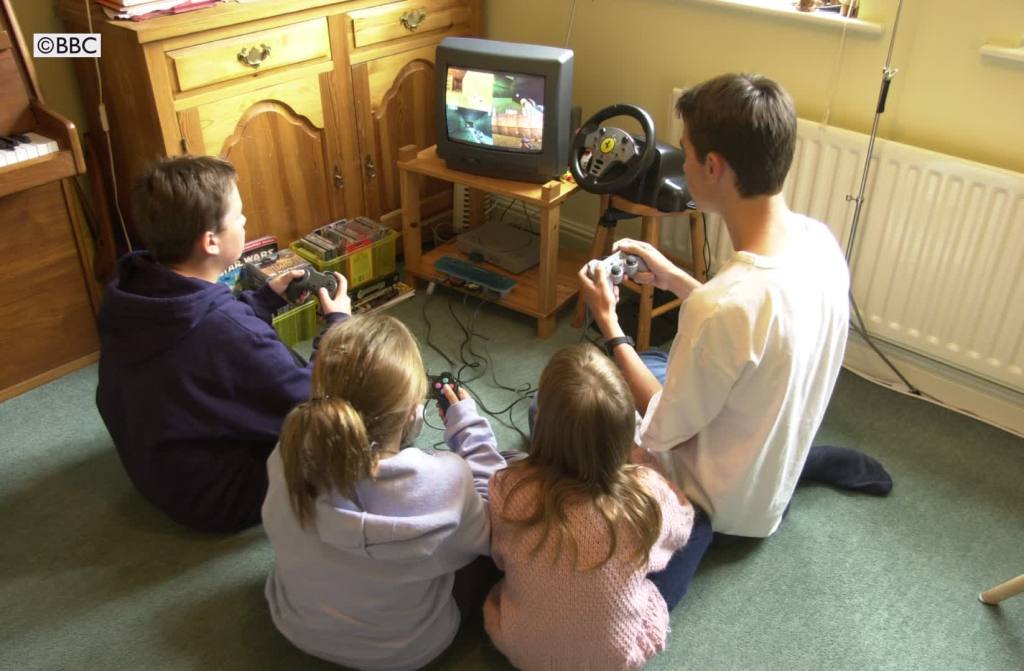
Figure VII. Children gathered round a PlayStation, as seen on BBC News, 1999.170
The link drawn in the press between video nasties (and digital technologies more broadly) and the correlating decline in children’s physical health was very clear, even though the headlines about declining play were usually based on academic work that would tend to acknowledge that technology was only part of the narrative.171 This disconnect between truth and popular perception meant the computer and TV were often talked about publicly as the problem to the exclusion of other factors. It was certainly the case, as a 2006 report for the NSPCC found, that restricting children to the indoors and digital environments was contributing to rising levels of obesity, diabetes, depression and other health problems, but in majority this was due to children no longer being allowed outside because of the perceived dangers of strangers and cars.172 In truth children with a lack of access to new technologies found themselves on the wrong side of a ‘digital divide’ which exacerbated pre-existing social divergences as highly social children more readily adopted digital devices as a means for deepening and expanding relations whereas less social children showed the opposite pattern.173 Furthermore, the ‘billion-dollar industries’ in technology surrounding children were making increasingly enviable profits from the sale of both security and safety devices as well as indoor education and play devices, in essence selling products that were both ‘the problem’ and ‘the solution’.174
2.7 Conclusion
Young people during this period found themselves sandwiched between the threats of urban spaces, paedophiles, and new technologies. The British media and the tabloid press especially, working in tandem with figures and groups representing the public, had taken a number of real but minor dangers and had created from them a series of moral panics, based around key ‘signal crimes’, that caused adults to restrict children’s independence and mobility for fear that the environments of childhood had become corrupted. The media not only reflected but actively produced a cultural geography of fear that redefined where children could and should exist. The Orkney scandal, the stranger-danger panic, and the video nasty controversy each reveal how different environments – rural, urban, and domestic – were symbolically charged with moral meaning. These meanings were not neutral but deeply classed, gendered, and spatialised, often privileging middle-class rural domesticity as the idealised space of childhood while casting urban, public, and technological environments as sites of danger, corruption, or moral failure.
Considering these moral panics within the ‘circuit of culture’ framework clarifies how media representations translated into material consequences. They contributed to a widespread culture of restriction toward children’s independent mobility, a reconfiguration of public and private space, and a growing suspicion of both outdoor and indoor environments. The result was a paradoxical situation in which children were increasingly expected to be confined to environments that were themselves problematised either as unsafe or unhealthy. Moreover, the media’s selective focus on certain dangers (strangers, paedophiles, video nasties) over others (cars, environmental degradation, domestic abuse) reveals how public anxieties were not simply responses to risk but were shaped by historically specific discourses of morality, class, and control. In reality the scale of these ‘new’ threats was not evidently greater than those of previous decades. Nevertheless, the belief in these dangers resulted in physical changes to children’s environments, as houses, schools, playgrounds, and neighbourhoods were built to be more insular – shielding those ‘inside’ from those ‘outside’. The threats from cars and car-oriented infrastructure were far more real to children, and indeed were the inciting factors behind the initial decline in children’s outside activity, but they did not provoke moral panic because they were not newsworthy. Instead, the media reporting of tabloids specifically created a climate of fear that represented most childhood environments as unsafe; particularly the tv-homes and stranger-stalked public urban spaces of working-class areas.
As the following chapters will explore through the two North East regional case studies of Byker and Chopwell, national narratives were not uniformly experienced but were mediated, resisted, or reinforced in different ways depending on local context. Understanding this interplay between expert discourse, public discourse, local environment, and individual childhoods is essential for grasping how the landscapes of play, safety, and risk were constructed and contested during this period. This is the context of the 1980s, 1990s, and 2000s in which real families and children, like those featured in the following interviews, had to negotiate the tricky process of growing up.
References
1 ‘Tabloid’ as in the style of journalism, as supposed to the format of paper.
2 Adrian Bingham and Martin Conboy, Tabloid Century: The Popular Press in Britain, 1896 to the Present (Oxford: Peter Lang, 2015) 86; Kevin Williams, Read All about It!: A History of the British Newspaper (London: Taylor & Francis, 2009), 211.
3 Ibid, 217.
4 Bingham and Conboy, Tabloid Century, 224.
5 Finlo Rohrer, ‘In praise of summer mischief,’ BBC News Magazine, accessed 15 February 2022, http://news.bbc.co.uk/1/hi/magazine/7510372.stm.
6 Mora et al., ‘Practice Theories and the “Circuit of Culture”,’ 59.
7 Dick Hobbs, Doing the Business: Entrepreneurship, the Working Class and Detectives in the East End of London (Oxford: Oxford University Press, 1989), 89; Martin Innes, ‘Signal crimes’: Detective Work, Mass Media and Constructing Collective Memory (London: Taylor & Francis, 2003), 63.
8 Ibid, 66.
9 Rob Nixon, Slow Violence and the Environmentalism of the Poor (Cambridge: Harvard University Press, 2011), 10.
10 Susan Cutter, Living with Risk: The Geography of Technological Hazards (London: Edward Arnold, 1993), 54.
11 Paul Slovic, ‘Perceptions of Risk: Reflections on the Psychometric Paradigm,’ in Social Theories of Risk, eds. Sheldon Krimsky and Dominic Goulding (Westport: Praeger, 1992), 55.
12 In practice they of course did not.
13 S.N. ‘Dangers of Motor Traffic,’ Daily Mirror, 4 August 1910.
14 S.N. ‘The classless society,’ Economist, 19 February 1994, 27.
15 John Myers, The Backlash: Child Protection Under Fire (London: Sage, 1994), 70.
16 Kate Hunt and Jenny Kitzinger, ‘Public Place, Private Issue: The Public’s Reaction to the Zero Tolerance Campaign against Violence against Women,’ in Defining Violence, ed. Hannah Bradby (Aldershot: Avebury Press, 1996), 45.
17 Ibid, 59.
18 Ibid, 59.
19 Jenny Kitzinger, Framing Abuse: Media Influence and Public Understanding of Sexual Violence Against Children (London: Pluto Press, 2004), 36.
20 Keith Soothill and Sylvia Walby, Sex Crime in the News (London: Routledge, 1991), 118.
21 Paul Skidmore, ‘Telling Tales; Media Power, Ideology and the Reporting of Child Sexual Abuse,’ in Crime and Media; David Kidd-Hewitt and Richard Osborne, The Post-Modern Spectacle (London: Pluto Press, 1995), 83.
22 Bingham, ‘It Would be Better for the Newspapers to Call a Spade a Spade,’ 102; Melanie McFadyean, ‘Sex and the Under-age Girl,’ New Society, 14 June 1984.
23 Audrey Droisen and Emily Driver, Child Sexual Abuse: Feminist Perspectives (Basingstoke: Macmillan, 1989), 148.
24 Bingham, ‘It Would be Better for the Newspapers to Call a Spade a Spade,’ 106.
25 Rosaline Barbour, Developing Focus Group Research (London: Sage, 1999), 202.
26 S.N. ‘Evil Mr Staring Eyes,’ Sun, 2 May 1991.
27 S.N. ‘Smile that hid the violent depravity of sex fiend headmaster,’ Star, 12 April 1991.
28 Susan Brownmiller, Against Our Will: Men, Women and Rape (New York: Bantam Books, 1975), 194.
29 S.N. ‘Man tells of homosexual abuse by care staff,’ The Independent, 10 October 1991; Kitzinger, Framing Abuse, 139.
30 Ian Katz, ‘Child Abuse Case Officer “Framed”,’ Guardian, 30 October 1991, 2.
31 James Dalrymple, ‘Slaughter of the Lambs,’ Sunday Times, 23 June 1991, 5.
32 Ibid, 5.
33 Specific 1980s/90s North East statistics are not available on this point, but more general studies from Britain and other countries around the world support this point: Kathryn Maguire-Jack et al., ‘Rural Child Maltreatment: A Scoping Literature Review,’ Trauma, Violence, & Abuse 22, no. 5 (2021): 1316; Kathryn Maguire-Jack and Kim Hyunil, ‘Rural Differences in Child Maltreatment Reports, Reporters, and Service Responses,’ Children and Youth Services Review 120 (2021): 105792; Ryo Uchida, ‘“Child Abuse” Occurs in Urban Areas,’ The Journal of Educational Sociology 76 (2005): 129-148.
34 Rebecca Hardy, ‘Scandal of sex abuse at top public schools,’ Daily Mail, 10 January 1991, 17.
35 S.N. ‘Twelve years for sex charge headmaster,’ Dundee Courier, 13 April 1991, 8.
36 Eileen Munro, Munro Review of Child Protection: A child-centred system (London: Department for Education, 2011), 19.
37 Ibid, 19.
38 Ibid, 125.
39 Maria Leedham, ‘“Social Workers Failed to Heed Warnings”: A Text-Based Study of How a Profession Is Portrayed in UK Newspapers,’ The British Journal of Social Work 52 (2022): 1110; Aimee Georgeson, ‘A Feminist Social Work Perspective on Misogyny and the Function of Empathy,’ Feminist Dissent 8 (2025): 103.
40 John Gyford et al., The Changing Politics of Local Government (London: Routledge, 1989), 310.
41 S.N. ‘Poison at Red Ted’s Town Hall,’ Daily Mail, 18 July 1985.
42 ‘Lambeth: The Council that Cares,’ BFI Video, 20:00, https://player.bfi.org.uk/free/film/watch-lambeth-the-council-that-cares-1982-online.
43 S.N. ‘Why did they not save her?,’ Daily Mail, 29 March 1985, 6.
44 Kitzinger, Framing Abuse, 86.
45 News at Ten, aired 12 March 1991 on ITV, ITV Archive.
46 News at Ten, aired 4 April 1991 on ITV, ITV Archive.
47 Social Work England, ‘Guidance on the Professional Standards,’ Accessed 27 September 2022, https://www.socialworkengland.org.uk/standards/professional-standards-guidance/.
48 Kitzinger, Framing Abuse, 95.
49 Newsnight, aired 15 March 1991 on BBC 2, BBC Archive.
50 Newsnight, aired 15 March 1991 on BBC 2, BBC Archive.
51 Seven O’clock News, aired12 March 1991 on Channel 4, National Archives; S.N. ‘Islanders Trapped in a Nightmare,’ Scotland on Sunday, 10 March 1991.
52 James Dalrymple, ‘Secrets of Orkneys ‘vice ring’ untravel,’ Sunday Times, 1 September 1991, 4.
53 William Paul, ‘Orkney outcry over child abuse,’ Sunday Tribune, 10 March 1991, 7.
54 S.N. ‘Fears of an Outraged Island,’ Mail on Sunday, 3 March 1991; Stephen Oldfield, ‘The day of hope for Satan case children,’ Daily Mail, 2 March 1991; S.N. ‘Orkney Reels,’ Scotland on Sunday, 2 March 1991. Other headlines of the period: ‘Islanders threaten to picket hearing into child abuse,’ Observer, 3 March 1991; ‘Islanders support families,’ Glasgow Herald, 5 March 1991; ‘OUTRAGE: They all came together in the small hall to demand: give us back our children,’ Mail on Sunday, 3 March 1991; ‘Island anger,’ Evening News, 4 March 1991.
55 As described in the New York Times’ review, which also describes that the village ‘casts its spell’ over the main character: Janet Maslin, ‘Film: “Local Hero,” Houston-to-Scotland Odyssey,’ New York Times, 17 February 1983, 25.
56 Anna Smith, ‘Taught to Nick Cars,’ Daily Record, 6 April 1991, 1.
57 Eric Bailey, ‘Family Impatient to Start Work on Rebuilding their Paradise Lost,’ Daily Telegraph, 4 March 1991, 10.
58 Kerry Gill, ‘Orkney parents dismiss child abuse allegations as ridiculous,’ Times, 4 March 1991, 2.
59 S.N. ‘They left here unharmed, they’re coming home abused,’ Daily Mirror, 5 April 1991.
60 Early Evening News, 5 April 1991 on ITV, ITV Archive.
61 Express, 6 April 1991.
62 Scotsman, 6 April 1991; Scotland on Sunday, 7 April 1991.
63 Scotland on Sunday, 24 March 1991.
64 Evening News, 28 March 1991.
65 BBC2, Newsnight, 15 March 1991.
66 Daily Record, 6 April 1991; ‘They taught me how to nick cars, mum’ Daily Star, 6 April 1991.
67 Anna Smith, ‘Taught to Nick Cars,’ Daily Record, 6 April 1991, 1.
68 Daily Mirror, 5 April 1991.
69 Daily Record, 6 April 1991, 5.
70 Daily Record, 6 April 1991, 5.
71 David Jenkins, Intimate Enemies: Moral Panics in Contemporary Great Britain (New York: Aldine de Gruyter, 1992), 186.
72 Independent, 1 April 1991.
73 Independent, ‘The Orkney Inquiry: “Reporter” is central figure in emotional saga,’ 28 October 1992.
74 Kitzinger, Framing Abuse, 95.
75 Kathryn Maguire-Jack and Kim Hyunil, ‘Rural Differences in Child Maltreatment Reports, Reporters, and Service Responses,’ Children and Youth Services Review 120 (2021): 105792.
Ryo Uchida, ‘“Child Abuse” Occurs in Urban Areas,’ The Journal of Educational Sociology 76 (2005): 129-148.
76 Geof Newiss, Beyond ‘Stranger Danger’: Teaching Children About Staying Safe from Abduction (London: Action Against Abduction, 2014), 10; Craig John Robert Collie and Karen Shalev Greene, ‘Examining Offender, Victim and Offence Characteristics in Cases of Stranger Child Abduction: An Exploratory Comparison of Attempted and Completed Cases Using Publicly Available Data from the UK,’ Aggression and Violent Behaviour 35 (2017): 73.
77 Aimee Wodda, ‘Stranger Danger!,’ Journal of Family Strengths 18, no 1 (2018): 10.
78 David Pimentel, ‘Criminal child neglect and the “free range kid”: Is overprotective parenting the new standard of care?,’ Law Review 2 (2012): 960.
79 Jenny Kitzinger and Paula Skidmore, ‘Playing safe: Media coverage of child sexual abuse prevention strategies,’ Child Abuse Review 4, no. 1 (1995): 48.
80 NSPCC, NSPCC Fact Pack (London: NSPCC, 1992).
81 Steven Collings, ‘The Impact of Contextual Ambiguity on the Interpretation and Recall of Child Sexual Abuse Media Reports,’ Journal of Interpersonal Violence 17 (2002): 1063–1074.
82 As quoted in: Kitzinger and Skidmore, ‘Playing safe,’ 47–56.
83 Jenny Kitzinger, Framing Abuse: Media Influence and Public Understanding of Sexual Violence Against Children (London: Pluto Press, 2004), 130.
84 Camilla Gleeson Mead and Sally Kelty, ‘Violence next Door: The Influence of Friendship with Perpetrators on Responses to Intimate Partner Violence,’ Journal of Interpersonal Violence 36 (2021): 7–8.
85 Michele Elliot, Bullying: A Practical Guide to Coping for Schools (London: Longman, 1991), 20, 121.
86 Dougal Shaw, ‘Stranger Danger: Still the right message for children?,’ BBC News 2018, https://www.bbc.co.uk/news/stories-45813069.
87 Kate Richardson, ‘Dissecting Disbelief: Possible Reasons for the Denial of the Existence of Ritual Abuse in the United Kingdom,’ International Journal for Crime, Justice and Social Democracy 4 (2015): 77.
88 Thomas Markus, Buildings & Power: Freedom and Control in the Origin of Modern Building Types (London: Routledge, 1993), 13.
89 Home Office, ‘Say no to Strangers’ September 1985.
90 ITV, ‘Strangers – Mr Punch,’ 1980.
91 Ibid.
92 Joe Frost, A History of Children’s Play and Play Environments (London: Routledge, 2010), 229.
93 Cowman, ‘Play streets,’ 254.
94 As seen in the portrayal of cars and slogan of this PIF: Central Office of Information, ‘Never go with Strangers,’ Public Information Film, 1971; Once again, the notion of a ‘strange car’ is a vague one that could mislead children if they do not perceive a particular car to be ‘strange’.
95 Home Office, ‘Say no to Strangers,’ Public Information Film, September 1985.
96 Duncan Staff, The Lost Boy (Bantam Press, 2007), 17-18.
97 Robert Church, Well Done, Boys: The Life and Crimes of Robert Black (London: Constable, 1996), 77.
98 ‘New Safety Strap Wins High Praise,’ Newcastle Journal, 22 July 1993, 9.
99 How Safe are Our Children, Kidscape (1993), 1.
100 NSPCC Annual Report 1985.
101 ‘Attempts to steal children reinforce danger message,’ Newcastle Journal (20 June 1990), 7.
102 The Times, Paedophile lists for police, 19 December 1996.
103 Terry Thomas, ‘The Sex Offender Register, Community Notification and Some Reflections,’ in Managing High Risk Sex Offenders in the Community, ed. Hazel Kemshall and Gill McIvor (Cullompton: Willan Publishing, 2010), 57.
104 Richard Wright, Sex offender laws: failed policies, new directions (New York: Springer, 2014), 50.
105 Ian Burrell, ‘Paedophile lists prompt mob attacks,’ The Independent (24 February 1997), 2.
106 Crane, Child Protection in England, 33.
107 The Guardian, 24 November 1996; The Observer, 15 December 1996; The Times, 11 January 1997; The Daily Mail, 3 February 1997; The Times, 12 October 1997.
108 Press and Journal, 9 June 1997; Torquay Herald Express, 2 September 1997.
109 Bill Hebenton and Terry Thomas, ‘Sexual Offenders in the Community: Reflections on Problems of Law, Community and Risk Management in the USA, England and Wales,’ International Journal of the Sociology of Law 24 (1996): 430.
110 Guardian, 18 October 1997; Evening Argus, 14 October 1997.
111 Hebenton and Thomas, ‘Sexual Offenders in the Community,’ 427; Daily Record, 25 February 1997.
112 Graham Wade, ‘The Video Nasty that Children Ought to See,’ The Guardian,15 Oct 1985, 13.
113 Mama Fatima Singhateh, Report of the Special Rapporteur on the Sale, Sexual Exploitation and Sexual Abuse of Children, United Nations Human Rights Council, March 2024, https://digitallibrary.un.org/record/4036606.
114 Carolyn Jackson and Penny Tinkler, ‘“Ladettes” and “Modern Girls”: ‘Troublesome’ Young Femininities,’ The Sociological Review, 55 (2007): 251.
115 Ibid, 252.
116 Barry Goldson, ‘A Reasoned Case for Raising the Age of Criminal Responsibility,’ The Howard Journal of Criminal Justice 48, no. 5 (2009): 514.
117 April Armstrong, ‘Comic Books, Censorship, and Moral Panic,’ Princeton University Archives,https://blogs.princeton.edu/mudd/2018/04/comic-books-censorship-and-moral-panic/.
118 Julian Petley, ‘“Are We Insane?”. The “Video Nasty” Moral Panic,’ Recherches Sociologiques Et Anthropologiques 43, no. 1 (2012): 12.
119 Kate Egan, Trash or Treasure? Censorship and the Changing Meanings of the Video Nasties (Manchester: Manchester University Press, 2007), 5.
120 Petley, ‘Are We Insane?,’ 35.
121 Ibid, 3.
122 Kate Egan, Trash or Treasure? Censorship and the Changing Meanings of the Video Nasties (Manchester: Manchester University Press, 2007), 57.
123 Stanley Cohen, ‘Folk Devils and Moral Panics,’ 2002.
124 The Secret Video Show, The Mail, 12 May 1982.
125 Richard Neighbour, ‘The Secret Video Show,’ Mail, 12 May 1982.
126 As far as I have been able to determine.
127 ‘How High Street Horror is Invading the Home,’ Sunday Times, 23 May 1982.
128 ‘This Poison Being Peddled as Home “Entertainment”,’ The Express, 28 May 1982.
129 Ibid.
130 ‘Switch Off the Nasties,’ Daily Mail, 29 June 1983, 7.
131 ‘Watchdog is unleashed on video horror,’ Sunday Times, 30 May 1982.
132 Commons: John Fraser, ‘Amendment Of Section 21 Of 1956 C 74,’ House of Commons (9 July 1982), https://hansard.parliament.uk/Commons/1982-07-09/debates/3f6e23b2-2866-4721-8a94-f69c2157907f/AmendmentOfSection21Of1956C74?highlight=video%20nasty#contribution-f7ea551f-76c9-4dd3-a757-8e3d847a530b; Lords: Viscount Colville of Culross, ‘Cinematograph (Amendment) Bill,’ House of Lords (9 June 1982), https://hansard.parliament.uk/Lords/1982-06-09/debates/16b0a2b1-4c58-4a93-9233-a6d26a0cc504/Cinematograph(Amendment)Bill?highlight=video%20nasty#contribution-f9f0b05d-c2ea-4c4c-948a-9d7cb32de9b1.
133 Andrew Holmes, ‘Let there be blood,’ Guardian, 5 July 2002.
134 ‘Home Affairs. Obscenity legislation (video nasties): meetings with Mary Whitehouse,’ Margaret Thatcher Foundation, accessed 20 April 2021, https://www.margaretthatcher.org/source/prem19/prem19-1792.
135 Richard Stanley, ‘Dying Light: An Obituary for the Great British Horror Movie,’ in Steve Chibnall and Julian Petley (eds.) British Horror Cinema (London: Routledge, 2002), 184.
136 Ben Thompson, Ban This Filth!: Letters from the Mary Whitehouse Archive (London: Faber & Faber, 2012), 335.
137 Christopher White, ‘A Video Nasty Killer,’ Daily Mail, 13 July 1983, 1.
138 Richard Neighbour, ‘Hooking of the Video Junkies,’ Daily Mail, 13 August 1983, 6.
139 Tony Dawe, ‘This Poison Is Being Peddled as Home “Entertainment”,’ Daily Express, 28 May 1982, 7; David Ross and Owen Summers, ‘God Help Our Little Children,’ Daily Express, 22 August 1983, 8.
140 Kay Dickinson, Off Key: When Film and Music Won’t Work Together (New York: Oxford University Press, 2008), 132.
141 Lee Grieveson, Policing Cinema: Movies and Censorship in Early-Twentieth Century America (Berkeley: University of California, 2004), 14.
142 Cohen, ‘Folk Devils and Moral Panics,’ ix.
143 Ibid, 18.
144 Ibid, 20.
145 Ibid, 38.
146 Ibid, 28.
147 Lorraine Cale and Joe Harris, ‘Exercise Recommendations for Children and Young People,’ Physical Education Review 16, no.2 (1993): 97.
148 ‘Video porn ban urged,’ Telegraph, 16 December 1982; ‘Video fears for the young,’ Guardian, 16 December 1982.
149 Stephen Evans, ‘Thatcher and the Victorians: A Suitable Case for Comparison?,’ History 82, no. 268 (1997): 607.
150 ‘We Must Protect Our Children Now,’ Mail, 25 February 1983.
151 ‘Rape of Our Children’s Minds,’ Mail, 30 June 1983; ‘Sadism for Six Year Olds,’ Mail, 24 November 1983.
152 Norman Abbott, ‘Film Classification,’ Broadcast, 4th April 1983.
153 ‘Pony Maniac Strikes Again,’ Daily Mirror, 3 January 1984.
154 Graham Bright, ‘‘Interview: Video Nasties,’ Channel 4, 1984.
155 Brian Brown, “Exactly What We Wanted,” The Video Nasties: Freedom and Censorship in the Media (London: Pluto Press, 1984), 80.
156 James Ferman, speech at London Film Festival, December 1975.
157 Lord Chief Justice Lane quoted in ‘We must outlaw the hard porn,’ Mail, 9 November 1983.
158 JSTOR Daily, Would You Let Your Servant Read This Book?, https://daily.jstor.org/would-you-let-your-servant-read-this-book/.
159 Stuart Hall, Encoding and Decoding in the Television Discourse (Birmingham: University of Birmingham press, 1973).
160 Lynda Lee Potter, ‘Fury Over the Video Rapist,’ Mail, 28 June 1983.
161 News of the World, 13 November 1983.
162 ‘Rape of Our Children’sMinds,’ Mail, 30 June 1983.
163 ‘War on Video Violence,’ Telegraph, 5 September 1982.
164 Lynda Lee Potter, Fury Over the Video Rapist, Mail, 28 June 1983.
165 Ibid.
166 Times, 5 August 1983.
167 Ibid.
168 Petley, ‘Are We Insane?,’ 52.
169 David Miller, ‘AIDS, the Policy Process and Moral Panics,’ in David Miller et al. (eds) The Circuit of Mass Communication: Media Strategies, Representation and Audience Reception in the AIDS Crisis (London: Sage, 1998), 216.
170 BBC Archive, ‘Children Playing PlayStation, 1999,’ https://archive-downloader.bbcrewind.co.uk/remarc/19990101_Childhood_Playstation?decade=1990s&theme=Childhood.
171 As charted in this literature review of the period 1985-2010: Nor Fadzila Aziz and Ismail Said, ‘The Trends and Influential Factors of Children’s Use of Outdoor Environments: A Review,’ Asian Journal of Environment-Behaviour Studies 2 (2017): 204.
172 Ruth Gardner, Developing an effective response to neglect and emotional harm to children (London: NSPCC, 2008), 14; ‘The Impact of Media Use and Screen Time on Children, Adolescents, and Families,’ American College of Pediatricians, accessed 14 April 2020, https://acpeds.org/position-statements/the-impact-of-media-use-and-screen-time-on-children-adolescents-and-families.
173 Danby, Digital Childhoods, 61.
174 Ibid, vii.
 Dr Louis Lorenzo