Tag: 17th Century

  • The Death of a New World: Disease and Population Decline In South America from 1492 to 1800CE

    Preface: A Subject of Scale

    In its whole, the story of population in South America from 1492 to 1800CE is one of demographic collapse. At the low point of this period the continent would be witness to a population that reached but 1/5th the size of its pre-Columbian standard. However, taken individually, the huge variance in experience within South America during this period becomes apparent; from regions whose population figures fall and rise in dramatic peaks, to those that undulate composedly across modest crests.

    Initially however, it is important to note the vast scale of this undertaking and the limitations therefore imposed, namely a limitation to the macro. Many of the studies concentrating on South-America in this field have been of a type that focus acutely on one specific area and are successful in realising the demography of such a space in fine detail. These studies range in size from David Noble Cook’s study into Peru over a period of 100 years to Brian M. Evans’ study of an Andean Village over a period of 43 years. The view herein over all South America over 308 years will draw on studies such as these but will not attempt to replicate them in outcome. The expansive scope of this article requires it to correlate broader trends and seek to contextualise them within a continent-wide context. This is a complimentary approach to the mathematical facet of this study which operates more effectively with larger pools of data. The ultimate achievement of this article is to plot the change of the indigenous and total population of South America over this period, as a collation of other studies done in this area alongside primary census data. Moreover, it will explain to what extent disease was the primary causation for demographic change and shall provide offerings as to the variance in population decline across five distinct regions within South America (see figure 1.). Furthermore, when the term ‘disease’ is used herein it is used as a collective term for multiple afflictions; this is due to the fact that there is much dispute as to which diseases affected which populations at what times, although it is generally accepted that smallpox, measles, and typhus were the main killers with the Variola Major strand of smallpox constituting the greatest killer overall.

    The standard disclaimer must be applied here that the figures presented herein, although primarily drawn from census data of the period and believed by the author to be broadly correct, are bound inevitably to be inaccurate in many aspects. This is the challenge of applying a scientific approach to historical data. However, dealing with incomplete source material is the perpetual challenge of the historian and one that cannot be shied away from, lest no history be written at all.

    Pre-Columbian South America

    Before we begin to assess change across the continent we must first be clear in what we are assessing a change from. What was the makeup of South America in 1492?  Estimates for the overall population for the region continue to exist in dispute however some mean figures have been produced for this article, in aggregation of several other estimates made over recent years. The central influence for these pre-Columbian figures continues to be the work of William M. Denevan and his text The Native Population of the Americas in 1492 which remains an excellent source on this topic. Ultimately the total population statistic reached for pre-Columbian South America in 1492 is 20,000,000. Across this study, this total figure is broken down into five regions across South America. These are: Northern S. America, Greater Amazonia, Central Andes, Southern S. America, and Chile. The continent has been split this way partially due to geographical differences in the five regions and partially to facilitate cross-comparison over time. If we were to use boundaries that shifted over time, such as the borders of nations, our comparisons would be less accurate. These borders are approximates of regions and are not intended, nor should not be taken, as accurate boundaries.
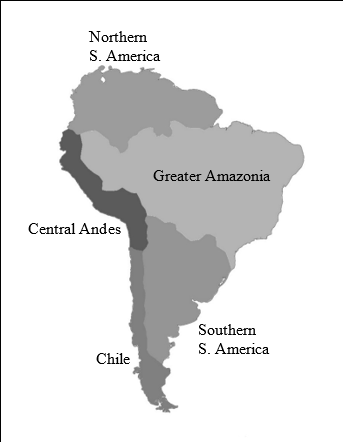
    Figure 1. Map of Identified Regions of South America

    The regions identified in figure 1 are the geography to which the rest of this article is referenced to. Thus, the population split for South America in 1492 is as presented below.

    Figure 2. Table of Pre-Columbian Populations in South American Regions

    These demographics aside, what other features can we ascribe to these five regions that might be important in a study of post-Columbian disease spread? For this study the focus lies on significant factors that can be compared across the five regions identified. These are: climate, geography, and patterns of settlement.

    In terms of climate, for which the Köppen-Geiger climate classification system is used, our two most northerly regions of Northern S. America and Greater Amazonia can be described as ranging between a tropical (Aw) and equatorial climate (Af). These warm and wet conditions which comprise the great majority of these two regions are well suited to the spread of disease, particularly as they are prone to monsoon; we would therefore expect higher levels of mortality in these regions than in others. The Central Andes region contains a greater variance in climates due to its mountainous geography: it is mostly covered by a cold desert climate (BWk) but also contains large areas of semi-arid climate (BSk) and temperate oceanic climate (Cfb). We would expect these colder and drier conditions to be more effective at staying disease spread here. The Southern S. America region would mostly be classified as a warm oceanic climate (Cfa) with some areas of tropical (Aw) and semi-arid climates (BSh). This region can be described as susceptible to the spread of disease but not to the extent of Northern S. America and Greater Amazonia. Finally, in Chile we find areas of cold desert climate (BWk), temperate Mediterranean climate (Csb), and temperate oceanic climate (Cfb). This, in similar fashion to the Central Andes, is an area we would expect to find reduced mortality rates in due to these pathogen-hostile climatic factors.

    The geography of the continent can be split into two areas on either side of the Andean mountain range which covers the regions of the Central Andes and Chile. These mountains are a dominant factor in the lower temperatures seen in these regions as discussed above. Additionally, the mountains help to curtail the spread of disease by limiting travel and isolating groups from one another. On the eastern side of this “Andean split” in Northern S. America we can identify the Guiana highlands as a geographical feature that would act similarly. This is also true for the Brazilian highlands in Greater Amazonia and Southern S. America. However, these highland areas will prove less effective at preventing disease spread in these regions as they do not cover them in entirety, unlike with the Andes, and thus their major comprisal of large lowland areas still allows disease to spread more efficiently.

    For patterns of settlement across the continent: in clear majority we are discussing a dispersed population of peoples that do not gather into large permanent communities. This is the case for Northern S. America, Greater Amazonia, Southern S. America, and Chile. Certainly, there were areas of more concentrated populations within these regions, often along rivers and coastlines, but these were still clusters of villages rather than towns or cities. This type of isolated pattern of settlement is one which is often effective in curtailing the spread of disease, so we would expect regions with this pattern to be less susceptible to illness. In 1492 the exception to this rule was the area of the Central Andes, occupied in majority by the Inca Empire which was home to cities with populations of 700,000 or more such as Cusco, Quito, and Choquequiaro. In this case we would expect to see this area prove more susceptible to disease spread than others.

    Three Hundred Years of Disease in South America

    Population figures across this period, particularly during the first 100 years, are to be taken with a large margin of error. After 1600 the Spanish and Portuguese began taking censuses of the regions they controlled, spanning by this point almost all the continent, and so we do have primary statistics available to us that were not available for our pre-Columbian assessment. Even so, it is highly likely the numbers they give are low estimates, as even today our estimates ever increase for the number of indigenous on the continent. Nonetheless, by collating all these censuses in conjunction with our pre-Columbian estimate we can produce a graph that tracks the population of the continent over these 300 years.
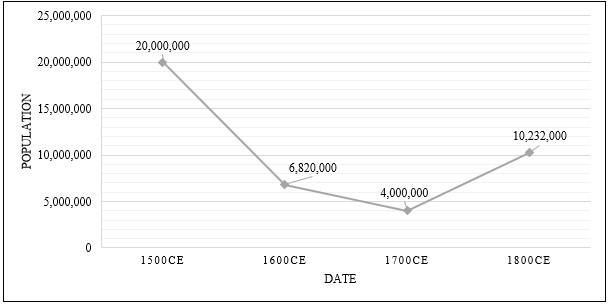
    Figure 3. Graph Plotting the Population of South America from 1500 to 1800CE

    Using this data, we can also calculate the rate at which the population changes between these points, as seen in the table beneath.

    Figure 4. Table of Total Population Rise and Fall (%) in South America 1500-1800CE

    These statistics show the immediate damage done to the continent and the recovery from that. However, it must be noted that these population statistics are not solely for indigenous peoples, they include all those people who have, either by choice or by force, moved to the continent during this time. This is what explains the 155.8% increase in population from 1700 to 1800, it is comprised of immigration, we would not expect a native population to recover at this rate. The question therefore asked becomes what is the rate of native population recovery, as supposed to simple population increase overall? For this we can utilise our regions; by splitting our demographics between these five zones, including those that saw large immigration and those that didn’t, we can determine the extent to which immigration as a factor has affected the overall population statistics. 
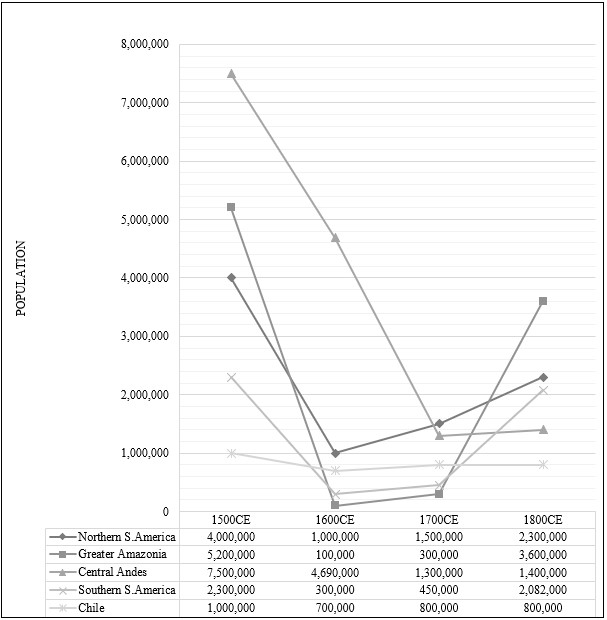
    Figure 5. Graph Plotting the Population of Regions of South America 1500-1800CE

    For this above graph we can also produce a population change rate table.

    Figure 6. Table of Population Rise and Fall (%) in Regions of South America 1500-1800CE

    This information is enlightening in multiple aspects. From 1500 to 1600 we can immediately see that some areas have declined to far greater extent that others, namely Northern S. America, Greater Amazonia, and Southern S. America have declined at much higher rates that Chile and the Central Andes. This can be explained by the climates and geography of these regions which, as was explained above, are far more suited to preventing the spread of disease in the Central Andes and Chile than in the other regions. In Chile this can be further explained by noting that disease did not reach the region before 1561, much later than the other regions (see figure 9.). However, some Umbridge must be taken with the 98% decline figure for Greater Amazonia during this period. Of all the data drawn on for this study this figure seems the most inaccurate. Although it may well be true that mortality rates were high in this region due to its tropical climate, the 0.59 population density for this area would never allow such a drastic reduction (see figure 8.). This article would hazard that the rate of reduction would be closer to the 75% reduction seen in Northern S. America as these two regions have very similar climates and geographies. Nevertheless, in the absence of any further data the -98% figure will continue to be used.

    From 1600-1700 the notable standout is the one region which continues to decline whilst the others begin to rise in population, the Central Andes. This is likely explained by the concentrated population density in this region which allowed for disease to continue to spread virulently, as seen in figure 8. By 1600 the other four regions all have populations densities beneath 1 compared to the Central Andes which sits at 3.13. At this point it may well be argued that these other four regions have reached a point beneath the ‘minimum concentration of hosts’ threshold whereas the Central Andes has not; this means their populations are now too small when compared to the size of their landmass to facilitate further disease spread. The well-developed road system of the Incas will have also allowed continual consistent movement of peoples around the empire; further facilitating dissemination of infection. This is especially crucial if you note the long incubation period of the two largest killers, smallpox and measles, which exist in the body for c.10 days before the person infected begins to show symptoms. The further a person is enabled to travel within these 10 days the faster these illnesses can spread. We can also see within the regions whose populations do rise the difference in the rates of the population increase. This is explained by immigration, not native recovery, and will be explored in depth with the assessment of the data between 1700 and 1800.

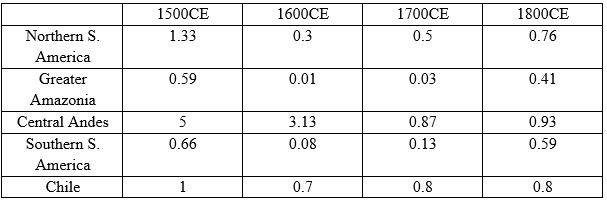
    Figure 7. Table of Landmass Area of Regions (km2)
    Figure 8. Table of Population Density of Regions Within South America (Number of Persons Per km2) from 1500-1800CE

    From 1700-1800 we can clearly identify the regions which are experiencing outside immigration and those which are not. Again, we see a divide made between the Andean regions of Chile and the Central Andes and the rest of the country. On the west side of the Andean split we see population figures that are struggling to begin a recovery towards pre-Colombian levels, with Chile’s population becoming stagnant and seeing no increase in the 100 years between 1700 and 1800. This is representative of how the native population across the country is recovering from the impact of disease: slowly. The reasons for this are numerous; one large factor is a decrease in fertility rates after disease has ravaged a population. This can be due to the disease itself physically affecting reproductive abilities or unbalancing the gender ratios in a population but can also be a result of social grief and stress. Recovery rates are also affected in the long term because disease results in higher mortality rates in the young population, who are the ones able to reproduce.
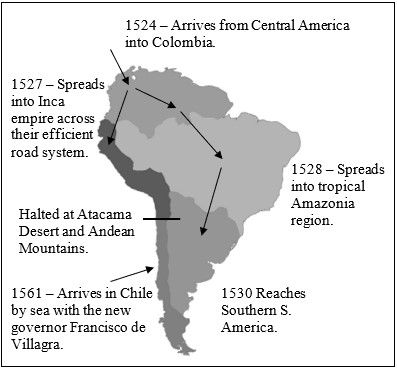
    Figure 9. Map Depicting the Spread of Disease Across South America 1524-1561CE

    With our knowledge of the western side of the Andean split the extraordinary nature of the figures from the eastern side becomes apparent. Even the 53.3% increase seen in Northern S. America would be classed as an unprecedented event, with figures of over a 1000% increase existing in realms of fantasy. These statistics correlate well with the records kept by the Spanish and Portuguese of slaves imported during this period, which indicate c. 5,000,000 were imported into the Viceroyalties of Brazil, Rio de la Plata, and New Granada from 1700-1800. Using this data we can calculate how much of the increase in population on the east side of the Andean split is due to immigration. Taking Greater Amazonia as our example, given that it saw the greatest increase in immigration, we can take 10% as a generous figure for the increase in native population during this period. This would constitute only 30,000 of the 3,300,000-increase seen in population and means that 99.16% of the new population is imported. Using similar thought we can interpolate new data across all our existing figures produce a graph that tracks only the indigenous population statistics
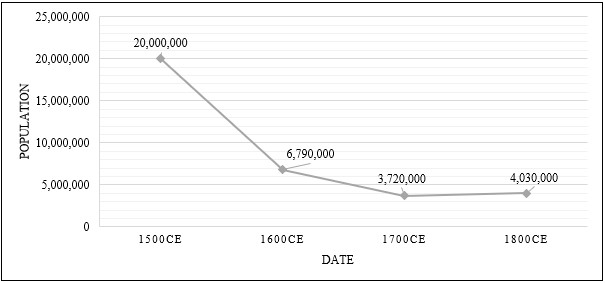

    Figure 10. Graph Plottingthe Indigenous Population of South America 1500-1800CE
    Figure 11. Table ofIndigenous Population Rise and Fall (%) in South America 1500-1800CE

    Now we have calculated the decrease in native population we must ask: to what extent is disease responsible for these deaths? It is understood that it is the major factor, but how far so? Let us examine the Spanish and Portuguese maltreatment of the indigenous to see the extent of their impact.
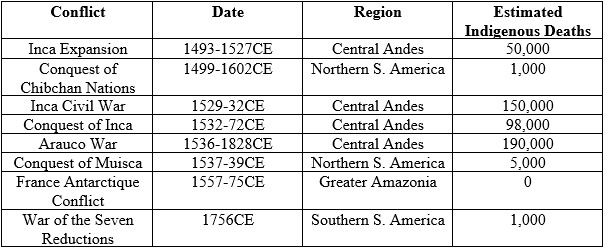
    Figure 12. Table of Conflicts Within South America 1492-1800CE

    It is evident from this information that death from conflict may be considered a negligible factor when considering the overall indigenous population decline of South America. The single conflict with most meaningful impact on population is the Inca civil war which accounts for only 1.1% of the population decline from 1500 to 1600. The Arauco war is the cause of the most deaths but stretched over a far longer period, giving it less impact.

    As for the encomienda and mita systems, alongside other forms of cruelties brought about by the Europeans, it is unknown how many died as a direct result of these persecutions as no records were kept, not even estimates. These, evidently, were not numbers the colonisers wanted recorded. Even if we did have such data it would be difficult to extricate deaths directly caused via cruelty and those that came tangentially because of it. We may still make some assessment of their material impact however; the one undisputable fact is that these systems helped facilitate the spread of disease through multiple means. They gathered previously dispersed populations into concentrated groups, forced them to travel long distances, and worked them into a state of weakness. All of which are ample conditions to facilitate infection. In this sense their impact on population decline may have been far greater than they are given credit for here. Nonetheless the ultimate cause of death is disease in majority by a far margin, as far as our statistics show us.

    If we take our statistics from figures 10 and 11 and subtract population decline for reasons aside from disease we can produce an estimate of indigenous population decline specifically as a result of disease. We have calculated that approximately 1% of the population die as a result of warfare between our 100-year intervals, using a global average we can also calculate that approximately 1% can be accounted for by “natural causes” and accident. As discussed there are no statistics for the impact of systems such the encomienda but we must estimate they had some impact given the severity of their programmes, and have been given a 2% impact factor. Overall these account for 4% of the total indigenous population decline from 1500 to 1800. The total indigenous population decline from 1500 to 1700 (it’s lowest point) is 81.4%, so therefore the total decline as a result of disease before the population begins to rise is 77.4%. This means the total number of indigenous killed by disease from 1500 to 1700 is 15,480,000. It must also be noted for clarity that even after this point, as the population increases, indigenous peoples are still dying from disease and that some of these infections continue to plague areas of South America in the 21st century. 

    Ultimately this article has been able to track the population, indigenous and otherwise, of the South American continent from 1492 to 1800. It has provided reasoning for the variance in figures seen across the five identified regions and compared them against each other to infer further detail about the impacts of disease and other factors during this time. Although it is understood that these figures are approximates, it is nonetheless understood their significance in helping us understand this troubled period of history.

    Author/Publisher: Louis Lorenzo      

    First Published: 19th of October 2018

    Last Modified: 23rd October 2018 (Clarity)

  • The Generalising Crisis of the 17th Century

    ‘The mid-seventeenth century experienced a “general crisis” in which a wave of economic, social and political upheavals swept over many parts of the northern hemisphere’ (Parker, 2001, p.20)

    To accurately assess this statement, it is necessary to first define the term ‘general crisis’. For the purposes of this article the definition used herein has been devised from a plain amalgam of ‘crisis’ and ‘general’. Crisis being defined as ‘a decisive stage in the progress of anything… applied esp. to times of difficulty’ and general as ‘approximately universal within implied limits’. Therefore, we define ‘general crisis’ as:

    “A period of decisive change that affects a significant proportion of the global population, commonly caused by times of difficulty.”

    By this definition, the ‘general crisis’ theory is not controversial, it is commonplace. Difficulty resulting in change is what you may simply term, “history”, and by extension, historiography itself, the study of change. Certainly the 17th century is no exception to this rule and Parker’s own contribution illustrates this convincingly. His figures on state-breakdowns, popular revolts, wars, and mortality rates are both global and numerous and his use of historiographical metrics gives a clear framework for what is meant by ‘general crisis’. Indeed, this clarity is what makes Parker’s argument superior to the efforts of many who preceded him, including the efforts of two highly influential crisis historians; Eric Hobsbawm and Hugh Trevor-Roper. Hobsbawm’s crisis emphasises trade depression and methods of production whereas Trevor-Roper’s describes a societal and political crisis based on unwieldy bureaucracy. These are fine premises but lack precision, never fully circumscribing ‘general crisis’ in the manner Parker manages. Their lack of empirical clarity has been widely criticised, particularly Trevor-Roper, who was heavily belied in a responding review. Therein, J.H Hexter asserts that ‘Trevor-Roper paints his picture… with such bold strokes and so broad a brush that he occasionally obscures rather than clarifies’.

    The Problem with The Crisis Theory

    However, no matter if we accept the crisis theory, we cannot avoid the debates’ wider issue for which I conclude that the term must be abandoned. Why do we find so many articles on the crisis that begin with a definition rather than a proposition? It is because the ‘crisis’ is no one instance, it is a theoretical grouping of events, the problem being that these events aren’t known quantities. What counts as the ‘general crisis’? Everybody will inevitably reach unique conclusions on this matter because there are no boundaries to choosing what constitutes ‘general crisis’. As we have seen, historians may include whatever they please.

    This results in a debate which keeps returning to definitional matters, an intellectual vacuum in which agreement is unattainable as we continue to talk at cross purposes. The ‘general crisis’ debate is therefore detracting from other possible 17th century discussion, generalising all debate on the period under the uncertain theme of ‘crisis’. To learn further from the 17th century then, we must change the game, because currently we’re all playing by different rules.

    The 17th century is unique in befalling this ‘generalising crisis’ because it lacks identity. The century has ‘Renaissance and Reformation on the one side, Enlightenment and Revolution on the other’, appearing inconspicuous in comparison to its neighbours. Naturally, we wish to seek what defines the 17th century as well. What the ‘general crisis’ theory did, and why it became so popular, was give the 17th century an identity. Unfortunately, this identity was not one that grew from the history, but was imposed upon it. Eric Hobsbawm devised the crisis to suit a Marxist historiography, the purpose always being to “show” a transition from a feudal to a capitalist economy. Such histories encourage cherry picking evidence to serve a conformation bias. This may have been inconsequential had it remained within Marxist historiography, but its subsequent envelopment of 17th century writing has led to an eternally skewed approach to the century, we lack the balance of differing approaches. The reality has become that we are writing within a framework that was purposefully designed to limit our scope.

    That said, this does not mean we may simply discount all generalist historiography. Contrariwise, most of this work is valid in identifying important 17th century occurrences and their origins. The problem lies only in how these events are then interpreted as we attempt to integrate them into a flawed theorem.

    New Approaches to the 17th Century

    Understanding this, we can examine further these ‘economic, social and political upheavals’ and explore several ways in how we can better understand the 17th century without this ‘generalising crisis’ obscuration.

    Looking through prior crisis articles we find the important economic events of the 17th century to be: the trade depression of the 1620s to 1650s, the “tulipomania” of the 1630s, the economic independence of colonies, the multiplication of costly offices, and the thirty years’ war, due to estimates being as high as 50% for national expenditure upon it. A generalist historian must value these factors on how they conform to their crisis thesis, but we can assess them purely on individual merit.

    To begin, we consider how these are exclusively European occurrences, not global. Further to this, we notice that these problems stem categorically from imperialist nations. The ‘tulipomania’ contained to a Dutch economic bubble, the expanding office bureaucracy concentrated within Britain. An increased independence of European colonies factoring toward a European trade depression. The thirty years’ war being motivated by imperialism as much as devoutness. Abandoning a generalist perspective reveals not a ‘Crisis of the European Economy’ generically, but an issue within European empire specifically. We see the economic costs of maintaining empire; particularly how increased economic independence of colonies leads to a long-term desire for political independence, as with North America. We also see a short-term impact of economic depression, all of which can be exacerbated by large-scale war, as with the thirty years’ war.

    Hobsbawm’s article comes almost to this conclusion, describing how ‘large and expanding markets’ brought economic downturn, but his focus on ‘crisis’ leads him toward the irrational conclusion of ‘transition from a feudal to a capitalist economy’. He misses the angle on empire, the maintenance of it, and the effects of war upon it. It becomes evident that allowing economic independence for colonies, especially during wartime, can hurt your economy even more greatly than may first appear. For Britain particularly, this helps us understand the economic roots of the decline of empire in the 20th century. Britain may well have handled its colonies with greater tact during the first and second world wars had it been aware of the consequences that may occur from neglect during wartime. As it was, we see events such as the Bengal famine of 1943 leading to an increased desire for political independence in colonies, one that felt additionally earned due to their efforts in the world wars.

    Politically, the 17th century was defined by a weakening of nobility as a result of a consolidation of power toward the crown as well as an expanding bureaucracy, as before mentioned in economic terms. Despite seeing this across the ‘northern hemisphere’ in both the east and west, and contrary to a generalist view, we only find political crisis on account of this in the west. Quite adversely, the Tokugawa period in Japan (1600-1868) and the Ming dynasty in China (1364-1644) have been determined to be unusually stable leaderships, the Ming dynasty especially, described as ‘one of the greatest eras of orderly government and social stability in human history’. What can we learn from this? We learn that political events cannot be a central factor toward causing crisis. The multitudinous revolts, breakdowns and wars cannot have been politically driven, at least in majority, otherwise we would have seen greater political instability in the east than we do. However, we do still see a degree of volatility in the east, an example being the Shimabara rebellion of 1637-8, so we must search for other factors that may have caused this.

    Social factors haven’t been explored as thoroughly as others when it comes to the general crisis. This is most likely due to the locality of social trends of the time. Very unlike the globality of politics and economy in the 17th century, social movements were far more localised, with only a handful of countries having postal services. Thus, social factors don’t fit well into the ‘general crisis’, because they weren’t very general. However, it is still clear to see the dominating social force in Europe in the 17th century: Religion. The thirty years’ war is a prime example of this but we can also point to the rise of religious polemics like Jonathan Swift, the glorious revolution, the eighty years’ war, and the abolition of the edict of Nantes. Here we do spot a consistency with the east, despite rebellions being rare the Shimabara rebellion of 1637-8 was directly a result of religious tension. Additionally, this was a European-exported tension as the conflict was between the Tokugawa Shogunate and the Roman Catholics. Also in the east, we see the rise of the Sabbatean movement. One conclusion here may be that Europe managed to export its religious troubles to the east and this is why we see some social parallel between the two continents.

    Centrally, this article explores the benefits of approaching the 17th century without thinking of ‘general crisis’. There is a far richer history to be found if you are prepared to cast the century in different lights, the surface of which we have not even scratched in this article. You may disagree with some, or many, of my conclusions, and that’s great. There is no lens through which you must view the 17th century, approach it in a manner which is logical to your interests.

    Author / Publisher: Louis Lorenzo

    First Published: 05th of April 2017

    Last Modified: 05th of April 2017

  • The 17th Century Economic and Political Crises Compared

    The problem with the debate around ‘the general crisis of the 17th century’ arose as soon as the phrase was put to paper, it’s the same problem that plagues debates over ‘brexit’, the central term is nebulous. Historians must decide for themselves what ‘general’ refers to, which causes great conflict like that we see between Hobsbawm and Trevor-Roper. It’s inevitable you will produce different paintings when you aren’t working from the same palette. We will hardly, therefore, draw fair conclusions by simply comparing the two articles, we must look for more useful approaches to this debate. Historians such as Roger B. Merriman have answered this by drawing the conclusion that the crisis did not exist, if there is no central understanding of its existence, how can it? However, this, although logical, is side-stepping the problem rather than tackling it, invalidating all previous discussion is counter-productive. Contributing constructively will be to accept the existence of a general crisis but to create a definitive core idea of what the crisis consisted of. This will allow fair debate and comparative historical writing on this topic. How will we achieve this? The answer is simple; by studying articles on the crisis and finding the key events that bind them together. Hobsbawm and Trevor-Roper are excellent initial candidates for this as they approach the debate from such antithetical positions that finding commonalities in their arguments is certain to reveal the core of this crisis.

    Hobsbawm’s Marxist interpretation is that the crisis is centrally economic whereas Trevor-Roper regards the crisis as primarily political, his viewpoint is concertedly ‘anti-Marxist’. These are such disparate standings that their articles seem bound to draw diametrically opposite conclusions. Indeed, Trevor-Roper’s article is even antagonistic towards the Marxist interpretation. However, their articles are not so divergent, in fact, they complement each other on the import of several key areas. These are: the expansion of empire in the 1500s, the multiplication of crown ‘offices’, the 1620 ‘decay of trade’ and the 30 years’ war (1618-48). These are our first key commonalities that we can use to definitively construe this crisis. So why, if the two articles agree on so much, would Trevor-Roper preface his article with a critique of Hobsbawm’s? Directly put, Trevor-Roper vehemently opposed how Hobsbawm utilised the crisis to justify the Marxist idea of inevitable progression from feudalism to capitalism. This anti-Marxism even went so far as to cause private hostility between Trevor-Roper and Hobsbawm. We can therefore safely write off Trevor-Roper’s initial attack on Hobsbawm as too personally motivated to be taken seriously as a critique. We can focus on what’s important accordingly; the arguments that the two historians forward regarding ‘the general crisis of the 17th century’.

    So how do they agree as wholly as is being implied if they attribute the crisis to different causes? Contrary to first impressions, these two lines of argument are not incompatible but work in tandem, there was both political and economic (alongside social and cultural) attributes to the crisis. Indeed, Hobsbawm himself recognises this commonality of purpose in a following article, remarking that their views “are complementary rather than competitive.”.  As is always the case with history there is a web of causation and no single factor lies withstanding from all others. The two historians are, of course, aware of this but in arguing the significance of their own chosen factor they have overlooked the importance of others.

    Both argue the importance of the expansion of empire during the 1500s. Hobsbawm describes it as “large and expanding markets… of the later 15th and 16th centuries” that had reached “the limits… of feudal or agrarian society”, and now, “when (they) encountered them, (they) entered a period of crisis”. These “limits” that Hobsbawm refers to are the limits of a feudal/manorial society that had little need for trade. In new, large empires, and with movements like the agricultural revolution which was facilitating trade, feudalism was proving ineffective and causing crisis as countries struggled to maintain the trade levels required to sustain themselves. Feudalism wasn’t an aggressive enough system, unlike the more competitive systems that would replace it. Trevor-Roper argues the same point: “The expansion of Europe (created) greater markets” and these “vast new empires (were) vaster than they (could) contain for long without internal change”. This is the same economic argument that Hobsbawm contends; that the economies of these countries had grown too large to be supported by a feudal system of commerce.

    Trevor-Roper furthers this economic point by adding a parallel political factor: “The political structures of Europe are not changed in the sixteenth century: they are stretched to grasp and hold new empires”. By ‘stretching’ he means a “multiplication of ever more costly offices (that) outran the needs of state”. The crowns of Europe were selling bureaucratic ‘offices’ in abundance and were letting the country pick up most of the cost, in Britain, 75% fell on the country: “this was an indirect, if also a cumbrous and exasperating way of taxing the country” Trevor-Roper argues “So ‘the Renaissance State’ consisted, at the bottom, of an ever-expanding bureaucracy which… had by the end of the sixteenth century become a parasitic bureaucracy.” These economic and political arguments are closely related; as the economy begins to hit its “limits” at the end of the 16th century it is pushing the crown to expand a “parasitic” bureaucracy which makes money for them in the short term. However, longer term it is further damaging the economy as the superfluous expenses continue to increase.

    Another significant factor the two historians point to is the universal depression of 1620, what Trevor-Roper refers to as the “decay of trade”. Hobsbawm describes it as “a general balance of rising and declining trade (that) would produce export figures which did not rise significantly between 1620 and 1660”. As you may imagine, this caused recession in the new societies of trade and empire and was caused by the debasement of currency in the early 1600s. This was the end of great economic expansion and it brought the frivolous expenditure of the 16th century into sharp clarity. The rise of puritanism during this time clearly shows that people were sick of the “gilded merry-go-round”, this is when the weight of the crown offices and the limits of feudalism began to show themselves, having been previously masked by a boom economy.  

    Both also concur over the significance of the 30 years’ war. Trevor-Roper arguing that the war “undoubtedly prepared the groundwork for revolution” and Hobsbawm that it “intensified the crisis”. The war made the illnesses of Europe’s economy acute, estimates are as high as 50% for national expenditure on the war, from all parties. It’s also important in how it diminished the influence of the pope, allowing puritanism to spread at an unusually fast rate and animosity toward traditional structures of power with it. It’s noteworthy that both historians don’t place as much emphasis on the war as you might expect. They present it as a more minor force that furthered the ‘greater’ change brought by political and economic factors. This can certainly be attributed to the fact that it neither falls strictly under economic or political history, but military history. As such the effects of the war in causing the general crisis are somewhat overlooked. However, the fact that it’s in both articles yet in neither historians’ chosen field proves its significance.

    In the interests of brevity, we will not discuss factors that Hobsbawm and Trevor-Roper have not spoken on: the expansion of the middle class, intellectual revolution, famine, disease, and many others. What’s clear is that more research needs to be done into these factors that straddle the multitudinous accounts on the crisis. But here we have the start, it’s not so that Hobsbawm and Trevor-Roper disagree, whatever their own thoughts on the matter. The political and the economic crises, specifically linked to the expansion of empire and the multiplication of ‘offices’, are two sides of the same coin and two of these ‘base factors’ that can be used to build a cohesive understanding on this crisis. They work alongside factors such as the decay of trade and the 30 years’ war to create separate crises in different countries which produce a sum-total of general crisis in the 17th century.

    Author / Publisher: Louis Lorenzo

    First Published: 05th of April 2017

    Last Modified: 15th of May 2017 (Grammar Corrections)

  • Castle Howard: Baroque Architecture and the Theatre of Reality

    Castle Howard is not actually a castle, but rather a stately home, situated in the Yorkshire countryside. It was designed by the famous Sir John Vanburgh, who is often referred to as the father of the ‘English Baroque’ style. The estate still remains in the possession of the Howard family today and has done so for over 300 years. Work began on building the ‘castle’ in 1699 and it was not to be completed for another 100 years, and in doing so, an entire village was destroyed in the process. This is one element of ‘classic’ architecture that people tend to forget when they complain that we have regressed in our architectural form. It may very well be nice to build your new library in the same way Castle Howard was built, but you’ll have to wait a hundred years, not even to mention the inordinate costs. By the by, when it was completed, the estate contained 13,000 acres of land and had its own railway station to service it, which ran from 1845 to 1950.

    The reason I am discussing castle howard is because it is as an example of Baroque architecture, which is the real focus of this article. If you are not quite sure what we mean by Baroque architecture, think of any of the great European cities and those buildings which are most visually impactful. Buildings like St. Peter’s Basilica in Vatican City, or the Palace of Versailles in France, or St. Paul’s Cathedral in England. This is because Baroque buildings are characterised by grandeur and high contrast, they are built to be flamboyant and purposefully designed to impress to such a degree that they can intimidate. The origins of Baroque architecture date back to the counter-reformation within Catholicism in the 16th century, and thus the form is inseparably linked to the church, you will find a great deal of religious imagery within baroque architecture, It seeks to be a visible statement of the power of the church. The first Baroque building was erected in France in 1642, it was the ‘Château de Maisons’. From there it then spread across Europe and adopted different styles with the borders it traversed, a trained eye may very well be able to identify which European country they are in simply by looking at its Baroque architecture.

    The grandiose nature of Baroque is very much theatrical, it is attempting to surprise and impress, to generate an emotional reaction from the viewer. But where did this desire for theatrics originate? What is it that gave us these inspiring designs?  It has been put, by historians such as Peter Burke, that the Baroque’s grandiose and theatrical design reflects a 17th century “crisis of representation”. The idea being that the economic, political, social, and spiritual crises of the time are fracturing a previously held world-view, an innocent, and perhaps naive, Christian view of everything having a purpose and being linked by its very nature to everything else. That things are done for a reason. Events such as the thirty years’ war, the great 1620s trade depression, the reformation, and others from this time run counterfactual to that belief.

    This is why people may turn to the idea, to predictably quote Shakespeare, that “all the world’s a stage, And all the men and women merely players” (As You Like It: 1623). People feel disconnected from reality, and so present it as theatre.

    Author / Publisher: Louis Lorenzo

    First Published: 05th of April 2017

    Last Modified: 14th of May 2017 (Grammar Corrections)

  • Powder Monkeys: An Engine of Empire?

    The term ‘Powder Monkey’ first came into use in the British Royal Navy in the early period of the 17th century (c. 1620), a time you may have heard referred to as ‘the age of sail’. As sailing ships, and their capacity for munitions, grew larger it soon became apparent that gunpowder was an extremely volatile cargo for a vessel to carry. It was important to keep the substance dry otherwise it would be of no use, but it was also key to keep it away from any source of ignition, otherwise you would be of no use.

    The answer to these problems was the ‘magazine’. Still used as a term for where ammunition is stored today, the magazine was a purpose-built room at the base of the ship where gunpowder could rest (relatively) safe from both water and fire. This led to a further issue however, now all of your gunpowder is several decks away from where your guns are, and there could often be over 100 cannons to constantly resupply. How are you going to sustain any reasonable form of rate-of-fire if you have to keep rushing up and down the ship to fuel your cannons and muskets?

    In steps the powder monkey. Your typical powder monkey was a boy around the age 12 whose job it was to supply the weaponry of the sailors with gunpowder. This meant dashing back and forth, up and down the vessel from the magazine to the upper decks and back again. This was extremely strenuous work; these were heavy bags of explosive material that you were running and scrambling and climbing with, as the ship lurches from side to side with the impact of waves and cannons, as chunks of splintered wood and shrapnel are hurled through the air, and as people die around you. Why is it that you are scrambling with such haste? Because the speed at which you can run up and down the ship directly correlates to the speed at which the ship can fire its cannons. The faster you go, the more likely you are to survive.

    The reason they used boys was because of their size, they were small enough to hide behind the gunwale of the ship and agile enough to fit through tight spaces, enabling them to reach the cannons in the shortest amount of time. Evidently, girls could just have easily been used for the same purpose, but I suspect that this was one element of patriarchal society they weren’t so concerned about at the time.

    Despite their important and horrific job, the boys were at the bottom of the naval hierarchy and never got official recognition as members of the crew on board. Their name isn’t comedic by chance, it’s because they were an easy punchline for the rest of the crew, who were much older and stronger. When ships docked in port it was very common for wandering boys to be kidnapped, either by those of the Royal Navy themselves, or from any other group of passing sailors. Once within the grip of the Royal Navy, powder monkeys were unlikely to see their homes again.

    They are somewhat the unsung heroes of the British navy, without them the guns would have simply stopped firing. Especially in a time where many guns would just… not work… it was crucial that the ones that did had a better rate-of-fire than your opponent. Perhaps this is mere polemics, but it could be argued that Powder Monkeys were one of the most important innovations of the Royal Navy. Britain’s empire was always wholly maritime at its core and it’s clear that Powder Monkeys were essential to naval warfare. They were never respected then and continue to exist as mere trivia today, but Britannia would surely have never ‘ruled the waves’ without them.

    Auhor / Publisher: Louis Lorenzo

    First Published: 05th of April 2017

    Last Modified: 15th of May 2017 (Grammar Corrections)